
8 Questions to Ask a Copywriter

You’ve learned why you should hire a copywriter. You’ve found some good freelance copywriters online and set up initial calls. What’s next? You need smart questions to ask. That’s where I come in. Below, I give you eight questions to ask a copywriter. These questions will guide your initial meeting.

BTW: Do you learn better by listening or watching a video? I got you! Scroll to the end of this article, and you’ll find my video on this topic.

Questions to ask a copywriter

1. Tell me about your experience. How long have you been working as a freelance copywriter? 

What to look for in their answer: Do they have experience and the portfolio samples to prove it? If they’re a new copywriter (everyone was new at some point, including me), what have they done to educate themselves about copywriting? How have they practiced their craft?

Don’t dismiss a writer for being new. You likely found them online, and something about their site and samples resonated with you. I’m all for giving new writers a chance if everything else checks out.

2. How do you approach researching a new topic or industry?

What to look for in their answer: Good copywriters are quick studies. They will have a process for getting up to speed quickly on a new-to-them industry. Good writers won’t have all the answers. But they’ll know where to look for the answers. You want a writer who shares this sentiment. Be wary of anyone who says “writing is writing” and the industry doesn’t matter.

3. How do you balance SEO and creative writing in your copy?

What to look for in their answer: You can skip this if you’re not talking about digital assets. But if your project involves web copy, blogging, landing pages, social media, or online advertising, you’re going to want to hear what they have to say about search engine optimization.

  • First, do they know what it is?
  • Do they discuss how they stay current on all things SEO?
  • How do they conduct keyword phrase research? Do they have a go-to SEO tool? (For example, I use Semrush.)
  • And, finally, how do they balance writing creative copy that’s also optimized for search?

4. Can you walk me through your process for developing a new piece of content?

What to look for in their answer:  Good writers love to talk about their process. Here are some things to listen for: They review all relevant collateral materials (from the client’s website to the brand guide), study the target audience, talk to subject matter experts as needed, and conduct their own research. Remember, a lot of work happens before the writing begins, so you should look for a writer who has a solid approach to this preparatory phase.

Once they draft a piece of content, they should also have a process for revising and proofreading before it lands in your hands.

Writers’ processes will vary. The above are broad strokes. But again, it gives you a starting point.

5. How do you incorporate feedback and revise your work?

What to look for in their answer: Good copywriters aren’t precious about their words. They understand that revisions are a natural part of any copywriting project. And good writers will also have a preferred way to receive client revision requests.

I always ask the client to get consensus internally and compile all comments into one doc before handing it off to me. And I always request revisions within 30 days of the client receiving the first draft.

Not all writers do the same thing, and that’s OK. But they should be able to talk about their approach.

6. What tools do you typically use to help you with your writing projects?

What to look for in their answer: Good writers have favorite go-to tools for things like keyword research (I use Semrush), transcriptions (I use Rev.com), and writing assistants (I use Grammarly).

There’s no wrong answer per se. But I’d be hesitant about any writer who has a blank stare and says they just use Word or Google docs to do their work. There’s much more to content marketing than that.

7. How do you make sure that your work aligns with the brand voice and messaging guidelines?

What to look for in their answer: The writer should ask if you have an in-house style guide and/or brand guide. But if they don’t ask, listen for other telling signs. For example, do they talk about carefully reviewing your website and other marketing materials to get a solid sense of the tone and brand voice?

8. What are your fees? How do you charge?

What to look for in their answer: Ah, the money question! I’m a fan of project-based fees. I’d be careful about working with anyone on an hourly basis, and not just copywriters. To understand why, read my blog post on how I advise copywriters to charge for their services.

OK, so there you have it: 8 questions to ask a copywriter!

These questions should give you a good sense of the copywriter’s experience, process, and approach to content creation, which are all important factors to consider when hiring a freelance copywriter.

From there, you’ll want to review their proposal and listen to your gut. If you’re on the fence between a couple of writers, give each one a small project and see who performs better overall. And not just with the writing. Who is easier to deal with? Who asks better questions? And who will fit better with your team? At the end of a trial project, you’ll likely have a good sense of who your go-to copywriter should be.

Got a Question for the Copy Bitch?

That’s me! I’m the Copy Bitch. Contact me or visit my YouTube channel and leave a comment on one of my videos. I might make a blog post or video with the answer.
How to Hire a Freelance Copywriter in 2025

You landed here because you already understand the value a good freelance copywriter can bring to the table. The challenge is you’re not sure how to hire a freelance copywriter. Where can you find them? How do you evaluate them? What questions should you ask?

Below, I provide specific steps to follow in your quest.

If you learn better by watching a video, I got you. Scroll to the end to see the video I recorded on this topic.

Note: This blog post uses affiliate links for products I believe in, like Grammarly or copywriting and marketing books. If you click on one of the links and end up buying something, it won’t cost you more, but I’ll earn a small commission.

1. Before you search, figure out what you want the copywriter to do.

This might sound pretty basic. You’ve already acknowledged you need a freelancer. But have you outlined the projects you want the copywriter to tackle? Taking the time to jot down project details, deliverables, deadlines, and available budget will save you and the writers you end up reaching out to a lot of back and forth.

I can’t tell you how many requests I’ve received that say something like, “I need help with X.” And there’s no further context. Sure, we’ll discuss the details during the discovery call, but providing the basics up front, like project details, deliverables, and deadlines, will help the writer get a sense if they’re the right fit before jumping on a discovery call. Because if you have a call, only to find out they’re booked when you need the project done, everyone’s just wasted time, right?

But what if you don’t want to commit to a bunch of projects just yet? What if you want to start with a small project to see if the writer is the right fit?

Fair enough. But you should still compile all the projects coming up for the next, say, quarter or so. Figure out what the test project will be and make sure you have clear details for that. When you reach out to prospective writers, you can let them know you want to start with a small project, but if all goes well, you have X, Y, and Z planned for the next three months.

2. Ask colleagues for recommendations and turn to Google, LinkedIn, and/or Upwork or Fiverr.

Whew! That sounds like A LOT, right? I’m not suggesting you do all those things. But those are the main options you have for this step.

Recommendations. Marketing folks often know good freelancers, so if you’re connected with people who have titles like marketing manager, VP of marketing, and content marketing manager, you can ask them if they know anyone. Again, it will help if you can provide THEM with details. For example, something like, “I’m looking for a good SEO copywriter who can help us with our website relaunch and also do ongoing blog writing.”

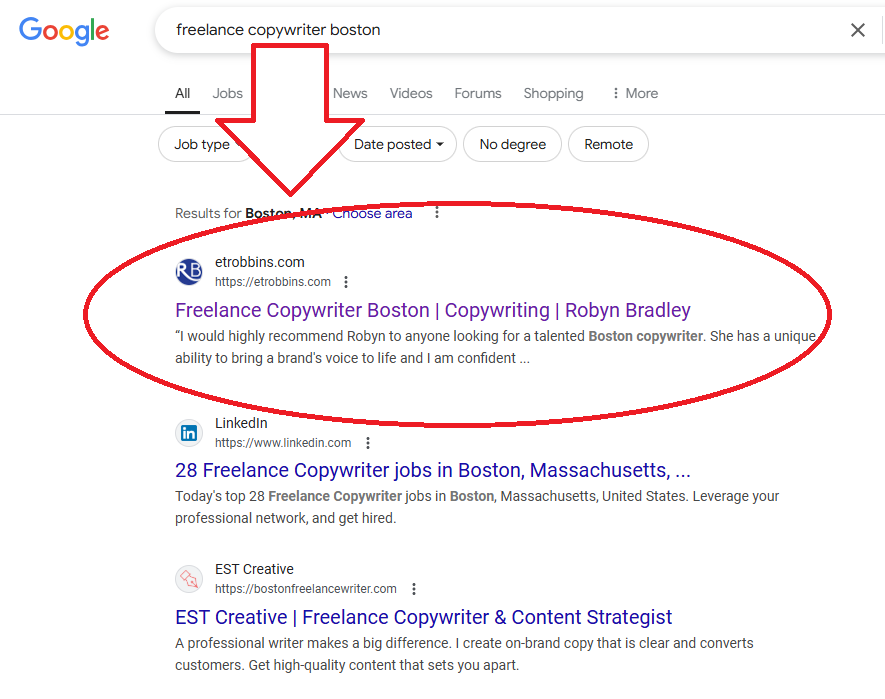
Google. If you’re looking for a specific type of copywriter (SEO copywriter, email marketing copywriter), search on that specific phrase for better results. Otherwise, “freelance copywriter” will work (or “freelance copywriter [nearest city]” if you want someone local for whatever reason). My website comes up on the first page of Google for “freelance copywriter Boston.” See the screenshot below.

Search engine results page for a Google search on "freelance copywriter boston." The first listing is circled with an arrow pointing at it

Keep in mind, however, that what shows up on the first page of Google isn’t the end of the search. Copywriting is competitive, and even with good website optimization, not every worthy copywriter will end up on the first page of Google. Be willing to scroll to the second or third page.

LinkedIn. You can search on “copywriter” or “freelance copywriter” on LI and see who comes up. Read their posts to get a sense of who they are, how they think, and so on. Visit their websites from there. You could also post that you’re looking for a freelance copywriter (with details . . . see the first step above). BUT BE PREPARED. You will likely be inundated with comments and DMs. Proceed at your own risk.

Upwork/Fiverr (etc.)

I don’t have direct experience with these platforms, but I have no doubt many talented writers have a presence on them. My suggestion is to pay attention to ratings and reviews. Upwork has a great step-by-step article on how to hire freelancers using its platform. Fiverr does as well.

3. Take a hard look at each copywriter’s website and portfolio. (And check out their LinkedIn profile if you haven’t already done so.)

When you land on a writer’s website, ask yourself the following:

  • Does it look professional? Professional doesn’t mean a ton of bells and whistles. Simple is fine. Amateurish is not.
  • Is it well-written? If the writer makes sloppy mistakes with their own copy, imagine what they’ll do with yours.
  • Do they have a portfolio? Is it easy to access and navigate? Does the copy resonate with you?
  • Does the portfolio have a good range of examples in different categories? The big categories to look for in a copywriter’s portfolio include the following:
    • Websites
    • Blogging
    • Email marketing
    • Premium content (white papers, guides, ebooks)
    • Branding/messaging

PRO TIP: Has the writer done the sort of project you’re looking for? Don’t dismiss them if they haven’t. For example, if you’re looking for a writer to pen case studies, but they don’t have any examples, yet you love all of their other work, reach out anyway. A good writer can likely do what you’re looking for. (And they might have samples they can send you. Not all of our work ends up in our portfolios.)

LinkedIn offers another way to vet and verify.

Ask yourself the following questions:

  • Is their profile professional? You can tell a lot about a writer by how they handle their own marketing.
  • Do you like what they have to say in their posts and comments? I’m not just talking about the substance, although that’s important. I’m also referring to their tone. Are they kind and courteous or snarky and combative? I see both types regularly on LinkedIn, and it always surprises me that the snarky, combative folks seem to forget they’re on a public forum and anyone can see their comments and posts.
  • Do they have testimonials from clients/colleagues? If they don’t, you can certainly ask for references. (I recommend doing so on big-budget projects.)
  • Have they given any testimonials? What do they say? You can tell a lot about a person by the things they write and say about other people they’ve worked with and for.

And, of course, pay attention to anything that feels “off,” even if you can’t put your finger on exactly why it makes you feel this way. (This goes along with always listening to your gut, which I get into more below.)

4. Reach out to the freelance copywriter with details about your project.

This is where all the work you put into step number one pays off. Once you’ve found a writer (or two or three) who you like based on their website, LinkedIn, etc., reach out to them with details about your project. Again, provide as much info about the project as you can.

At the very least, include the following:

  • A clear company snapshot (include a link to your site)
  • Your role with the company
  • Project details, including deadlines

Here’s an example of what an email to a freelance copywriter might look like:

Hi Carrie Copywriter,

I’m the marketing manager for a background check company. We work with HR managers and recruiters in a variety of industries, but our top three are healthcare, professional services, and real estate. We have a full-time writer in-house, but she’s stretched thin, so we’re looking for outside support from a freelance copywriter.

I found your site on Google and liked what I saw. I’d love to set up a time to chat.

Our first project is a series of case studies that we like to write in a problem, solution, and results format. No more than two pages. See the attached example. We have four clients ready to share their stories. We simply need a writer to do the interview and drafting. We handle design in-house. We want to issue one a month starting in two months. So we’d need the first draft in a month or so.

Let me know if this is something you’d be interested in discussing (and if you have the time to take it on). If this project goes well, there’s an opportunity for more regular monthly work if you’re up for it.

Looking forward to connecting!

Best,

Awesome Marketing Mary

PRO TIP: Don’t call the copywriter. I can almost guarantee that you’ll get voicemail. 🙂 Instead, send an email or use the contact form on the writer’s website. (I think email is the better option.) Send as much info as possible since this will help the writer know if they’re a good fit. Plus, it will help them prepare before the initial call. Sending an email saying that you have “a project you’d like to discuss” isn’t helpful to anyone (including you). You’ll have a much more productive discovery call if you share details beforehand.

5. Set up a discovery call with the freelance copywriter.

Once you arrange a call, here’s what to look for in a freelance copywriter: . . .

  • Have they come to the call prepared? (For example, have they taken the time to review your website?)
  • Do they ask good questions?
  • Are they prompt, friendly, and courteous?
  • Do they seem to have a genuine curiosity about your business?
  • Do they make good suggestions?
  • How do they keep up with copywriting and content writing trends? I like talking about my current favorite reads, like this marketing book by Nancy Harhut (Amazon affiliate link).
  • What’s their approach to writing?
  • What are their thoughts on AI?
  • What’s their process for editing? Do they use tools like Grammarly?
  • How do they charge? I’m a fan of project-based quotes. I’d be careful about working with anyone on an hourly basis, and not just copywriters. To understand why, read my blog post on how I advise copywriters to charge for their services.

This isn’t an exhaustive list, either. You might have some additional go-to questions that you normally ask vendors.

6. Pay attention to how the copywriter handles things AFTER the discovery call.

Here’s a good sign: The copywriter sends you a quick thank-you email for your time and reiterates when they’ll get you a proposal. You shouldn’t have to wait long for a proposal. Figure a couple of business days max.

If you have to nudge them about something as basic as getting you a proposal, that doesn’t bode well for your time-sensitive projects. Consider moving on. If they disappear completely, cross them off your list. (Sadly, this does happen.)

Once you get the proposal, review it carefully. Has the writer captured the project deliverables accurately? Does the project quote feel fair? (This is relative, of course. Even if it feels fair, it could still be beyond your budget.) Does the writer clearly indicate timelines? What are the payment terms?

Note: If you accept the project quote/proposal, EXPECT A FORMAL CONTRACT. This is business, and most serious writers will require a formal, legally binding contract. Most serious writers require a down payment (often up to 50% of the project quote) before work begins. Again, this is normal.

7. And finally, when it comes to how to hire a freelance copywriter, listen to your gut (and watch out for common red flags).

After going through the above, you’ll likely have a good sense of whether this writer is the person for you. Always listen to your gut. And watch out for these red flags:

  • Writers who ghost you or fail to respond promptly
  • Writers whose correspondence is littered with typos (an occasional typo is forgivable since we all make them, but more than one or two is definitely a red flag)
  • Writers who don’t follow up on what they say they’re going to do

Got a question about how to hire a freelance copywriter?

Contact me or visit my YouTube channel and leave a comment on one of my videos. I might make a blog post or video with the answer.
Why Hire a Copywriter: 5 Smart Reasons

I spend a lot of time on this blog talking about how to be a successful copywriter. But why hire a copywriter in the first place? Can’t someone else in the company write that blog post or send the monthly email newsletter?

Remember, a good copywriter is an asset. Here are five reasons why it makes sense to hire one—either in-house or on a contract basis like you do with a freelance copywriter like me.

Psst. Do you learn better by watching a video? I got you! Scroll to the end of this blog post where you can view my video on this topic.

Why Hire a Copywriter

1. A good copywriter can help you clarify your brand messaging, tone, and voice.

What’s special about your business? How do you put that “something-something” into words that will compel prospects to take action? How do you put that special “something-something” into optimized words that can be found in search? How do you make sure that the special “something-something” theme is infused throughout all the different types of content you have, like a website, blog, social media, brochures, and the like?  A good copywriter will be able to capture the essence of your brand in words and parlay it into messaging that will resonate with prospects and current clients alike.

Now, I know what you might be thinking: “Well, I can do all that.”

Can you, though?

Aren’t you busy running a business?

Besides, do you truly understand what goes into branding and messaging, inbound and outbound marketing, SEO and social media? There’s a reason why big brands have full-time copywriters in-house and smaller businesses outsource to people like me.

2. A good copywriter can free up internal resources.

Sorry, but Bob from the mail room shouldn’t be tasked with blogging, and Peggy from accounting has enough on her plate without having to write pithy tweets.

Unless you or someone on your team is a naturally talented writer, it makes more sense to work with someone who has talent in writing.

A good writer can also take on overflow work. Much of the work I do falls into this category. The business might already have a full-time writer or marketing person on staff. There’s overflow work, but not enough to justify hiring another person full-time (and all that entails, like benefits). I serve as a cost-effective stop-gap.

Hiring a copywriter can free up in-house marketing teams to focus on other important tasks.

3. A good copywriter will understand how to write content that is optimized for search engines (SEO), which can help improve website traffic and ranking.

Digital marketing is where it’s at. A good copywriter will know SEO, and they’ll keep up with content marketing trends beyond SEO so that you don’t have to.

4. A good copywriter can help you create a consistent and cohesive brand identity across all marketing channels.

You’ve worked hard to create your business and connect with customers. Your brand identity matters, and it needs to be consistent across all marketing channels. A good writer will make sure that consistency stays intact.

5. A good copywriter can think in terms of strategy.

A good copywriter can do so much more than “just writing.” They can identify content gaps, they can provide input on larger marketing initiatives, and they can look at your existing content library and find ways to get the most out of every piece of content.

Because remember, a 2000-word white paper isn’t simply a white paper. It should be a series of blog posts and social media posts. It should be an offer in lead nurturing emails and the subject of a video for your YouTube channel.

Bottom line: A good copywriter is an asset, not a liability. Hiring or contracting a good one might be the smartest move you make.

Got a question for the Copy Bitch?

That’s me—I’m the Copy Bitch. I have over 20 years of experience as a freelance copywriter and love sharing what I’ve learned. Reach out with a question or leave a question in the comments on one of my YouTube videos.

20 Essential Copywriting Skills

Want to be a kickass copywriter? Silly question. Of course, you do. Well, if that’s the case, make sure you embrace these 20 essential copywriting skills. I base these skills on my 20+ years as a successful freelance copywriter.

Do you learn better by watching a video? I got you. Scroll to the end of the blog post for the video I recorded.

20 Essential Copywriting Skills

1. Make sure you know how to write.

Duh, yeah, seems pretty basic, right? But I know many folks who dream of becoming a writer and spend ZERO time learning how to write.

How do I know? I used to be that person.

When I was a kid, I talked about becoming a writer. I did this through college. But I never devoted myself to the craft. That wouldn’t come until later when I somehow managed to get hired to teach a writing course to first-semester law students.

Nothing makes you learn something faster than teaching it. It was a humbling experience but also a critical experience for my growth as a copywriter.

If you’re not sure you’ve got writing “chops,” as I like to say, don’t fret. Writing is a learnable skill. Take a course. Udemy is a great place to check out. (I’m sure there are others.)

Once you feel you’ve got your writing chops, come back to this article and keep going.

2. You proofread like a pro.

Nothing can doom a copywriting career faster than sloppy mistakes. Listen, we’re all human, so typos can and will happen. But you must try your hardest to deliver sparkling clean copy to your clients. So get good at proofreading. Don’t treat it as a passive exercise, either. There’s an art to it.

Check out my video on proofreading tips and tricks. (Also, my hair looks really good in this video.)

3. You know the tenets of inbound marketing and content marketing.

As a copywriter, you need to know more than simply writing. You must understand inbound marketing, email marketing, search engine optimization (SEO), social media, design basics—the list is seemingly endless.

The good news is you can teach yourself all of the above. But this won’t be a “once and done” thing. You need to keep your finger on the marketing pulse and stay up with what’s trending in Copy Land and Marketing Land.

Subscribe to blogs and devote 30 minutes daily to reading about copywriting and marketing topics.

4. You’re creative and know how to tell good stories.

Can creativity be learned? Some would argue no. I like to think that everyone has a creative well inside of them. You simply need to figure out how to tap into it. And here’s the thing: I’m not talking about the type of creativity you need to sustain a whole novel or a screenplay. I’m talking about the little creative spark that can elevate a piece of copy from meh to wow.

So, yeah, I do believe you can learn how to become more creative for copywriting tasks like creating clever (and effective) email subject lines, writing compelling video scripts, developing memorable taglines, etc.

HubSpot has an excellent guide on becoming more creative when you’re not naturally creative.

5. You know how to ask intelligent questions.

I ask great questions. It’s one of the skills I bring to the table. And guess what? You can learn how to ask great questions, too.

I did a video and blog post on 10 copywriting questions to ask clients. Read. Watch. Learn.

6. You have mad interviewing skills.

As a copywriter, you’ll be doing many interviews when creating blog posts, white papers, guides, and the like. You need to know how to interview well. This skill comes naturally to some. But for introverts like me, interviewing people can be one of the most stressful parts of being a freelance copywriter. And yet, it’s also one of the most essential skills to embrace.

And yes, I have a blog post and video on how to sharpen your interviewing skills.

7. You’re not afraid of teaching yourself something you don’t know.

I’m a self-taught copywriter. I didn’t come into this with a degree in writing or English. (I was a communication major in college.) I’ve learned everything on the fly through books, online courses, blog posts, webinars, etc.

And I’m still learning! My newest obsession is ChatGPT. I’ll be doing a series of blog posts and videos this summer. Stay tuned.

Bottom line: You will need to teach yourself things along the way. Jump in.

8. You read—a lot.

Good writers read. Great writers read a lot. And not just for work but for pleasure.

Follow blogs and publications that have their finger on the marketing pulse. Off the top of my head, I recommend following . . .

9. You know how to research—accurately and quickly.

Anyone can plug a query into Google and get an answer. That’s not research. You need to understand how to conduct meaningful research, what a reputable source is, various media biases, your own biases, the difference between primary and secondary sources, etc.

You’ll be writing a lot of content that requires sound research and current data. If you’re weak in this area, focus on developing these skills and flexing this muscle—you’re going to need it.

10. You know what you don’t know.

Often, you won’t know what you don’t know. But much of the time, in our gut, we know what we don’t know. Never claim you know something when you don’t. (That rarely ends well.) Smart people don’t necessarily have all the answers—they know where to LOOK for the answer. (Which ties into the previous point.)

11. You listen well. You listen actively.

Listening well has become a lost art. Our attention spans are shrinking, and so many things are vying for our attention. But listening well and learning to listen actively is only going to make you a better interviewer, a better thinker, and a better partner to your clients and colleagues . . . and it will help you in your daily life as well.

12. You communicate well in writing and verbally.

Many writers suffer from “marble mouth,” meaning we’re much better at using written words than spoken words. It’s natural and understandable. But to take your copywriting business to the next level, you must practice communicating well verbally. You’ll speak with clients, their clients, subject matter experts, fellow writers at networking events, etc.

No one is expecting you to deliver a TED talk. But challenge yourself to improve from where you are today. For example, that might involve getting better at speaking on the phone.

Don’t ignore your written communications, either. I’m not talking about client deliverables—I’m assuming you’ve done a great job there. I’m talking about the emails and texts you send to clients and the comments you leave on social media. Remember, your writing will be under deeper scrutiny if you call yourself a writer. This is fair.

Recently, I’ve seen several budding copywriters make sloppy mistakes in social media comments. I can forgive a typo or two. I have difficulty getting past zero punctuation, misspellings, poor grammar, and incomplete thoughts. I’m watching. So are other people. You’re always on. That’s the world we live in.

13. You meet deadlines.

Deadlines are not suggestions. If you struggle at meeting deadlines, you’ll struggle in this business. So figure out how to get better at this ASAP. Maybe working with a business coach might help. Or having an accountability partner. Maybe give yourself a different deadline than you give the client (and stick to your internal deadline).

14. You can play well with others, but you can also fly solo.

Many writers are introverts and love working alone. (HI!) But keep in mind that you will have to collaborate at times. So you’ll want to make sure you sharpen this skill . . . or if you have it going in, don’t let it get rusty. (The pandemic had this effect on many of us.)

15. You’re good at budgeting your time.

This point relates to the deadline point. If you’re freelancing, you’ll be juggling multiple clients and projects. This is a skill that you usually have to learn as you go. And you will probably falter a bit in the beginning as you get to know your own pace. My best advice here is to always under-promise and over-deliver to the client. If you think you can get a website done in two weeks, tell the client three weeks. I can almost guarantee something will come up. And if it doesn’t, and you deliver the project in two weeks, you’ll look like a rock star.

16. You’re empathetic.

Empathy is when you put yourself in someone else’s shoes and see things from their POV without passing judgment. We need more of it in this world. And it’s an essential concept in marketing. Read more about empathetic marketing here.

17. You don’t panic.

You don’t panic when business slows down, when you get negative feedback from a client, or when new tech hits the scene like ChatGPT. Because here’s the honest truth: You will have ups and downs in your business life, just like in your personal life. The key is not panicking. When something goes awry, take a deep breath, go for a walk, think about the next steps—and then take them.

For example, if work has slowed, reach out to past clients to remind them you’re still available. Send them links to recent work. Go to a networking event through your local Chamber of Commerce. Network virtually through groups on LinkedIn. Etc.

18. You know how to set boundaries, including when to say no.

Ah, boundaries. You must set them—with partners/spouses, kids, pets, and friends. You need to set them with yourself. (As in, you shouldn’t always be working. You need to take time away from your keyboard.) You need to know when and how to say no. This is not an easy skill. But again, it is an essential skill that will serve you well as a freelance copywriter.

19. You’re not afraid to talk about money.

You run a business. Don’t be afraid to discuss money. For example, if a client is late paying you, even if it’s only one day, reach out. That’s what the cable company would do, right? This is no different. More than likely, it’s an oversight, which is fine. But you still need to get paid.

Don’t underestimate the value you bring to the table as a freelance copywriter.

Don’t undersell yourself. (Check out my video and blog post on what to charge for copywriting services.)

20. You mind your copywriting ‘house.”

This ties in with the previous point. YOU’RE RUNNING A BUSINESS. You must keep good books. You must pay quarterly estimates to the IRS and your state (if you’re in the US). You must understand basic accounting concepts, reasons to buy supplemental insurance (e.g., disability, business), and whether you should become an LLC.

I know, I know. You just want “to write.” But if you want “to write” without dealing with all the rest, you might be better off treating writing as a hobby rather than a profession.

Trust me; I get it. And I’m not always great about minding the details consistently. But I always come back because this is my profession and livelihood.

Got a Question for the Copy Bitch?

That’s me! I’m the Copy Bitch. Contact me or visit my YouTube channel and leave a comment on one of my videos. I might make a blog post or video with the answer.
‘We Miss You’ Email Subject Lines: 5 Great Examples

If you do a lot of email marketing for clients, one type of email that you’ll want to occasionally send is the “We miss you” email.

Below, I discuss . . .

  • Why do you need to send “we miss you” emails?
  • What is graymail?
  • How often should you send “we miss you emails”?
  • What to keep in mind when creating “we miss you” emails
  • Five examples of “we miss you” email subject lines

Let’s get to it.

Why do you need to send “we miss you” emails?

There’s no rule saying you must send these emails. But if you want to make sure you have an email distribution list filled with contacts who are genuinely engaged with your content, you need to occasionally nudge those who haven’t opened your emails to see if they still want in.

And if you get no response? You should remove them from the list.

I know, I know. That sounds super scary. Why remove someone who might engage with your content someday?

Here’s what I tell clients: I’d much rather have a smaller list of engaged fans than a bloated list with people who never open my emails but who I keep hoping will “someday.”

The number of people on your email list is a vanity metric. “I have 10,000 people on my list!”

The number of active people on your list is the metric that matters.

So again, I’d prefer a list of 1000 people who want to be there rather than 10,000 contacts who mostly have no interest in playing with me.

Of course, cleaning your list matters for another critical reason: Graymail.

What is Graymail?

HubSpot explains it best: “Graymail is email that contacts have opted in to receive, but never open or click. Spam filters can identify and filter out emails that your recipients aren’t opening or clicking. This increases the likelihood that future emails will end up in the junk folder or spam filter. By continuing to send emails to contacts who don’t open or click, you’re lowering your sender score overall.”

Basically, you want to keep a clean and tidy list so that the emails you send have a better chance of getting opened and read by the people who want them.

How often should you send “we miss you” emails?

That will depend on myriad factors, including how often you send emails and your industry. Online retailers (think boutique clothing shops) are famous for sending emails a few times a week—if not more. They might have a better tolerance for someone not opening their emails for months.

Remember that just because someone doesn’t open the email doesn’t mean they aren’t engaging with your business. They might read the subject lines. They might see your brand on social media and click over to the website, remembering that subject line about your new product, for example.

Some businesses are aggressive with their email list hygiene and won’t even bother sending the “we miss you” emails—they’ll simply remove you. (I find this annoying, to be honest. Especially when it’s only a handful of emails I haven’t opened.)

HubSpot has a good article on creating a “sunset policy” for removing unengaged people from your email list.

What should you keep in mind when creating “we miss you” emails?

The point of the “we miss you” email is to reengage folks who haven’t been opening your emails. If they see a subject line that indicates they’re about to get booted off the list (said more nicely than that!), they might be inclined to open the email and take action.

Here’s what you should keep in mind when creating these emails:

  • Make sure your subject line is clear. Using words like “We miss you” can be an excellent way to get someone to re-engage. But make it clear what happens if they don’t open the email.
  • Simplicity works best for the body copy. No need for fancy designs. Text-based emails work best. Don’t guilt people into staying. Acknowledge that everyone’s inboxes are overflowing, and you’ll understand if someone wants out. But if they want in . . . they need to take action (usually by clicking a link).
  • Honor the results. I won’t lie: You won’t have huge conversions when you send a re-engagement campaign. That’s OK. That’s the point. Honor the results, even if it means you’re removing a ton of contacts. (“A ton” is relative. But it will likely feel like a lot to you.)

Here are five examples of “we miss you” email subject lines.

In this video, I share my screen and show you five examples of “we miss you” emails. See what you think.

Got a Question for the Copy Bitch?

That’s me! I’m the Copy Bitch. Contact me or visit my YouTube channel and leave a comment on one of my videos. I might make a blog post or video with the answer.

How to Find Copywriting Portfolio Examples to Inspire Your Own

One of the most common questions I get from new copywriters is this: How do I get copywriting samples if I don’t have any clients yet? And that question is followed quickly by this: How should I present my samples on my website?

I answered the first question in this video, which I’ll embed at the end of this blog post. Today, however, I’ll address the second question and discuss how to find copywriting portfolio examples that will inspire your own. Note: I’ve also recorded a video about this topic that I’ll embed at the end of this article. In the video, I share my screen so you can see me go through the exercise. If you’re more of a visual learner, check it out.

How to find copywriting portfolio examples to inspire your own

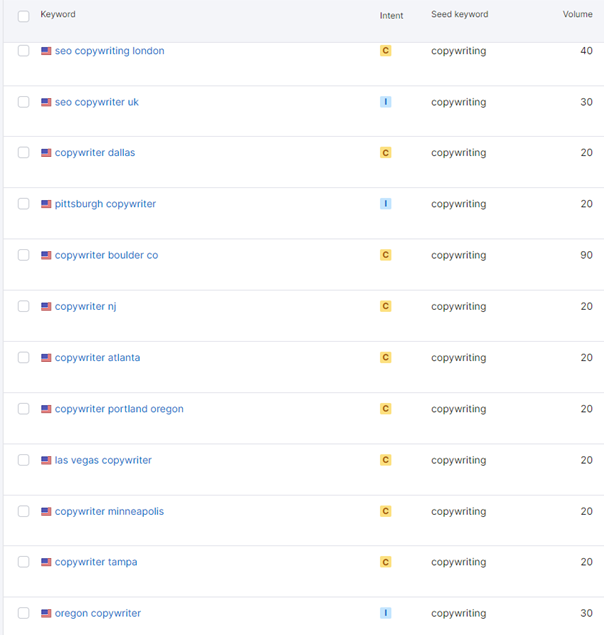
Google the word “copywriter” and the name of the nearest city that you’re in. Why? Well, people often perform location-based searches for copywriters, meaning they’ll search on the word “copywriter” and the nearest big city where they’re located. Think “Boston copywriter” or LA copywriter.”

See the screenshot below. The volume column means the number of searches per month in the U.S.

So, for example, people search on “copywriter boulder co” 90 times per month.

A screenshot showing four columns: keyword, intent, seed keyword, and volume. The keyword column includes phrases with the word "copywriter" like "copywriter boston"


When you do one of these searches, you’ll see who’s ranking on the first page of Google. You can check out their portfolios for inspiration. And at the same time, you’ll have a sense of who you’re competing with online.

Tips for Creating a Good Copywriter Portfolio

The following tips apply to online portfolios.

  • Make it easy to find—no need to be cute or coy. Simply using the word “Portfolio” in the main nav works.
  • Keep it current. Your portfolio is never “done.” You should add new pieces over time.
  • Audit it for broken links. Things break. This often happens if you link directly to a page on a client’s website. Get in the habit of reviewing your portfolio every quarter. Check for broken links. Add in newer work.
  • Swap out older or “meh” work. When starting out, you’ll probably add everything you write to your portfolio to bulk it up. As you do more work for clients, you’ll have more samples to choose from, which means you can be more selective in what you highlight. Your portfolio should demonstrate your range and the best work in each category. Make sure you curate, curate, curate.
  • Break down samples by category. By category, I mean website copywriting, email marketing, landing page copy, white paper, blog posts, etc. You can break things down by category on one longer page. Or you could have a website page devoted to each category if you have enough samples to warrant the separate page and/or if you want to optimize the category page for a particular copywriting service.
  • Remind people you have more samples to share. It’s always good practice to conclude your portfolio with something like, “The above is a small sampling of my work for clients. Ask if you’re looking for something specific that I don’t include above. I likely have examples I can share.”

Got a question for the Copy Bitch?

That’s me—I’m the Copy Bitch. I have over 20 years of experience as a freelance copywriter and love sharing what I’ve learned. Reach out with a question or leave a question in the comments on one of my YouTube videos.

How to Market Your Copywriting Business Online

You’ve hung out your virtual shingle for your copywriting business. Now what? Where are the clients? How can you help them find you? Step up, friends. Because that’s what I discuss in this post on how to market your copywriting business online.

Below, I’m going to talk about one specific way: optimizing your website for location-based copywriter searches.

If you’re more of a visual learner, check out the video I did on this topic, which I’m embedding at the end of the post. I share my screen and walk you through how location-based copywriter searches work and the evidence in Semrush.

Let’s get to it.

What do I mean by location-based copywriter searches?

If someone’s in the market for a freelance copywriter, they’ll likely turn to Google. One of the phrases they might search on will be the word “copywriter” or “freelance copywriter” and the city they are in—or the nearest “big” city to them, like Dallas, Boston, or Tampa.

How do I know this?

I’m seeing it in Semrush, the keyword research tool I use.

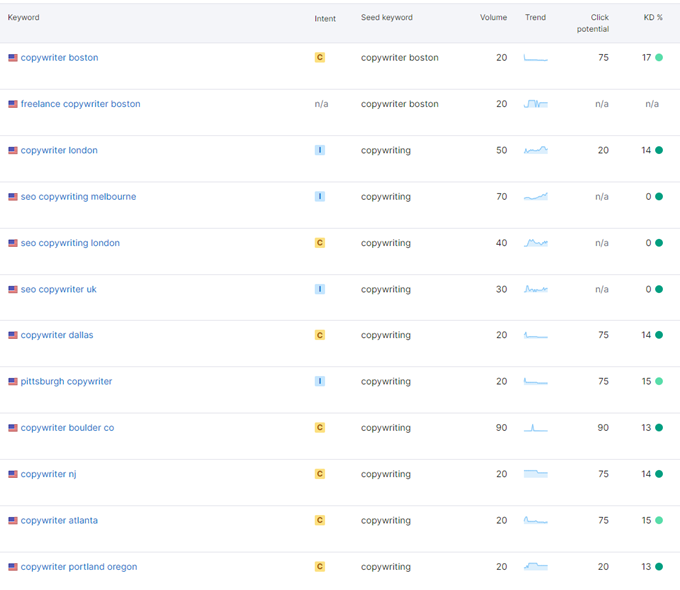
Check out the screenshot below. This is a small sampling of location-based searches for copywriters.

Results from a database search in Semrush, a keyword research tool. Columns include keyword, intent, seed keyword, monthly search volume, and keyword difficulty. Examples of search phrases include "copywriter boston"


Now, 20 or 30 searches a month isn’t a lot. (Seventy and 90 are better.) But when it comes to successful marketing, the key is doing a bunch of little things well. Plus, check out the column labeled KD or keyword difficulty. The lower the number, the better your chance of ranking well for the keyword phrase.

So a copywriter in the Boulder, Colorado, area could crush it by creating a kickass landing page optimized around the phrase “copywriter boulder co.”

Bottom line: Location-based searches for copywriters have a lot of potential. If you effectively optimize a page on your site for a location-based search, the page could bring in business—while you sleep.

If the page is compelling and the rest of your site does well, prospects will likely be reaching out. No, maybe not a ton. But again—this is simply one recommendation for how to market your copywriting business online.

But it’s a straightforward way. And the best part about it? Once it’s done, it’s (mostly) done. (You do need to monitor its effectiveness. More on this in a moment.)

Another benefit of going through this exercise is seeing who you’re competing with online (both in paid search and organic listings).

How do you optimize your website for location-based copywriter searches?

Use a keyword research tool like Semrush (paid) or Google’s Keyword Planner (free) and search for “copywriter” and a large city near you in your state.

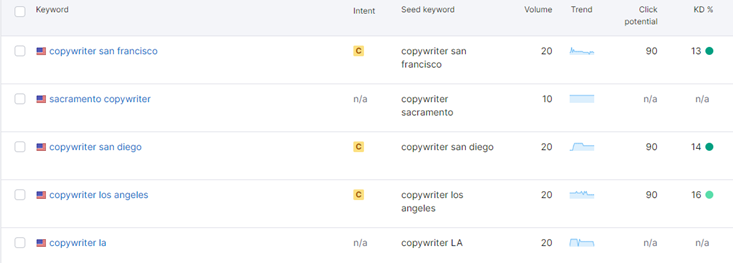
If you’re in a big state like California or Texas, do searches on various big cities. For example, here’s what Semrush is showing me for some cities in California.

Search results from keyword research tool called Semrush. The image shows several columns, including keyword phrase, search volume, and keyword difficulty. Phrases include "copywriter LA," "copywriter san diego," and other California-related location-based searches

You can choose the city nearest to you and optimize for it. Or you might decide to optimize various pages on your site for these California-based searches since you reside in the state. The beauty of freelancing copywriting is that you don’t have to be in the same place as the client. So why not become the “go-to” copywriter in various places?

Build a compelling landing page.

When building a page around a keyword phrase, you must make it compelling. This is the place to show off your writing chops. You absolutely could keep it simple and optimize your Contact page. But even your contact page should have more to it than something like “Contact me to learn more about my services.” Talk about yourself and what makes you unique. Include “social proof” (i.e., a quote from a happy client). Promote your certifications, if available, like HubSpot Academy badges. Include links to your best work. You get the idea.

Got a Question for the Copy Bitch?

That’s me! I’m the Copy Bitch. Contact me or visit my YouTube channel and leave a comment on one of my videos. I might make a blog post or video with the answer.

How to Get into Copywriting with No Experience: 4 Ways

You probably landed here because you’ve decided to become a copywriter. The only problem is you don’t have any copywriting experience. It’s a chicken and egg conundrum, isn’t it? But don’t worry. I’ve got your back.

Below, I’ll discuss how to get into copywriting with no experience. I’m living proof that it is possible. I’ve been doing this copywriting thing for over twenty years, and when I started my freelance business, I had zero copywriting experience, too.

The trick is turning “zero experience” into “some experience” and parlaying that into more and more paid gigs.

Note: For this blog post, I’m assuming you already know how to write well, meaning you know the rules of grammar and punctuation, you know when you can break those rules, and you’ve had people tell you you’re a strong writer. If you’re struggling with the writing piece, focus on developing your writing chops first. Then, come back to this blog post and carry on.

If you’re more of a visual/audio learner, scroll to the end, where you’ll find my video on this topic.

How to get into copywriting with no experience: Take a course (or two).

You can never go wrong with education. And the nice thing about education is you’ll often have copywriting assignments that include instructor feedback. So it’s an excellent way to learn, practice, improve, and connect.

Copyblogger and American Writers & Artists Institute (AWAI) have courses. Copyblogger’s are priced at $149/each, and AWAI has various levels. You’ll get feedback from veteran copywriters (and you’ll make meaningful connections to boot; you never know when an instructor might recommend you for a paid gig).

If you’re nervous about jumping straight into a copywriting course, you might want to start with HubSpot Academy. My regular readers have heard me praise HubSpot and for good reason. HubSpot spread the concept of inbound marketing back in the mid-aughts and has remained the leader ever since. It is passionate about educating people in all things inbound and content marketing.

HubSpot Academy is its education hub. Here, you’ll find many free certifications. Start with the following:

  • Inbound Marketing
  • Content Marketing
  • Email Marketing
  • Social Media Marketing
  • SEO

As you complete the courses, update your LinkedIn profile with the certifications.

How to get into copywriting with no experience: Reach out to small business owners you know and offer to do some work pro bono (for a limited time).

You’ve taken courses. You’ve gotten your certifications. Now, you need to apply what you know to real businesses to get some all-important samples for your copywriting portfolio and develop your confidence while you’re at it. Consider people you know who own small businesses. I can almost guarantee you know someone—or you know someone who knows someone.

It could be the owner of a . . .

  • Local hair salon
  • Limo company
  • Garden supply store

You get the idea. Small business owners need help with their marketing. Reach out, let them know you’re breaking into copywriting, and ask if you can do X, Y, and Z for them—free of charge, with no strings attached, and no obligation to work with them after you complete these three items. (This is the ONLY time I recommend writers work for free.)

They’d be foolish to say no, right?

The key is being super specific with what you’re offering. Say something like, “I’ll write two blog posts, a month’s worth of social media posts, and revise your About page.”

Right there, you’ll get plenty of experience and samples you can use in your copywriting portfolio.

And if you do a great job and demonstrate your value, they might ask you to continue doing work for them, at which point you’d say something like, “I’d be happy to continue doing work for you. Here’s what I charge for blog posts, social media management, and revising website copy.”

How to get into copywriting with no experience: Approach local nonprofits or organizations you’re involved with/volunteer for.

Nonprofits and charitable organizations always need marketing help. (I’m talking about smaller organizations, not the big guys like the American Red Cross.)

Take the same approach I outlined above for small businesses.

How to get into copywriting with no experience: Just do it.

The best way to learn anything—how to draw, play tennis, and cook—is by doing.

  • Rewrite the emails you’re inundated with from various businesses. How would you revise the email subject lines? The body copy?
  • Revise the direct mailers that come to your house.
  • Same with any sales letters or letters from charitable organizations (professional direct response copywriters often write the latter, so they can be good pieces to study)
  • How would you rewrite the radio commercial and the TV spot?
  • How would you revise the home page, navigation, etc., for every awful website you encounter?

Practice, practice, practice.

You do that enough, and you’ll develop the confidence to tackle steps #2 or #3 if you haven’t already. Plus, you’ll likely feel confident enough to apply to gigs, network, or even send cold emails or make cold calls.

Now that you’ve learned some ways to get copywriting experience, dig into these relevant topics:

Got a Question for the Copy Bitch?

That’s me! I’m the Copy Bitch. Contact me or visit my YouTube channel and leave a comment on one of my videos. I might make a blog post or video with the answer.


10 Copywriting Questions to Ask Clients

Asking great questions is the difference between a good copywriter and a great copywriter. Don’t worry: This is a learnable skill. To get started, check out my 10 copywriting questions to ask clients. This works for prospects. And with some customization, this will work with existing clients when they have a new project.

Now, I consider the following general questions that you’d want to ask prospects when you’re chatting for the first time. Once you know what the project is, you’ll want to ask many more project-specific questions. After these 10 questions below, I’m going to give you project-specific questions for a fictional website redesign/relaunch.

Note: If you’re more of a visual/audio learner, scroll to the end for my video on this topic.

1. Give me your elevator pitch about your business. What sort of products or services do you sell?

You want to hear how the client describes their business. Is their message clear? Because if it isn’t, you’ll need to help with that.

2. Talk to me about your audience. (Do you have formal buyer personas?) 

Not sure what a buyer persona is? Read this. The gist: A persona is a fictional representation of the client’s ideal buyer. You want to ask the prospect about their audience’s pain points and how their products or services can help to solve them.

3. Tell me about your competitors. In what ways are you the same? How are you different—and better?

Get specific names so you can check out their websites. Ask the client about their USP, or unique selling proposition.

4. Tell me about the project. What are the main goals? What are your expectations for the final product? What style/tone are you looking for? How will you decide if this copywriting project was successful?

Note: Once they identify what the project is, you’ll want to have a set of project-specific questions handy. (See the ones at the end of this article.) But the above questions are a good starting point.

5. Have you done this sort of project in the past? What were the results? What worked, what didn’t work?

Their answers will alert you if the client has unreasonable expectations or if they might be the reason a project didn’t work in the past. (In which case, you might want to pass on the project. Or, at the very least, charge more.)

6. Do you have an in-house style guide/brand guide? Are there any other specifications or requirements I need to know? (Like legal regs, for lawyers and financial clients.)

You’ll want to know this going in.

7. Do you have a subject matter expert for me to talk to—and will you be facilitating the interview?

The best writing happens when you can interview subject matter experts on the client’s end. That’s what separates generic content generated by AI and compelling content that can’t be found anywhere else, like a competitor’s site.

8. What’s the budget and timeline?

Clarify details around deliverables and milestones. This will help you manage their expectations. And it will help you from a timeline perspective as well.

9. Who’ll be part of the review process?

You know the saying about too many cooks in the kitchen, right? Knowing who’ll be involved in the review process is important to avoid any surprises or delays down the line.

10. So here’s the project as I understand it. Did I miss anything?

You want to make sure you and the client are on the same page. Reiterate the goals, timeline, budget, style, and other details. Do it during your call, but follow up with an email outlining everything, and ask them if it looks good or if they have anything to add. This will help you create a more accurate proposal.

Copywriting Questions to Ask Clients About a Specific Project

Let’s pretend a client wants to redesign their website. Here are some smart questions you could ask IN ADDITION TO THE ONES ABOVE.

Note: These questions are for prospects. If you’re working with an existing client on a website redesign, you’ll want to tweak the questions accordingly. For example, you can bypass questions on the target audience since you’ll already be familiar.

  • What’s motivating the redesign/relaunch?
  • What does the current website do well?
  • What content are you keeping?
  • What new content do you need?
  • Who’ll be handling keyword research?

Website relaunches are ALWAYS fraught. Sometimes businesses think they need a new website simply because they’re bored with it. This is where I might try to steer them into a smaller project, like looking at underperforming pages and seeing if we can improve those.

To identify if a website relaunch is completely necessary, here are some questions you could ask.

I recently asked a client these questions. The client is a professional services company. You’d tweak the questions based on the type of client.

  • How do you define a lead?
  • How many leads came in from your website last year? Of those, how many turned into business?
  • How many leads came in last quarter? How many turned into business?
  • Of those that didn’t turn into business, how many are still in the pipeline?
  • This is more of a subjective question, but what has the lead quality been like overall the last two years?
  • What are the ten most popular pages on the site?
  • What are the top five downloads?
  • When you launched your current website, did you—or the person who wrote it—do formal keyword phrase research? Is it optimized for search?
  • What do you like best about your site?
  • What do you like least?
  • Have you taken website accessibility into account?
  • What other stats/conversion points do you think would be helpful for me to keep in mind?
  • Who are your top three revenue generators?
  • Did any of them originate as web leads?
  • Who do you consider your top three best clients? (“Best” is subjective, of course, but I’m thinking from a revenue perspective AND a “they get and appreciate what we do” perspective)
    Did any of them originate as web leads?
  • If none of the above originated as web leads . . . is there anyone on your current or recent client roster who exemplifies the type of website lead that you want to get more of?
  • Do you really need to redo your website, or are you just bored by it? 🙂

Got a question for the Copy Bitch?

Contact me or visit my YouTube channel and leave a comment on one of my videos. I might make a blog post or video with the answer.

How to Be a Good Copywriter

Whether you’re just starting out or you’ve been at this copywriting thing for a while, you may be wondering how to be a good copywriter. And by “good,” you might mean “great.” Or, as we say in Boston, “wicked pissah.”

Since “how to be a wicked pissah copywriter” doesn’t get many searches, I will stick with the phrase people search on. Below, I discuss ten strategies for being a good copywriter. Note: If you’re more of a visual or audio learner, scroll to the end for the video I recorded on this topic.

How to be a good copywriter.

1. Read in general and read specifically.

Serious writers are serious readers. If you’re getting into copywriting and you’re not a reader, well . . . you’ll want to rethink things. I’m not saying you should forgo copywriting. Instead, I suggest you challenge yourself to embrace reading or get back into it if you’ve placed it on the back burner. Read for pleasure. But also read blogs and publications that discuss copywriting and related marketing topics. Here are some to check out:

Get into the habit of spending 30 minutes reading daily about copywriting and marketing.

2. Learn how to conduct research quickly without losing accuracy.

Anyone with access to Google can conduct quick research. Accuracy is critical. Make sure you understand what is and isn’t a reputable source. I did a video on how to evaluate sources. I also wrote a blog post on the difference between primary and secondary sources. And here’s HubSpot’s guide on how to research like HubSpot’s research team.

3. Be pleasant to work with.

Sounds so simple, right? But you’d be surprised how much this matters. If you’re pleasant to work with, meet deadlines, and produce good work, you’ll never be without business for too long.

4. Under-promise, over-deliver.

You’ll be eager to do the work and wow the client when you start. Resist the temptation to say you’ll turn around the project quickly to impress the client. (Even if you can.) First, perception matters. You don’t want the client to think you have nothing else to do. Second, life happens. If you promise a tight turnaround and get sick, then what? Plus, you’ll find that most things take longer than you expected, especially when you’re starting out and learning how long projects take. So get in the habit of under-promising and over-delivering. If you end up beating your deadline, great! You’ll look like a rock star, which is what you wanted in the first place.

5. Deliver error-free, original copy. Don’t plagiarize.

I shouldn’t have to say any of this, but you want to consistently produce great work. Proofread, proofread, proofread. Know your weaknesses and edit for them. Don’t plagiarize, period. Keep in mind that unintentional plagiarism is still plagiarism. (And it can happen more easily than you think, even to the best of us.) Grammarly has a good article on how to avoid plagiarism. And here’s my video on proofreading tips and tricks.

6. Keep learning.

Take courses, attend webinars, and go to conferences like Inbound if that’s your thing. The most successful people never stop learning. Plus, consider how much copywriting and marketing have changed in the last two decades. Now, with the rise of AI tools like ChatGPT, we will see even more changes. You must keep up by reading (see my first point above) and educating yourself.

7. Play Devil’s Advocate.

I’m not suggesting you become a contrarian. But clients often need reality checks with their marketing. If they’re going down a road that doesn’t make sense for them, speak up. They might not listen, but you’ll have planted the seed. And sometimes they will listen. I have a client who’s told me I’ve saved their company a lot of money over the years because of the questions I ask and my Devil’s Advocate position on many topics.

8. Learn your strengths and lean into them. Be mindful of your weaknesses.

I mentioned this earlier in the point about writing well. But your strengths and weaknesses will extend well beyond your writing capabilities. You’ll have specific strengths in running a business, maintaining records, networking, etc. The same is true for weaknesses. Lean into your strengths, but know your weaknesses so that you can mitigate them.

9. Learn how to ask for feedback and accept feedback.

Oh, man. Asking for feedback and giving feedback are essential skills for a copywriter . . . and some of the most challenging skills to develop. There’s a talent to each. And both require regular practice. Here’s a good article on how to give feedback to writers. After reading it, you’ll understand what feedback you can expect (and how to request it). You’ll also learn how to give helpful feedback.

10. Strive for work-life balance.

Most of us hear this advice all the time. And you might be thinking, “Well, if I want to be a great copywriter, I need to be working all the time, especially in the beginning.” I’m not going to lie: You might need to work a lot when you’re starting out, and not just on client work, but marketing your business, putting together a copywriting portfolio, and networking. But there’s a difference between “a lot” and “all the time.” Working all the time isn’t going to make you a good or great copywriter. It will make you overtired, grumpy, possibly resentful, and more prone to making mistakes. Take breaks. Get sleep. Eat well. Schedule time for fun things, even if that means simply watching a 30-minute show on Netflix.

Got a question for the Copy Bitch?

Contact me or visit my YouTube channel and leave a comment on one of my videos. I might make a blog post or video with the answer.