How to Nail Your Subject Matter Expert Interview

Wondering how to nail your subject matter expert interview for your article, blog post, white paper, guide, or some other piece of marketing content you’ve been tasked to write as a freelance copywriter or content writer?

Well, step right up.

Below, I answer the following:

  • What is a subject matter expert (SME)?
  • Why should freelance copywriters seek out interviews with subject matter experts?
  • How do interviews with SMEs differ from other interviews (like the ones journalists conduct)?
  • How do you nail your subject matter expert interview?
  • What are some best practices when coming up with questions for SMEs?

What is a subject matter expert?

A subject matter expert, or “SME,” is exactly as it sounds: A person has expertise in a specific topic. In my world of content marketing, an SME is usually someone within the organization I’m writing the content for. The SME might be the business owner, a sales rep, or an engineer. (That’s not an exhaustive list). I do a lot of writing for a urology practice, so the subject matter experts I talk to are urologists.

Why should freelance copywriters seek out interviews with SMEs?

There’s a glut of mediocre content, much of it written as part of a content marketing strategy. In the past ten to fifteen years, we’ve pumped out content at alarming rates, often for the sake of getting content “out there.” This worked for a while. But now, we have this glut.

Here’s the thing: When it comes to content marketing, the goal should always be to provide people with helpful content that goes above and beyond the mediocrity gumming up the interwebs.

To do this sort of writing, you need fresh, original perspectives. AI like ChatGPT can’t give you that. Copywriters and content writers who simply research and write up stuff can’t provide that unique perspective either.

But subject matter experts can.

Since everything I write is on behalf of a business that’s trying to promote its brand, products, or services, it makes sense that I should talk to subject matter experts within the organization. The SMEs will have hot takes, contrarian points of view, and an understanding of the little nuances that matter most to the prospects who are being sold to.

Bottom line: Talking to subject matter experts elevates content. It’s the special sauce and the thing that differentiates the content from the competitor’s.

How do subject matter expert interviews differ from other types of interviews, like the ones journalists do? 

The biggest differences? Allegiance, tension, and process.

Let’s talk about allegiance first. A journalist’s job is to be objective. You’re not beholden to a business owner. Your job is simply to capture and present the facts without bias. As a freelance copywriter or content writer, your allegiance is to the brand you’re writing for. This doesn’t mean you should ignore ethics. You certainly shouldn’t make things up. And you shouldn’t write misleading or incorrect info, either. But you’ll be writing things that ultimately make your client look good.

Let’s talk about tension. As a journalist, you often have to interview people who have no desire to talk to you. That can lead to lots of stress and tension.

When you’re a freelance copywriter doing an interview with a subject matter expert, there’s zero tension. The folks you interview are invested in what you’re doing.  They want to see you succeed since it’s beneficial for them and their business. So they’re usually happy to help.

That said, the nerves don’t go away in either case. This is normal, even for copywriters like me who’ve been at it a good long while. If you’re an introvert and you hate talking to people, conducting interviews via phone, Zoom, or in person can be challenging. Especially in person since that requires pants. 😉

Let’s talk about the process. In journalism land, you don’t give people questions before the interview, and you don’t let people review or edit your drafts. (The latter is a big no-no.) When you’re writing content for a client, the folks you interviewed usually sign off on their quotes and often make edits to your content.

How to nail your subject matter expert interview

Develop your questions in advance and send them to your interview subject ahead of time.

You’re going to want to do some preliminary research based on the angle of your article, blog post, or white paper. Develop questions from there and send them to the subject matter expert. Keep it reasonable, though. I wouldn’t send more than 15 questions via email. If you feel you’re going to need to ask a lot more questions than that, double-check to make sure the focus of your article is focused enough.

Set clear expectations.

How will you be conducting the interview? Over the phone? Zoom? Skype? Should they have their cameras on, or is audio-only OK? When scheduling, let people know how long you’ll need them. Plan for more time than you need. It will be a treat for them if you complete the interview early. Suddenly, they’ll have 10 or 15 extra minutes in their day.

Always send a calendar invite and make sure they accept it.

I always follow up a calendar invite with an email alerting them that I just sent it. (Yeah, yeah, I know.) And I paste the info in the email, just in case. I might be going overboard. But it works for me. You do you.

Send a reminder the day before or the morning of.

Provide the details, like a Zoom link, phone number, and the list of questions again. If you don’t send the reminder, then don’t be surprised when someone flakes out.

Show up early to the interview.

You’ll likely be conducting most interviews via phone or Zoom. Show up five minutes early. You’ll be able to troubleshoot any glitches. And if your interview subject is early, they won’t have to wait.

RECORD THE INTERVIEW.

Be redundant and use a backup device. I use Zoom and the memo function on my phone. I always alert people that I’m recording and explain why (because I can never read my own handwriting). I tell them that I promise I won’t use anything they say against them in a court of law. This almost always elicits chuckles and puts people at ease.

And while all of the above is true, the real reason you want to record is this: You will listen better and more deeply if you’re not worried about taking notes. I think you should still take some notes, as needed. But put your focus on your interview subject. Follow their directives. Yeah, you don’t want the interview to go off the rails, but allow yourself to follow tangents that seem relevant or interesting.

Ask follow-up questions or clarification as needed.

Your interview subjects will likely say something that surprises you or that you want to know a little more about. ALLOW for this. Ask those questions.

Resist the temptation to bring yourself into the interview.

I’ve seen this mistake one too many times. It’s not about you. Shine the light on your subject. (Unless, in rare instances, your experience is highly relevant or directly related.)

PAUSE AND TAKE A DEEP BREATH.

And when doing so, simply say, “Great, I’m just double-checking my questions here. Bear with me.” This allows for a little breather for both of you, and for you to catch any questions you missed.

Lean into the silences and let your interview subjects fill them in.

They will, too, because it’s human nature.

At the end of the interview, set clear expectations about what happens next.

For example, let them know when they can expect to see the first draft. Remember, in Copywriting Land, your interview subject will review, edit, and approve the final copy. This is one of the biggest differences between journalism and copywriting.

In Journalism Land, people don’t get to approve or change their quotes. What’s on the record is on the record. But in Copywriting Land, it’s a little different. So explain what happens next: “I’ll be sending you a draft in a week. You can make suggested edits in the margins, or if we need to discuss more complex edits, we can schedule a call.” Let people know they are welcome to reach out to you via email if they forgot something or whatever.

Be classy and say thank you.

Send a quick email thanking them for their time and reiterating the next steps.

Best practices for asking questions during interviews with subject matter experts

Ask open-ended questions. Remember, the goal is to get people talking.

If you need clarification, ask for it. Say something like, “Can you elaborate?” Or: “Can you provide an example?”

Don’t be afraid to ask someone to dumb something down. You can even ask them to do exactly that: “Hmm. I’m not quite sure I understand. Let’s pretend I’m ten. How would you explain this concept to me?”

Here’s a great question to end all interviews (or some variation):

  • Is there anything you were expecting me to ask that I didn’t?
  • If there’s one thing you’d want a reader to take away from this article, what would it be?
  • Is there anything else you want to make sure I convey?

Remember, don’t fill in the silences. IT’S SO TEMPTING, I KNOW. But bite your tongue, especially when asking these closing questions. Let the interview subject fill in the blanks.

Final tips on how to conduct an interview with a subject matter expert 

Use a service like Rev.com to transcribe the interview.

Either with a human or with their automated transcription, which is pretty good. It’ll make your life so much easier, trust me. Instead of spending valuable time transcribing the interview, you can focus on highlighting important messages, identifying great quotes, conducting additional research, and—oh yeah—writing awesome content. Plus, you’ll get to the writing part SO MUCH FASTER, which is good for the client and you.

Wondering how it’s good for you? Well, let’s say you charge $500 per blog post, and that includes initial research (keywords and topic), scheduling the interview with the subject matter expert, conducting a 30-minute interview, reviewing the transcript, writing the blog post, getting feedback from the client, and providing one round of revisions.

If you don’t record the interview and simply go by notes, I guarantee you’ll have overlooked something/forgotten something. And if you choose to transcribe the interview yourself, think of how much time that will take. I don’t care if you’re a good transcriber—it will take you at least 30 minutes (if you’re truly super fast) and more like an hour or more easily. What if you got that hour back for writing—or what if you get that hour back in your pocket, period?

Look at it this way: Let’s say it takes you five hours from start to finish to produce the final blog when you use a transcription service, but it takes you six to seven hours if you transcribe the interview yourself. You can do the math! Consider how much an hour of your time is worth.

Be kind to yourself, especially if you’re just starting out.

And know that even if you end up doing this for years, some days will be better than others. Even now, I still have moments where I’m like, “Hmm. That wasn’t my best work.” It happens. The good news is that all that messy stuff happens in the background. In other words, the interview itself is not the final product—the piece of writing is. So even if it’s a little messy getting there, you can still make sure the final prose shines in the end.

Are you new to copywriting? Here are my go-to resources for learning the ins and outs.

I use Amazon Affiliate links. If you use one of the links to buy something, it won’t cost you more, but I’ll earn a small commission. I only recommend stuff that I believe in. I own both of these books.

Aaand here are my go-to writing and editing resources.

Again, I use affiliate links where noted.

Got other questions about how to conduct an interview for an article?

Get in touch and ask away. Always happy to help!
Is Copywriting Hard? NOPE (Provided You Like to Write)

A question folks ask me: Is copywriting hard to do or hard to learn?

Well, if you hate writing, then copywriting will likely be hard to learn and to do. It will probably be painful as well.

I often tell folks that working as a copywriter means always having another term paper due. That’s what it feels like. And for some folks, that would be the WORST. THING. EVER. It would conjure bad memories of high school and writing term papers on mind-numbing subjects at 2 AM while hopped up on Red Bull.

But for someone like me?

BLISS.

Bottom line: If you enjoy writing, you’re decent at it, and you’re willing to learn, then no—copywriting isn’t “hard” to do. And it’s an absolutely learnable skill.

I’m living proof!

Ever since I was a kid, I wanted to be a fiction writer. I took a detour out of college and worked in radio where I learned about copywriting. I wrote promotional copy, liners, radio ads, etc.

In 2002, I started my freelance copywriting biz. The freelance aspect is perfect for me since it gives me plenty of flexibility to write fiction as well.

As for the copywriting part, I’m mostly self-taught. And I’m still learning because things change, like SEO best practices and email marketing best practices (just to name a few).

Are you thinking about getting into copywriting (also known as content marketing)? Do you need some resources?

To get started, I highly recommend the following:

Or check out some of my other blog posts about copywriting:

To recap: Is copywriting hard? NOPE. Check out my video below for more insights.

How Do Copywriters Get Paid? (How to Pay Yourself When You’re Self-Employed)

A bunch of years ago, a good friend of mine was thinking of making the leap into Copywriting Land. He’d been a journalism major in college, and he loved to write. (He was, and still is, an excellent writer.). After college, he detoured and worked for various small businesses in the retail and printing industries. When he saw I was making a living as a freelance copywriter, the writing spark inside him reignited. When he began to seriously contemplate making the shift to freelance copywriting, we met for lunch, and he came equipped with a bunch of questions.

And his first one? “How do you pay yourself?”

It was such a beautiful, vulnerable question. He’d worked for a paycheck all his life. And even though he’d been studying copywriting and content marketing in recent months and doing little side projects here and there, the whole concept of paying himself felt foreign to him. Like, HEY. How do I get them dollars I just earned into my bank account? Legally?

This brings me to today’s post .

How do copywriters get paid? How to pay yourself when you’re self-employed?

My goal here is this: SIMPLIFICATION. You can find plenty of articles, books, and tutorials on how to create profit and loss statements and/or how to use QuickBooks (or its equivalent) and all the various official definitions regarding small business bookkeeping. That’s NOT what this post is about. I want to simply show you how to think about money and your freelance copywriting business AT A HIGH LEVEL. And how I pay myself month to month.

In terms of your freelance copywriting business, think of three buckets when it comes to money.

  1. Revenue bucket. That’s the money coming in from paying clients.
  2. Expenses bucket. That’s the money going out to pay for your legit business expenses, like Internet and health insurance.
  3. Taxes bucket. That’s the money you pay to Uncle Sam and your state government.

For the purpose of this post, I’m going to assume you’re making a profit. As in, your revenue exceeds your monthly business expenses. Again, this isn’t a how-to article on bookkeeping or business terms.

And I realize if you’re just starting out, your business expenses might exceed your revenue, at least for a short while until you gain some traction. That’s OK. It’s expected. And even understandable. And the IRS has a whole way of determining whether your “business” is really a business or a hobby, based on how much you bring in year-to-year. But that’s a subject for another article by someone who holds the title of “accountant.”

Speaking of accountants, consider these two important recommendations:

  • Work with an accountant. Have them prepare your taxes and quarterly estimates. I recommend doing this from the start, even if you’re not making a lot of scratch. A good accountant will help guide you and make sure your T’s are crossed. It’s an expense, but not as expensive as you might think. I spent under $600 on mine last year. (Your mileage might vary depending on a bunch of factors, but I’m a big believer in being transparent with numbers whenever possible.) And that expense is EXACTLY that: a business expense that you can deduct the following year.
  • Work with a financial advisor. Specifically for retirement planning. (But they can help with your entire financial landscape.) Don’t put off contributing to your retirement. As a self-employed copywriter, IT’S ALL ON YOU TO WATCH OUT FOR YOURSELF. It’s OK to start small. Make it $25/month, if you can swing it. Then up that amount by 10 or 20 bucks every month or quarter. You won’t notice such incremental increases, but they will add up quickly. I have a standing directive with my financial advisor to keep upping my contribution every quarter until I tell him to stop.

But back to our topic: How do copywriters get paid? How to pay yourself when you’re self-employed?

As you work for clients, you will invoice them. (I’m going to write a blog post about how to create a copywriting invoice.) So the money—the revenue—comes in. Either via check or electronic payment.

You’ll deposit this into your BUSINESS BANKING ACCOUNT. My business and personal banking accounts are with the same bank for ease. And I use the bank’s online banking portal for even more ease.

You’ll pay your monthly expenses from your business banking account. ALL of my recurring expenses are automatically debited from my business banking account, from my health insurance to my cell phone to my IT maintenance. This makes end-of-year bookkeeping a breeze because it’s ALL done electronically and there’s a paper trail. I also have a business credit card for those one-off purchases I occasionally need to make, like a new computer or a new office chair.

Be mindful about taxes. In the beginning, you might not be making enough (again, consult an accountant!), but as you grow your business (because you’re going to GROW, right?), you will need to pay taxes. You’ll make quarterly estimates (and I recommend doing so . . . you’re supposed to do it, for one thing, but beyond that, it’s a much easier pill to swallow to spread the payments out over four payments rather than one big check in April).

You might have heard the adage: Think in terms of thirds. A third of the money you make will go to taxes, a third will go to expenses, and a third you get to keep (in your business account and/personal account; obviously, you need to keep a chunk of money in your business account, but you pay yourself from that dough as well). That’s a rough rule, but from a high level, not a bad way to think about it. As a freelance copywriter working from home, you’ll have fewer expenses than other small business owners, so you might not necessarily be putting a third toward expenses. (Again, your mileage might vary.)

OK, a reminder about my disclaimer: I’m not an accountant. I’m not a lawyer. And I never did successfully shimmy up the ropes in gym class. Oy!

I’m simply sharing my ways. Every month, I go into my business banking account and pay myself by transferring money to my personal bank account. This is known as a draw or an owner’s draw. (This article from NerdWallet talks about the owner’s draw.) I have a small range, but it’s usually the same amount month-to-month. From my personal account, I pay non-business expenses, like my personal credit card bill, which covers things like Panera (LOTS OF PANERA) and groceries or dinners out with Mister Word Nerd. You get the idea. Business is business. Personal is personal. But yes, I pay myself each month.

You could set up recurring payments through the online banking portal. You could also pay yourself every week or every other week. I choose to do it monthly. But you do you!

And I know the big question you’re asking is HOW MUCH should you pay yourself month-to-month? That very much depends on a variety of factors, like your personal expenses, how much you want to make, and how much you’re making in reality. See point #3 in this helpful article from Intuit QuickBooks.

Need more help on how to pay yourself when you’re self-employed?

More resources to check out:

Are you new to copywriting? Here are my go-to resources for learning the ins and outs.

I use Amazon Affiliate links. If you use one of the links to buy something, it won’t cost you more, but I’ll earn a small commission. I only recommend stuff that I believe in. I own both of these books.

Got other questions about running a freelance copywriting business?

Be sure to browse my Ask the Copy Bitch blog and my Ask the Copy Bitch YouTube channel.

What is SEO Copywriting?

Maybe you’re thinking of becoming a freelance copywriter and wondering what sort of work you’ll be doing. In your research, you might have come across terms like SEO, which has left you wondering, What is SEO copywriting?

This brings me to my (hopefully helpful) article. Below, I discuss

  • What is copywriting?
  • What is SEO?
  • What is SEO copywriting?
  • What do SEO copywriters do?
  • What SEO copywriting tools do I use?
  • How can you learn SEO copywriting?

What is copywriting?

At its simplest, copywriting is writing that sells a product, service, or cause. You will encounter different definitions—and even criticism of mine. But mine works, and here’s why: The digital landscape has blurred the lines between different types of writing.

In today’s digital marketing landscape, people use the terms copywriting, marketing writing, content marketing, and content writing interchangeably. And I don’t think they’re wrong in doing so. Content drives all business. It’s a 400 billion-dollar industry. And the goal of all content, ultimately, is to get people to buy or take some other deliberate action, like donate or vote.

Cue the cranky critics!

Critics tend to believe that copywriters are all about getting immediate sales, and content writers are all about engaging an audience. My take: the goal dictates what you write and how you write it, not your title.

For example, if you’re working on a long-form website landing page that’s trying to get people to subscribe to a course, you’ll lean into persuasive sales tactics. However, if you’re writing a “how-to” blog post that answers a question related to your client’s business, you’d write the content from an educational lens.

As a freelance copywriter for over 20 years, I regularly write both types of content.

(Read my in-depth post on what copywriting is.)

What is SEO? 

SEO stands for search engine optimization.

Hearing what it stands for probably doesn’t help much, does it? What the heck does search engine optimization even mean?

Have you ever done a search in Google and wondered HOW Google decides which sites to serve up in its organic listings—especially on the first page? Well, Google uses a complex algorithm to determine what to serve up. (And only Google knows every element of the algorithm. It’s kind of like Colonel Sanders’ recipe for KFC.)

Basically, Google’s algorithm involves many moving parts and evolves over time. For example, twenty years ago, the algorithm didn’t even consider mobile devices because smartphones hadn’t been widely adopted yet (the first iPhone came out in 2007). Today, mobile friendliness is an important “signal” in Google’s algorithm.

Why does Google care so much?

Google’s primary goal is to satisfy the user’s search query. (That way, you’ll continue using Google search and clicking on its ads. That’s how Google makes money.) Whether you’re looking for “sandwich shops near me” or “senior living marketing services” or “how to clean corroded batteries,” Google’s primary goal is to give you the answers you’re looking for.

Its lightning-fast algorithm determines what to serve up in its results. Many factors go into this, such as the quality of the content itself, the number of authoritative backlinks pointing TO the content, how the keyword phrase that the user plugged into Google is used in the content, even how fast the site loads. (Note: That is an incredibly SMALL sampling of what goes into the algorithm, but you get the idea. To dig deeper, check out this article from Semrush on how the Google search algorithm works.)

When it’s searching through the thousands and thousands of potential sites it can serve up, the algo eventually lands on the top contenders and thinks, “This web page does the best job of answering the user’s search query, so let’s serve that up first on the list of organic search results.”

Let’s demonstrate with an example . . .

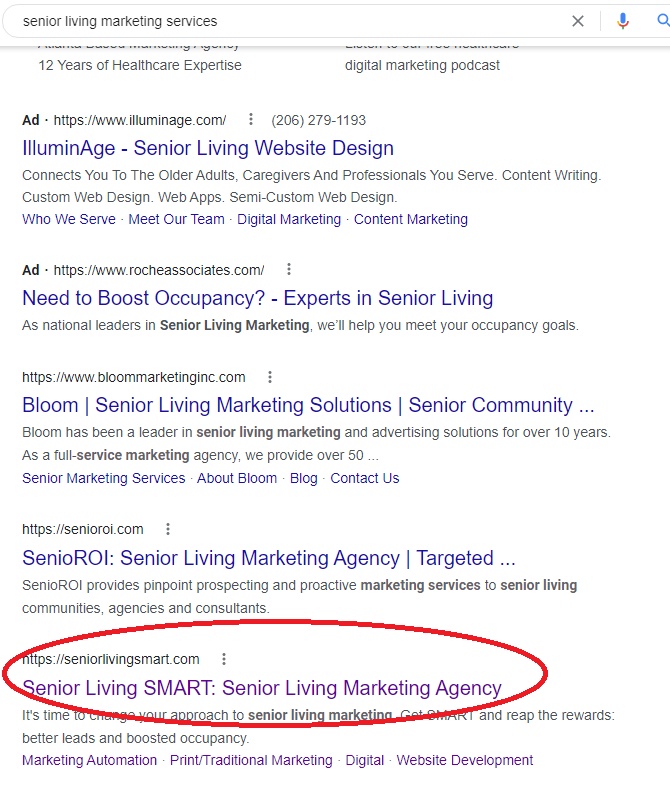
Let’s say you’re the director of sales and marketing for a fictional senior living community called The Elmwood Senior Living. And you need help with marketing. You google “senior living marketing services” and some paid ads show up at the top of the results, but also some organic listings.

You see one that catches your eye—the one for Senior Living SMART. You visit the site and love the vibe, the owners’ experience, and the impressive list of other senior living communities it works with. You decide to request a complimentary 30-minute brainstorming session.

Google results on the search for "senior living marketing services"

THAT right there is an example of search engine optimization at work. (And yes, that’s one of my clients. I optimized a page on the site for the phrase “senior living marketing services.” Keep on reading to understand WHY I did this.)

Can you give website content a leg up so that it has a chance of being “chosen” by the Google algorithm?

Yes! That’s where search engine optimization and SEO copywriting come into play. You can finesse—or optimize—your online content so that it has a better chance of being served up (or, as we say, ranking well) in the search engine results pages (SERPs).

In fact, search engine optimization is its own field. People have titles like “SEO specialist” or “SEO consultant.” These folks know all aspects of search.

But at the end of the day, one of the most important pieces in the SEO puzzle is the content itself. And good news, copywriting newbies: The main goal in SEO copywriting is to simply write awesome content, meaning content that’s helpful, engaging, and error-free, which is likely the main reason you were drawn to this field—because you want to write great content.

OK, yeah: kickass SEO copywriting is a bit more involved than writing awesome content. But honestly, if you’ve got the “awesome writing” part down, the rest is straightforward. Sure, you need to know the target keyword phrase you’re writing about. SEO copywriting tools exist that can tell us what keyword phrases real people are searching on for every topic under the sun. (I use Semrush, which is a paid service. But there are some good freebie keyword tools out there.) So, if you have a client who operates a senior living marketing agency (like I do), you can do research in the tools to see what phrases people are plugging into Google search.

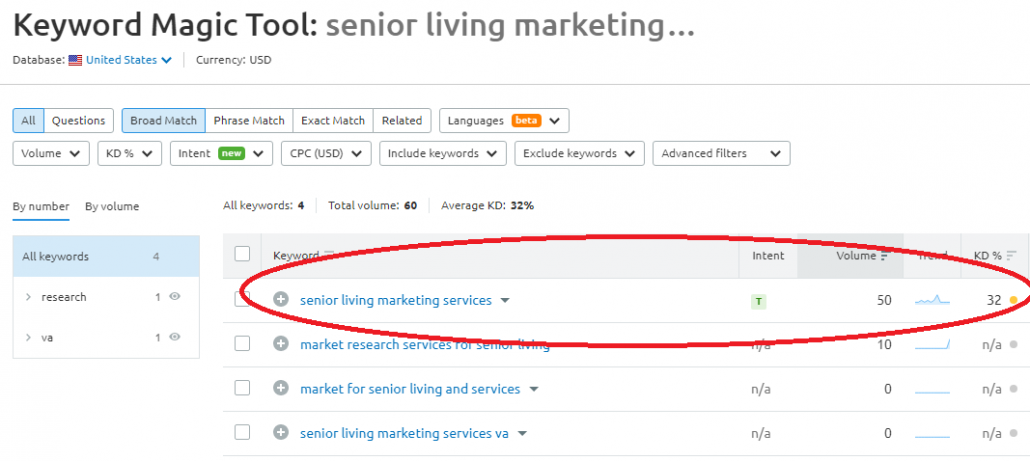
In the example I provided above, the phrase “senior living marketing services” has a search volume of 50, meaning 50 times a month, on average, people are plugging that phrase into search engines. It has a keyword difficulty of 32. The lower the keyword difficulty, the better chance you have of creating content that can rank well for that particular keyword phrase.

keyword research result for senior living marketing services

Some phrases (like the term “marketing services”) are incredibly competitive. There are thousands and thousands of searches on that phrase each month, but because there are so many other websites out there using the phrase, it would be next to impossible for you to get a new site, blog, or article ranking high for that phrase.

But a phrase like “senior living marketing services” is incredibly specific and doesn’t have as much competition (that’s what the “KD” indicates in the image above: keyword difficulty. The lower the number, the better chance that your content can rank for that phrase if done right).

And, sure, there’s a much lower search volume for the phrase “senior living marketing services.” But if you write awesome content that ranks and brings in some of those 50 searches a month . . . well, only good things can happen, right? (As in, that anonymous website traffic becomes bona fide leads and even customers.)

OK, so what is SEO copywriting?

SEO copywriting involves using keyword phrases and adeptly weaving them into engaging and helpful online content. The content can vary—you might be writing a home page. You might be writing a service page. You might be writing a blog post. You might be writing a landing page. But your job is to take the keyword phrase and produce a piece of engaging, helpful, error-free content that follows SEO best practices.

The number one best SEO copywriting technique? Writing for HUMANS first. Perhaps you write a blog post on Senior Living Marketing Services: How to Choose Ones That’ll Boost Occupancy. See how that incorporates the keyword phrase, but also hints at a great piece of content that can solve the searcher’s problem?

What does an SEO copywriter do?

As an SEO copywriter, you will need to . . .

  • Understand your client’s business—particularly their ideal customer. What are the customer’s pain points? What solution does your client provide? How would that ideal customer search in Google to solve the problem they’re experiencing?
  • Do research in keyword tools. As I mentioned above, there are free tools and paid tools, like Semrush. You need to research phrases that real people are searching on related to your client’s business, particularly those “longer-tail” keyword phrases that tend to have lower overall search volume, but less competition.
  • Expertly weave the keyword phrases into the content, but in a way that sounds natural. No keyword stuffing!
  • Follow SEO copywriting best practices for formatting. Use the keyword phrase in the title and in sub-headlines, and use bullet points and short paragraphs. (Kinda like what I’m doing here.)
  • Write effective page titles and meta descriptions. Again, you can learn how to do this.
  • Stay current with the latest SEO and SEO copywriting trends.

Basically, any writing that you—as a professional copywriter—do online will involve search engine optimization. So if you’re thinking about pursuing freelance copywriting, take the time to become familiar with SEO.

What SEO copywriting tools do I use?

  • My brain and common sense. SEO copywriting isn’t rocket science. The biggest battle is writing fresh and original website content, and you need your brain for that.
  • My clients. I’m not suggesting that my clients are tools. 😉 But in order to write fresh and original website content, you need a unique perspective. Turn to your clients for that perspective. Otherwise, you’ll just be adding to the pile of adequate and mediocre content that already exists. For example, are you writing service or product pages? Talk to the sales folks, engineers, or creators of those products or services to understand what makes them different. Are you writing an in-depth blog post about an important industry topic? Again, tap your client to get their take.
  • Semrush. Semrush is my go-to tool for keyword research, competitor analysis, and more. I’m a paid subscriber.
  • Grammarly. Catch embarrassing mistakes and typos before sending your copy to a client or publishing it. I always run my content through Grammarly, but I don’t accept all of its suggestions. You can sign up for the free version of Grammarly here. (If you sign up or buy via my affiliate link, it won’t cost you more, but I’ll earn a small commission.)
  • Google Docs or Microsoft Word. The words gotta go somewhere, right?

When it comes to SEO copywriting, you don’t need much more than your brain, a way to research keywords, and something to write with.

How to learn SEO copywriting

Everything you need to know to become an SEO copywriter is available online for free (or low cost). I’m not against paid courses, but I always recommend starting with the free stuff.

Some great sites to subscribe to (in addition to HubSpot):

You’ll also want to brush up on copywriting basics and marketing. Here are my go-to recommendations:

Note: I use Amazon Affiliate links below. If you use one of the links to buy something, I’ll earn a small commission, but it won’t cost you more. I only recommend stuff that I believe in. I own both of these books.

Do you have other questions about SEO copywriting? As the Copy Bitch!

That’s me. I’m the Copy Bitch. Get in touch here.

Is Copywriting Still in Demand? Yes, But With a Few Caveats

Maybe you’ve been thinking about a career in copywriting. But given ChatGPT is taking the world by storm, maybe you’ve been asking yourself, Is copywriting still in demand? Is it a smart field to enter? What if the robots come for my job?!?

Here’s the thing: As I update this post in August 2024, I can confidently say that copywriting is still very much in demand. That doesn’t mean AI hasn’t had an impact. It has, but not to the extent that some folks might have you believe, at least not yet.

But just because copywriting is still in demand, that doesn’t mean anyone who wants to “be a copywriter” can simply snap their fingers and start making six figures overnight.

Copywriting is a skill. And yes, it is a learnable skill, provided you have basic writing chops and a willingness to learn.

But let’s get back to the question: Is there still a demand for copywriters?

Here’s what to know.

Is copywriting still in demand? Yes. But we need to discuss definitions to understand why.

Thirty years ago, copywriting had a much narrower definition. But thanks to the Internet, which birthed digital marketing, the word copywriting today is often used interchangeably with phrases like content marketing, marketing writing, content writing, or even freelance writing.

You’ll see discussions on other sites—including respected sites—that copywriting and content writing are two different things. Purists say copywriting is all about selling and that content writing is all about engaging. I disagree. All content must be engaging. And on some level, all content is “selling,” even if it’s only on a subconscious level by creating brand awareness.

For example, the goal of the “how-to” blog posts on a business website is to lure people in through organic search with the hope that some of those folks will become customers somewhere down the road. (That’s a simplified way of looking at it, I realize, but you get the idea.)

Businesses wouldn’t spend the money on developing that content if they didn’t see ROI. That’s basic business 101.

Engaging people is part of the selling process, especially at the beginning when prospects are learning about the brand. You also need to engage people at the end of the sales process when you’re asking them to fork over their hard-earned cash.

It’s true that businesses (and writers) tend to focus more on engaging the audience than “hard selling” when people are just learning about the brand or they’re in the very early stages of researching solutions to their problems. It’s also true that writers will use more persuasive tactics in content designed to convert people ASAP.

But good copywriters understand this distinction. They know how and when to write content that simply engages, and how and when to write engaging content that sells.

And vice versa. Good content writers know how to sell. What we happen to call ourselves is semantics more than anything else at this point.

When I say copywriting, I mean all of the following (and then some):

  • Email copywriting
  • Direct mail copywriting
  • Content marketing
  • Marketing copy
  • Social media copywriting
  • Website copywriting
  • SEO copywriting
  • Scriptwriting (think videos or TV spots)
  • Radio advertising
  • Print advertising
  • Digital advertising

The job titles follow:

  • Email copywriter
  • Direct mail copywriter
  • Content marketer
  • Content writer
  • Marketing writer
  • Social media content writer
  • Website copywriter
  • SEO copywriter
  • Advertising copywriting

This isn’t an exhaustive list, either.

So, is copywriting still in demand? Yes, and here’s some data. 

Why am I so sure? Simple. Content makes the business world go round.

Think of all the content you encounter throughout the day—content that’s trying to sell you something. It could be a TikTok, Instagram reel, YouTube video, website landing page, blog post, TV commercial, or email promotion. (I could go on.) Someone needs to write that content, and no, AI can’t do much of it well at this point, and it sure as heck can’t do it without human involvement.

Some organizations have their own writers on staff, some outsource to freelance copywriters like me, and some do a combination of having a staff and outsourcing overflow work.

Consider these stats about the copywriting and content marketing industry:

I just did a search on “copywriter” on LinkedIn.

There are over 1100 listings (which include other titles besides “copywriter,” like content writer. More evidence that you can use the terms interchangeably).

What about AI? Isn’t ChatGPT going to affect copywriters?

The buzz around ChatGPT took us all by surprise, leading to fear and dire predictions about writers (and lots of other people) losing their jobs.

AI has undoubtedly affected some writers. I’ve been searching for stats on how many writers in the US have lost their jobs to AI, but I’m coming up empty as I update this blog post in August 2024 (I imagine we’ll start seeing numbers from reputable sources in 2025). Personally, I had a client pull back after spending $30,000 on an annual license with an AI product. (They’ve since come back to me twice on two writing projects, which was amusing to me.)

Here’s the thing: AI is a tool like any other tool. But you still need someone who knows how and when to use it.

Savvy businesses either know this or will figure it out the hard way. You still need human writers. Will that still be the case in 10 years? I suspect yes, although I don’t have a crystal ball.

The reason I’m not especially worried about generative AI like ChatGPT coming for me is because effective writing involves thinking.

It involves understanding nuance. It involves understanding that sometimes breaking a grammar or punctuation rule makes sense because the writing simply sounds better. ChatGPT’s biggest downfall is that it doesn’t think. Also, it’s not proactive. It’s not tapping me on the shoulder saying, “Hey, we should repurpose this blog post in these five ways.” Or “that conversation you had with the client’s customer could make a great social media post.” It’s not client-facing. Not to mention, I don’t trust it to get things right. (Forget using it for research at this point, although that’s bound to improve and quickly.)

Bottom line: ChatGPT needs humans more than we need it, at least right now.

But like I said, ChatGPT is still a great tool.

Things ChatGPT does well that can help writers:

  • Analysis. For example, give it three of your client’s competitors’ websites and have it create a short report on themes, keywords, and opportunities.
  • Brainstorming. From blog post titles to email subject lines.
  • Outlining. Short-form and long-form content.
  • Interview prep. I use it to help develop questions to ask subject matter experts.
  • Audience profiles/personas.
  • Transcript review/consolidation.
  • Feedback. Ask it to provide feedback on your writing.
  • The custom GPTs are constantly evolving and worth keeping tabs on.

OK, but you’re beyond the midpoint in your career. You can ride it out until retirement. What if I’m thinking of pivoting into copywriting?

This is the smarter question to ask. I see lots of different newbie copywriters out there. Some see it as a quick way to six figures because someone on YouTube lured them into this thinking. Yes, some copywriters make six figures, and some do it quickly. But these folks tend to be unicorns, not the norm. It’s hard to achieve those numbers quickly, and even harder if your writing skills aren’t strong. And if your primary language isn’t English and you’re focused on US-based brands? That’s even harder.

So having realistic expectations at the outset is critical.

Some other things to keep in mind before you dive into copywriting as a career:

  • The copywriters who enter today and who will still be around 10, 20, or 30 years from now are the ones who will lean into AI. They’ll become adept at using AI to produce winning, on-brand copy and more (analyses, marketing plans, brand bibles, etc.). They’ll stay ahead of the curve.
  • The copywriters who enter today should consider expanding their skills beyond writing. The more related skills you can develop—design, branding, marketing, etc.—the more invaluable you’ll make yourself.

Bottom line: Copywriting is still in demand, but with a few caveats, as noted above.

So what should you do if you’re still interested? Be realistic. Never stop learning. Regarding the latter, I have three items to get you started. And the first one is free.

Here are two books that I recommend to new copywriters. Note: I use Amazon Affiliate links. If you use one of the links to buy something, it won’t cost you more, but I’ll earn a small commission. I only recommend stuff that I believe in. I own both of these books.