Best Tools for Copywriters (My Picks for AI, SEO, and More)

If you’re new to freelance copywriting, you’re likely on the hunt for tools and apps that will make your prose shine and your job easy. Step right up! I’ve been working as a freelance copywriter for over 20 years. Below, I share the best tools for copywriters.

Here’s what might surprise you about my list: Not all of these tools are writing tools. That’s because copywriters do so much more than simply write. For example, you interview subject matter experts. You edit. You do basic design (like YouTube thumbnails or PowerPoint presentations). The tools I’m sharing below include ones I use regularly in my life as a freelance copywriter. I’m also sharing info about tools you’re likely to encounter, particularly in the area of project management.

Before we get started, a quick note: I use the terms copywriter, content writer, and content marketer interchangeably.

I explain why, in-depth, in my post, “What is copywriting?” But here’s the short of it: Purists think copywriters are all about getting immediate sales, and content writers are all about engaging an audience. I say the goal dictates what you write and how you write it, not your title. For example, are you writing an email to people poised to buy? You’ll lean heavily into persuasion and sales tactics. Are you writing a blog post answering a “how-to” question related to your client’s business? You’ll write the content from an educational lens. But guess what? Everything you write needs to engage people.

OK. One more thing before we get started. Some of the items below include affiliate links, which means if you try or buy the tool after clicking a link, I’ll earn a small commission. But it won’t cost you more. I only recommend tools I use and believe in.

Ready? Let’s get to it . . .

Best tools for copywriters: Let’s talk editing.

Hello, Grammarly.

I used to rely solely on my own editing chops and the grammar and spellcheck in Microsoft Word. But Word changed its grammar and spellcheck somewhere along the way, and not for the better, in my humble opinion. So I began using Grammarly’s free version* for a while. Eventually, I became curious about the paid version. A year or so ago, I decided to give it a go and discovered it was ideal for my needs. (*That’s an affiliate link. If you sign up, it won’t cost you more, but I’ll earn a small commission.)

Do I follow all of its suggestions? Nope. (And you shouldn’t either.) These products are great at understanding the rules and pointing out when you violate the rules. But they’re not good at recognizing when you’re breaking a rule intentionally, which good writers do all the time. Still, Grammarly is excellent at catching critical errors, and it’s good at making me stop and think if the way I’ve deliberately written something is the best way.

When it comes to choosing the so-called “best” copywriting tools, you need to learn what works best for you. Whether you choose Grammarly or an alternative, you do need some sort of good grammar and spellcheck. (That’s true for all writers.)

Don’t skimp. And don’t think you’re above needing help.

Here’s the link to the free version. You got nothing to lose by trying it out. (Again, it’s an affiliate link.)

Best SEO copywriting tools: I use Semrush.

Writing blog posts and optimized website copy is my bread and butter as a freelancer. The main goal of this content is to bring people in via organic search.

This blog post you’re reading is a great example. You likely landed here because you searched on something like “best copywriting tools” or “SEO copywriting tools.”

That’s not luck on my part. It’s strategic. I use SEO copywriting tools, specifically keyword research tools, to uncover the best opportunities for optimizing a piece of online content so it will rank high in search results.

Semrush is my go-to tool for keyword research, competitor research, content ideas, and more.

Confession: I used to bristle when it came to conducting keyword research on my own. I preferred having the keyword phrases handed to me. Why? I didn’t always feel confident in my ability to look at numbers and stats. And earlier keyword tools (think the early to mid-aughts) weren’t as user-friendly (in my estimation) for regular folks like me. But they’ve come a long way, and in recent years, I’ve embraced doing keyword research.

But Semrush does so much more than keyword research. You can do site audits and backlink gap analyses. You can do competitor research. Plug in a competitor’s domain and see things like their domain authority score and ranking keywords, among other things. You can get content ideas and tips for improving existing content that has a great opportunity for performing better. It might be able to do your laundry, too!

Semrush might feel overwhelming when you first log in. I recommend reading these:

How much does Semrush cost?

Semrush offers a free trial and different paid tiers. I’m a paid subscriber because I conduct keyword research regularly for clients and myself.

I realize that cost might not work if you’re a new copywriter. Luckily, some good free keyword tools exist. So you can start with those if you’re just launching your freelance copywriting business. But if you find that you’re doing a lot of SEO copywriting, I recommend investing in a paid tool and figuring that cost into your client quotes.

Best AI copywriting tool: Let’s address the elephant in the room.

Ask 20 copywriters about AI and you’ll get 20 different opinions. The one thing I am confident about is this: No one knows with any certainty how AI will affect the copywriting landscape. Certainty only comes in hindsight.

But here’s my hot take as I answer this question in August 2024.

AI is not new, generally speaking.

But widely accessible large language models (LLMs) are, relatively speaking. ChatGPT was the tipping point because it’s the LLM that everyone started playing with and talking about back in late 2022.

But plenty of other AI copywriting tools existed before ChatGPT hit the scene, like Writer and Jasper.

I have experience with Writer (through a client) and ChatGPT Plus, which I pay for.

TL;DR: I think copywriters just starting out will do fine with the free version of ChatGPT. If you can swing the $20/month and you find you’re using it regularly, consider upgrading to ChatGPT Plus.

OK, so what about my experience with Writer?

With Writer, I had a “seat” on a client’s Writer account, so I was able to work with the product up close and personal. Can I speak to every feature? Nope. But I can tell you about my experience.

For writing purposes, I didn’t find it much better or different than ChatGPT for writing or Grammarly for editing. Writer did OK. It was fine. But I didn’t think it produced copy with that special something-something that makes copy sing.

The average reader wouldn’t have batted an eye at the output. But the whole point of hiring a professional writer is to elevate your copy. Most people can’t point to what makes a piece of copy special. But they know it when they read it. They can feel it. Good copy acts on a subconscious level. Training a machine on something like gut feel is impossible because it doesn’t have a gut. You need good writers for that.

(I will say this: When I hear ChatGPT talk aloud, its spoken voice is more nuanced than its written voice. So perhaps over time, the writing output from AI products will improve.)

Bottom line: In my experience, these AI copywriting tools write perfectly adequate copy but not special copy. They are excellent tools for doing certain things—just not writing fresh, original content.

And that’s exactly how I feel about ChatGPT, too, even though I consider it my go-to AI tool.

ChatGPT 4o is an excellent tool for many things except writing original content with an authentic voice (even with training). That’s where we’re at with it right now. But I suspect ChatGPT and other AI copywriting tools will get better with time.

However, and this is a BIG however, I don’t believe AI isn’t going to replace all human writers.

Sure, some folks will fall away. Honestly? They probably would have anyway.

But the reason I’m not especially worried about AI writing tools coming for me is because effective writing involves thinking. It involves understanding nuance. It involves understanding that sometimes breaking a grammar or punctuation rule makes sense because the writing simply sounds better. (Go re-read my blurb above about Grammarly. Grammarly is an AI tool as well.)

AI doesn’t think. (As far as I’m concerned, that’s a feature, not a bug.) Also, AI writing tools aren’t proactive.

For example, ChatGPT won’t be privy to the magical conversations you have with clients when they share a random aside and you think, “That would make a great blog post, video, or social media post.”

That said, ChatGPT is a great tool for copywriters.

Things ChatGPT does well that can help you with your work:

  • Analysis. For example, give it ten of your client’s competitors’ websites and have it create a short report on themes, keywords, and opportunities.
  • Brainstorming. From blog post titles to email subject lines.
  • Outlining. Short-form and long-form content.
  • Interview prep. I use it to help develop questions to ask subject matter experts.
  • Audience profiles/personas.
  • Transcript review/consolidation.
  • Feedback. Ask it to provide feedback on your writing.

The challenge is that not every business (even the big guys) will necessarily agree or realize that human writers are still needed. They might think all they need is an AI product. I suspect they will learn the hard way that having an AI tool isn’t enough. It’s a hammer. And you still need someone who knows how to wield the hammer. And even more importantly, you need someone who understands what it takes to build a solid house.

AI is a tool just like any other tool. 

Again, if you’re just getting started with AI, use the free version of ChatGPT. Experiment. Read up on how to prompt it. Practice your prompts. Review the output. Ask ChatGPT to revise. Practice using it for things other than straight content creation (see the list above).

But once again, that’s my opinion. Find the AI copywriting tool that makes sense for you. (Yes, I do think you should have one in your toolbox. You don’t want to get behind the curve. And these tools can do some things really well.) And if you find you like Writer, Jasper, or some other tool more, great! Use the AI tool that works best for you.

Other tools for copywriters

Zoom

I was using Zoom pre-pandemic, and I’ve loved it since the beginning. Why do I feel the need for conferencing software? Couldn’t a phone call work? Well, with Zoom, you can share screens, which comes in handy (for example, when showing a website mockup). Plus, I can record the calls on Zoom as well. I can also have multiple people join the call (which is sometimes necessary—I’ve been on calls with five or six people on the client side). Not to mention, most people are comfortable with Zoom (thanks to the pandemic).

I’m currently on the Pro plan, which works great for my needs and budget. You can certainly start with the free version, but beware there’s a 40-minute limit on phone calls. I can almost guarantee that you WILL have calls that go over 40 minutes, and it can be embarrassing or ruin the vibe when you have to pause and send out a new invite.

Note: I record ALL client calls. I always let them know and remind them that nothing will be used against them in a court of law. (This always elicits a chuckle.) Recording eliminates the need for me to frantically take notes (which I can never read anyway). Instead, I can focus on the substance of the conversation. I can also turn the recording into a transcript, which brings me to my next tool for copywriters.

Rev

I mentioned above that I always record my calls. From there, I upload the calls to Rev.com to get the recording transcribed. I’ve used both manual transcription, where a human listens and transcribes word-for-word, and AI, which does automated transcription. The two biggest differences between the two? Price and accuracy. Humans are much more accurate, but I have to admit the AI is pretty close (depending on how good the recording itself is—a client on a landline vs. in the car).

I tend to use humans for complex interviews involving medical topics (write for a urology practice), but AI works great for almost everything else.

As for pricing, as I write this, the human transcription is $1.25/minute while the AI is .25 a minute. (And keep in mind that this is a legitimate business expense for a writer. I have a line item in my business expenses for Rev.com.)

Note: I’ve heard good things about Temi.com, another AI option.

Dropbox

I find Dropbox particularly handy for big files, like videos or print files.

If I have to share huge files with a client, I drop them into a Dropbox folder and share the view-only link.

For example, I work with a team in a marketing agency for one of my clients. We manage the clients’ employee headshot files, logos, etc. (there are lots of big files). Dropbox makes it easy for everyone, including the client, to have access.

  • PRO TIP: If you do a lot with video files, here’s a tip. To save space on your hard drive, make your video files available online only. You can always change a video file to “make available offline” when needed, but if you keep all videos available offline, they’ll take up hard drive space on your device. (I found this out the hard way when Bessie, my old PC, was limping along, and then I discovered making that simple switch fixed the problem.)

Canva

When I started out as a copywriter in 2002, I was a firm believer that writers should focus on writing and designers should focus on designing.

But that’s partly because we didn’t have awesome tools that could turn most people into decent enough designers. Don’t get me wrong: We absolutely still need professional designers. But copy and design work together, and more and more clients are looking for people who are more than just a one-trick pony. I’ve softened my stance as a result. There’s no reason why a good writer shouldn’t be able to lay out the copy for a white paper (for example) using software like Canva.

Canva has free and premium versions. I upgraded to premium last year because I was doing more with YouTube thumbnails and some other design initiatives. Canva has ready-made templates and designs awaiting your copy and finishing touches. I find it incredibly intuitive, too.

Slack

You’re likely familiar with Slack. I love it. I’m on various Slacks for clients, and it’s great for quick questions so you can avoid mucking up people’s inboxes.

I don’t pay for Slack; my clients add me to their workspaces.

Lettercount

Lettercount.com is quick, easy, and my favorite price: FREE. I’ve used this site for years. It’s just a box that does a quick character count. It’s perfect for double-checking meta descriptions, title tags, tweets, and anything else restricted by a certain number of characters.

Task management software du jour

This topic makes me chuckle and roll my eyes. Man, are there A LOT of project management tools out there. And you will be amazed at how many different ones you have to juggle. That’s one of the “joys” (she says sarcastically) of being a freelancer. You must be a project management chameleon and get on board with whatever your client is using.

In the last year, I’ve used . . .

I have another client moving to Smartsheets shortly.

Other names you’ll likely come across:

Seriously, google task management software, work management software, or project management software, and you’ll see other names, too.

I don’t have a favorite. Not that it matters if I did because it’s not about me. I must assimilate to whatever tool my client uses. (And if you work with a client long enough, I can almost guarantee that they’ll shift gears at some point.)

I’ll be honest. It can be a pain to use multiple platforms, each with its own quirks and features. Luckily, most are fairly intuitive. (And you can always google your questions and find videos.) And for the most part, as a copywriter, you’re only going into the tool to check assignments and upload or post your work.

Copywriting books: Here are my go-to resources for learning the ins and outs.

I use Amazon Affiliate links below. If you use one of the links to buy something, it won’t cost you more, but I’ll earn a small commission. I only recommend stuff that I believe in. I own both of these books.

Got questions for the Copy Bitch?

That’s me! I’m the Copy Bitch. Get in touch with me here.
Blogging and Copywriting: What’s the Difference?

Listen, I get it. We want things to be clear. And simple. And well-defined. But in the loosey-goosey world of writing, some things overlap. Take blogging and copywriting. What’s the difference? Are they different?

Let’s discuss.

Blogging and Copywriting: What’s the difference?

It all comes down to purpose. Consider the person who starts a blog as a hobby, just to share their navel-gazing thoughts. That’s blogging at its purest, the true definition of a “web log,” which is where the word “blog” comes from.

The purpose is almost diary-like, right? The person is writing it mostly for themselves or a handful of friends and family. The person isn’t expecting to make money. They’re just . . . writing.

I’d never in a million years call that copywriting.

If the blog gains traction over time and the person starts treating it like a business, then the game changes a little.

See, blogging can be a subset of copywriting.

Refresher time: What is copywriting? At its simplest copywriting is any writing that sells a product, service, or cause. Your grandma isn’t going to hire a copywriter to blog about her garden, but the garden store down the street might very well hire a copywriter to blog for them.

The goal of the garden store’s blog is to capture people who are already googling relevant phrases linked to what the garden store is selling. The idea is that if you bring in someone to the site who is already searching for, say, “best mulch for flower beds” (1900 searches a month) thanks to a kickass blog post on that subject, the person might appreciate the value they’re getting from the article, stick around the site, and maybe order products, services, or the garden store owner’s latest book.

You get the idea. The blog post was written to answer a prospective customer’s specific question and engage them enough that they’ll come back or stick around and maybe one day become a customer.

As a freelance copywriter, I’ve written hundreds (and maybe thousands) of educational blog posts like that over my career. And yes, clients call me a copywriter. And yes, they hire me to write blog content.

That’s precisely why I consider blogging a subset of copywriting.

Now, you might be thinking, “An educational blog post probably isn’t going to get someone to buy right then and there, right?”

Right you are! Most prospects need more than one well-written blog post to convince them to buy. But that initial blog post still provides an important first step in their overall buying journey.

Jargon alert: People who are just starting their buying journey are in the “top” of the sales funnel. Our job as writers is to provide high-quality content to attract these folks who are likely doing searches in Google. Once we lure them to the site via the blog—and they hopefully take another action, like subscribe to the blog or sign up for email alerts—the goal is to stay in front of them and help nudge them down the sales funnel until they are ready to come out the other end as a customer.

Bottom line: I consider blogging an essential service that I offer as a freelance copywriter. In fact, I’d say blogging probably makes up 70 percent of my copywriting business. Today alone, I blogged about vaginal atrophy, social media screening services, how to market a senior living community, and tips for being successful in beauty school.

Blogging and Copywriting: Some Folks Will Say It’s Content Writing, Not Copywriting.

I use the terms copywriter and content writer interchangeably. The purists will tell you that copywriting is all about selling. It’s all about conversions. It’s all about shorter, action-oriented copy. The same purists will tell you that content writing is all about engagement. They’ll say the goal is to engage the audience, not sell.

But businesses don’t pay writers to write stuff merely to “engage” prospects and customers. Businesses have an ulterior motive: They want the sale. They want the customer. And they want to keep the customer. Businesses realize content marketing is a long game. But they wouldn’t put any money toward it if it didn’t ultimately lead to sales.

Understanding how copywriting works

Engaging people is part of the selling process, especially at the beginning when prospects are learning about the brand. You also need to engage people at the end of the sales process when you’re asking them to fork over their hard-earned cash. (If you can’t keep their attention, good luck getting them to take the action you want.)

Sometimes, you’re engaging people who aren’t aware of the brand, which means they’re probably not ready to buy yet or maybe ever. But still. The reason the brand bothers with “engagement” in the first place is because it hopes a good chunk of those “engaged” folks will become sales somewhere down the line.

It’s true that businesses (and writers) tend to focus more on engaging the audience than “hard selling” when people are just learning about the brand or they’re in the very early stages of researching solutions to their problems. It’s also true that writers will use more persuasive tactics in the content designed to get people to convert ASAP.

But good copywriters understand this distinction. They know how and when to write content that simply engages (like educational blog posts), and how and when to write engaging content that sells (like an email trying to get someone to “buy now”).

(And vice versa. Good content writers know how to sell. What we happen to call ourselves is semantics more than anything else at this point.)

How do Blogging and Copywriting Work in Real Life with My Clients?

When I blog for clients, I will . . .

  • Do keyword research using Semrush. (I highly recommend this tool and following the Semrush blog.)
  • Create a blog editorial calendar, one that works in harmony with all the other marketing initiatives the company has for the quarter.
  • Talk to subject matter experts, as needed.
  • Research, research, research.
  • Draft the blog post and social media posts to promote the blog post (and sometimes newsletter content to promote the blog posts as well).
  • Monitor traffic/engagement.
  • Revise/refresh past blog posts, as needed, based on analytics.

So, to recap: blogging can be an important subset of copywriting. And if you decide to enter the wonderful world of freelance copywriting, I can (just about) guarantee that you’ll do your fair share of blogging.

Are you new to copywriting? Here are my go-to resources for learning the ins and outs.

I use Amazon Affiliate links below. If you use one of the links to buy something, it won’t cost you more, but I’ll earn a small commission. I only recommend stuff that I believe in. I own both of these books.

What is Freelance Copywriting in 2025? Here’s the Unvarnished Truth.

OK, it’s time for my straightforward explanation of freelance copywriting based on my 22 years working as a freelance copywriter. Below, I begin by answering the burning question, “What is freelance copywriting?” But I also answer related questions.

What follows is my own unvarnished truth. Do I know everything there is to know about copywriting? Absolutely not. But I’m tired of all the rah-rah gurus claiming people can make six figures with zero experience after taking one course.

There’s nothing wrong with pursuing six figures. There’s nothing wrong with educating yourself by taking courses (with a few caveats, which I’ll get into below).

But there’s nothing saying you must make six figures—or that you will, even if you’re good. (Or that you’ll be happy if you do.) And there’s nothing saying you need a copywriting degree to become a copywriter.

Everything you need to know about copywriting you can learn online for free.

Yes, really. I’m living proof.

So this is (the beginning) of my attempt to set the record straight about copywriting, what it means to “be” a copywriter, and how to get started in copywriting.

If you want to jump to a specific section, I’ve created jump links in the list below for easy navigation.

Ready? Let’s go.

What is freelance copywriting?

To define freelance copywriting, we first have to define copywriting. Simply put, copywriting involves coming up with the words that sell stuff. And by “stuff,” I mean products (like Doritos, solar panels, nail polish), services (landscaping, HVAC maintenance, bat removal), and causes (politicians, nonprofits, blood donation).

The words must inspire action. The words must persuade. But before they can do either, the words must get noticed and resonate with whoever’s doing the noticing. In other words, the copy must engage.

That last line about how the copy must engage will ruffle some feathers, which I’ll address in a moment.

As for freelance copywriting . . . that simply means the person doing the writing isn’t an employee. They’re a freelancer who’s been contracted to write the website, marketing brochure, print ad, social media posts, video scripts, radio spot . . . you get the idea.

Are copywriting and content writing the same thing?

To answer this question, I need to provide some context—and a little history.

Forty years ago, content writing and content marketing didn’t exist. Those things came about once the online world took hold. Copywriters, however, did exist. (Think advertising copywriters like Peggy from Mad Men.) And direct mail copywriters. (You probably still get those long sales letters pitching you something.) And radio and TV commercial copywriters.

Copywriters wrote the words that drove people to buy stuff (products, services, causes). Good copywriters from yesteryear knew how to capture their audience’s attention and how to get them to act.

And that’s how it was until the 90s when the digital era dawned.

How the digital era affected writing

As more businesses developed their online presence (starting with a website), they realized they needed good content to attract visitors, engage them, and eventually convert them to sales.

Someone needed to write this online content, and those who did began calling themselves content writers and content marketers.

Where did that leave copywriters?

Many copywriters didn’t miss a beat. They recognized that content is content, and the label you call yourself is irrelevant.

The thing these old-time copywriters did have to learn was how online content works. When a copywriter writes an ad, they’re writing to sell. But with online content, you often take a few steps back before you get to that point. Some content (for example, blog posts like the one you’re reading right now) is more about educating people, while some content is more about selling.

Is there a reason why a copywriter of yore can’t write content that engages or educates instead of sells? Nope. Not unless the copywriter gets hung up on titles and semantics.

That’s why many people, including me, use the terms copywriter and content writer interchangeably.

Cue the cranky critics who insist copywriting and content writing are different animals.

Yep, the purists will tell you that copywriting is all about selling. It’s all about conversions. It’s all about shorter, action-oriented copy. The same purists will tell you that content writing is all about engagement. They’ll say the goal is to engage the audience, not sell.

But businesses don’t pay writers to write stuff merely to “engage” prospects and customers. Businesses have an ulterior motive: They want the sale. They want the customer. And they want to keep the customer. Businesses realize content marketing is a long game. But they wouldn’t put any money toward it if it didn’t ultimately lead to sales.

Understanding how copywriting works

Engaging people is part of the selling process, especially at the beginning when prospects are learning about the brand. You also need to engage people at the end of the sales process when you’re asking them to fork over their hard-earned cash. (If you can’t keep their attention, good luck getting them to take the action you want.)

Sometimes, you’re engaging people who aren’t aware of the brand, which means they’re probably not ready to buy yet or maybe ever. But still. The reason the brand bothers with “engagement” in the first place is because it hopes a good chunk of those “engaged” folks will become sales somewhere down the line.

It’s true that businesses (and writers) tend to focus more on engaging the audience than “hard selling” when people are just learning about the brand or they’re in the very early stages of researching solutions to their problems. It’s also true that writers will use more persuasive tactics in the content designed to get people to convert ASAP.

But good copywriters understand this distinction. They know how and when to write content that simply engages, and how and when to write engaging content that sells.

(And vice versa. Good content writers know how to sell. What we happen to call ourselves is semantics more than anything else at this point.)

Understanding what copywriters do

When I write something for a client, I don’t think about whether I’m doing copywriting or content writing. What I’m thinking about is the goal.

  • Am I writing an educational blog post about a topic people search for on Google? Maybe I’m teaching them something or helping them solve a problem. The goal isn’t to sell at all. It’s to help. It’s to plant a tiny seed in their brain about who helped them with their problem.
  • Or am I writing an email to existing leads who’ve already shown an interest in the business, and I’m inviting them to take the next step in their buying journey by registering for an upcoming webinar?
  • Or am I writing an email to an existing customer trying to upsell them? This copy will likely be shorter and heavy on persuasion because the person is already aware of the brand.

Everything I write must “engage.” Otherwise, people will ignore the content, hit delete, or toss it in the trash. But not everything I write asks for someone to hand over their money.

Sometimes, I’m asking for people’s time. Sometimes, I’m asking them to do something else, like download a piece of content. Sometimes, I’m writing a piece of educational content—like a report or white paper—and I know a good chunk of the people reading it might never buy from the business. Those folks are just looking for info. That’s OK. Because there will still be a good number of folks reading the longer educational content who ARE looking for the products or services the brand is selling.

Everything I do as a copywriter, content writer, etc., is in service to the ultimate goal of (hopefully) converting a person into a customer. (Or, in the case of a “cause,” getting them to donate, vote for the candidate, or call their state rep about an issue.)

This debate between copywriter vs content writer never dies, by the way.

It wasn’t until I started blogging here regularly, doing more on LinkedIn, and posting more videos to my copywriting YouTube channel that I became aware of this debate.

I’ve been calling myself a freelance copywriter since 2002. Much of my day-to-day work for clients is blogging, which the purists would consider content writing, not copywriting.

So, have I been calling myself the wrong thing for over 20 years? The purists would likely say yes. But here’s the thing: The folks I write the content for have never called me out on it—not the marketing agencies I work for, not the clients, no one.

That’s because the only people who care about the potential distinction between copywriters and content writers are copywriters and content writers.

Want more evidence that the line between the two is blurred? Look up job postings for copywriters, content writers, content marketers, etc. on LinkedIn, Indeed, Glassdoor, wherever, and I guarantee you that you’ll see what I’m talking about—you’ll see listings for content marketers that talk about writing sales emails and listings for copywriters that talk about writing blog posts.

My point: Don’t get hung up on the title. If you want to enter this field, you must learn how to write copy that engages and persuades—and how and when to lean more heavily on one than the other.

And yes, over time, you might find you’re working on one type of content more than others. Maybe you love writing hard-hitting sales copy for emails and long-form sales letters sent in the mail. Or maybe you love developing a brand’s voice. Perhaps you’re a wiz at writing educational blog posts and guides.

Groovy. Let the content guide you on how to write it. Don’t fret about your title.

Where do copywriters work? What about freelance copywriters?

Writing makes the online business world go round. Copywriters work for advertising agencies, marketing agencies, big brands, small brands . . . OK. You get the idea.

As a freelance copywriter, I do contract work for marketing agencies, where I’m placed on different client accounts. I also do contract work directly for businesses where I usually work with someone in the marketing department.

If you want to get an idea of what jobs are available, search for “copywriter” or “content writer” on LinkedIn or Indeed.

How much money do copywriters make? (AKA: Are you obsessed with becoming a member of the blessing?)

This varies greatly. I wish I could tell you that most writers fall into this or that category, but the reality is that the money is all over the place.

The six-figure and millionaire copywriters on YouTube (the ones selling courses) exist, but I consider them unicorns. And by “unicorn,” I don’t mean only one or two. More than one or two do indeed exist—a flock, if you will. A flock of unicorns is called a “blessing.”

But just because a blessing of them exists doesn’t mean you’ll enter the blessing six months after you start—or ever.

I’ve been doing this for 22 years, and revenue-wise, I haven’t broken the six-figure mark yet. I’ve been consistently in the mid-80s (US dollars) for the last several years. I’m embedding a video below that will walk you through my 2023 numbers.

Here’s a link to an article that outlines how much I’ve made over the last 20-plus years, including the early years. (Spoiler: It was under $10K in 2003.)

A six-figure income is well within my reach now, but it wasn’t when I started—or even ten years ago. I don’t actively pursue it for a couple of reasons:

  • I’m comfortable where I am.
  • My focus right now isn’t just on serving clients and making money (I’m trying to build other sources of passive income, which takes time).

If you have ZERO writing experience, you’ll be hard-pressed to make six figures (whether you freelance or find a full-time gig) within the first year or two. Yes, YOU might be a unicorn. And if you are, great. But most people don’t go from zero to six figures overnight—or after taking one course.

And some writers like me never break that vaulted six-figure threshold and do just fine.

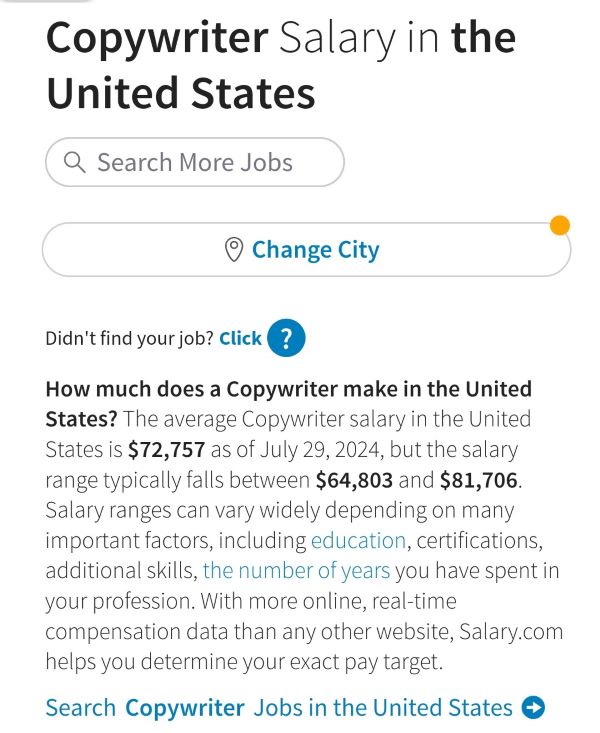
But let’s look at actual data, shall we?

Here’s what Salary.com has to say about the average salary for a copywriter in the U.S. as of July 2024.

screenshot of salary.com web page showing copywriter salaries

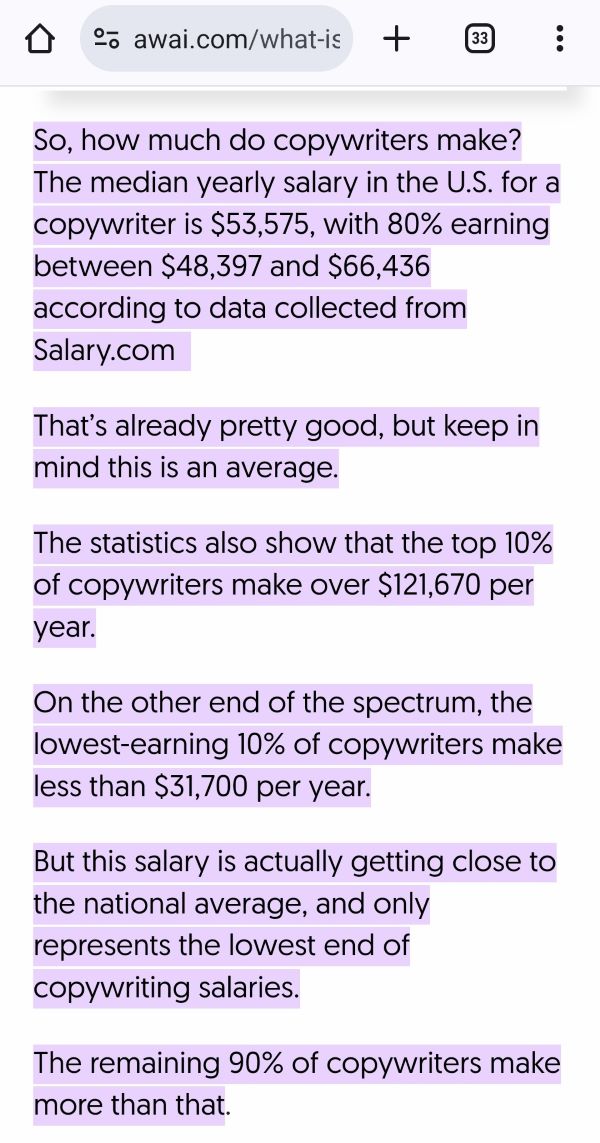
Here’s what the American Writers & Artists Institute (AWAI) has to say.

screenshot of AWAI's copywriting salary page

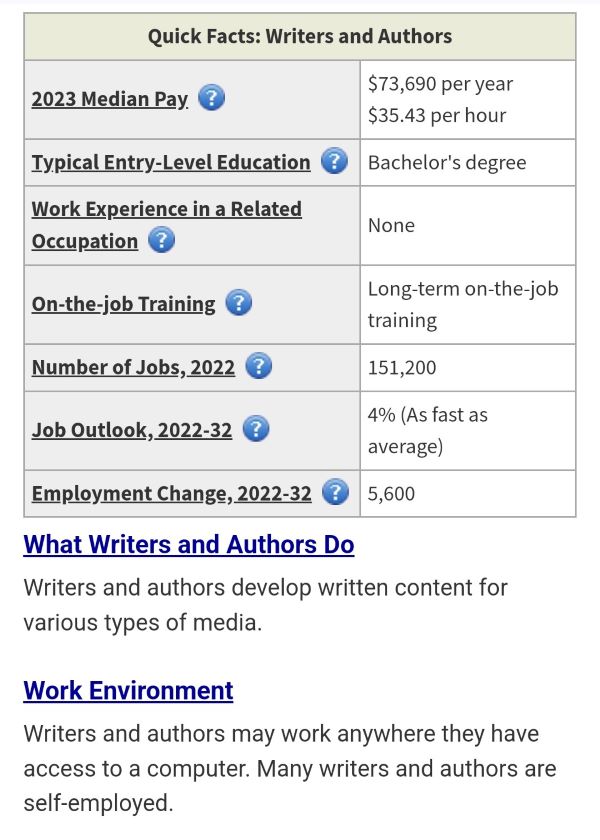
And here’s what The United States Bureau of Labor Statistics has to say about the job outlook for writers and authors (which includes copywriters, according to its definition).

screenshot of us bureau of labor statistics copywriting page

I can’t speak to averages in other countries.

My biggest suggestion if you’re reading this and you’re outside of the U.S. is to network with copywriters, content writers, and marketers in your area (or the nearest major city to where you are).

Yes, one of the nice things about copywriting is that you can do it from anywhere, and it doesn’t matter where the business is located, either. But the reality is often different, right? If English isn’t your first language, you might face challenges breaking into copywriting for US-based businesses. I’m not saying it’s impossible, but it’s an incredibly crowded landscape.

I always advise writers to start local first. How do businesses in your area or your country market themselves? What does the marketing scene look like? Are there any digital marketing agencies in your area? Do the local universities have marketing courses?

Marketing is the big umbrella under which all the various roles—like writers, designers, web developers—often reside, which is why I recommend starting there.

I can only speak about being a copywriter in the US (and one whose first and only language is English).

So, what I’m writing next will be coming from that lens.

If you’re like me and you’re in the U.S. and English is your first language, then keep reading. If not, I highly recommend connecting with copywriters, marketers, etc. in your country. Ask them about their experience, what pitfalls to avoid, and their recommendations for getting started.

Is it hard to become a copywriter? 

Saying whether something is hard or easy to do is somewhat subjective. Also, I think the real question is this: is copywriting hard to learn? And the answer is—like so many things in life—it depends.

Do you love to write? Are you a solid writer? Do you understand punctuation and grammar rules (yes, they do matter) and how and when to break those rules successfully? Do you love to read? (Great writers read widely.)

If you answered yes to the above (and I’m talking an honest yes) AND you’re willing to learn AND you’re realistic about how long it will take to learn AND you’re realistic about how long it might take to drum up work or find a job, then yeah . . . it’s not necessarily “hard.”

Learning copywriting takes effort. It takes time. It takes skill. And starting a freelance copywriting business or finding a full-time copywriting gig will take time and effort, too.

There is no shortage of gurus selling courses on how to become a copywriter and make gobs of money seemingly overnight. And I have no doubt that some unicorns exist. Heck, you could be a unicorn.

But for the rest of us—those who are working a full-time job and transitioning into copywriting, those who are interested in learning copywriting but not sure if they have what it takes, or those who are just a bit slower when it comes to launching into something new—it will take time.

Copywriting isn’t crypto. This isn’t something you just do or play around with (like buying low, selling high, and making a huge profit).

Why?

Because copywriting careers are built on relationships, not transactions.

At least, the long-term careers are.

Yes, there are copywriters out there who are more transaction-focused. They write emails or sales letters selling a product or service and have royalty agreements so they get a cut of every sale. You might see these folks on LinkedIn or YouTube touting how much money they’ve made for clients—and themselves.

It’s one approach to copywriting. The copywriters and content writers I know and follow don’t fall into this camp. (The ones I follow and hang with are more like me, freelancers who work with small businesses and agencies.)

I might sound judgmental of the royalty-based approach, but honestly, I’m not. If someone loves doing royalty-based work, that’s great. There’s a place for all of us copywriters, content writers, and content marketers.

What I do have a problem with is people making it sound like that’s the only way to be a copywriter. There are many ways to be a copywriter—that’s just one of them.

And I’m not suggesting that royalty-based copywriters who focus on emails only or direct mail don’t have relationships with their clients. No doubt, they do—especially the ones who’ve been at it a long time.

My concern is this: For folks just entering the copywriting business . . . I’m seeing too many of them get starry-eyed by the numbers. I’m seeing too many folks enter copywriting because they think it’s a fast and easy way to make good money. That’s more of the transactional, crypto mindset I’m warning against.

It’s not sustainable. That’s my hot take, my two cents. Based on private messages I’ve received from struggling writers who took these courses promising fast and steady success and money—only to discover, it’s not as easy as that or worse: They discover they don’t have the chops because they don’t know the basics of writing. (I could be wrong, but I don’t think the folks selling the courses are vetting who’s taking them . . . like, can you pass a basic punctuation and grammar test?)

How to get into copywriting?

OK, I have strong opinions on this. But they’re just that: opinions. There are many paths to Copywriting Land.

Here’s the thing: Everything you need to know about copywriting is free online. You can absolutely teach yourself. But not everyone has the personality for that autodidactic route. I get it. You want a comprehensive course that teaches you what you need to know so you don’t have to waste endless hours cobbling together your education.

I don’t recommend pouring money into courses straight off the bat.

First, ask yourself if you know how to write. Do you understand grammar rules? Do you know how to punctuate? Yes, editors and tools like Grammarly can help you polish your prose, but unless YOU understand the rules first, those tools can’t save you from yourself. (You can try the free version of Grammarly here. That’s an affiliate link; I’ll earn a small commission if you sign up or buy.)

So be honest with yourself. If you’re struggling with the mechanics, start there. (Those are learnable skills.)

Do you enjoy writing? Being a copywriter is like being back in high school or college when you were assigned a term paper—except now, you have those assignments daily. Does that sound awesome to you? Again, be honest.

I think some folks are lured into the idea of copywriting—the freedom to do it anywhere. The ability to set your own rates if you freelance. The giddiness that comes from the idea that you can make money—and maybe even a lot of money—by putting words on a page.

And yet, some of these folks don’t like writing. They don’t want to do the work.

Copywriting takes work. Period. Full stop.

Yes, even with a good AI assistant. (And that’s all ChatGPT is right now. A good tool and assistant. More on AI below.)

If you love to write and are confident in your writing skills, that is GREAT.

You’re ready to learn. There’s no shortage of online courses (paid and free).

Again, I’m a big believer that you can learn everything you need to know for free—or pretty close to it.

I created a free 14-week introduction to copywriting blueprint. This self-directed “course” covers inbound marketing, content marketing, and copywriting basics. I lay it out, but it’s up to you to execute.

You’ll learn about copywriting tips and techniques, copywriting strategy, and how to write effective marketing copy.

I’m embedding the video below. Click through to the YouTube description so you can see the entire course with all the direct links.

I also recommend two books for your Marketing and Copywriting 101 journey. (I’m using Amazon affiliate links. It won’t cost you more if you buy, but I earn a small commission if you do buy. I only link to stuff I believe in.)

The Copywriter’s Handbook by Robert Bly (Amazon affiliate link)

Using Behavioral Science in Marketing: Drive Customer Action and Loyalty by Prompting Instinctive Responses by Nancy Harhut (Amazon affiliate link)

The first book is the one I turned to when I got started in 2002. Bob Bly is a legend. I moved a couple of years ago, and I lost my copy in the process. So, I bought a new copy this year—the improved and fully updated edition.

And Nancy’s book on behavioral science is a GEM because it’s so comprehensive.

How is AI affecting the copywriting landscape?

Ask 20 copywriters about AI and you’ll get 20 different opinions. The one thing I am confident about is this: No one knows with any certainty how AI will affect the copywriting landscape. Certainty only comes in hindsight.

But here’s my hot take as I answer this question in July 2024.

AI is not new, generally speaking.

But widely accessible large language models (LLMs) are, relatively speaking. ChatGPT was the tipping point because it’s the LLM that everyone started talking about back in late 2022 and early 2023 and started playing around with, even if only to experiment for a day or two.

ChatGPT 4o is an excellent tool for many things except writing original content with an authentic voice (even with training). 🙂 That’s where we’re at with it right now. But I suspect ChatGPT will get better with time.

However, and this is a BIG however, ChatGPT isn’t going to replace all human writers.

Sure, some folks will fall away. Honestly? They probably would have anyway.

But the reason I’m not especially worried about AI coming for me is because effective writing involves thinking. It involves understanding nuance. It involves understanding that sometimes breaking a grammar or punctuation rule makes sense because the writing simply sounds better. ChatGPT’s biggest downfall is that it doesn’t think. Also, it’s not proactive.

For example, ChatGPT won’t be privy to the magical conversations you have with clients when they share a random aside, and you’re like, “THAT would make a great blog post, video, social media post.”

Bottom line: ChatGPT needs humans more than we need it.

That said, ChatGPT is a great tool.

Things ChatGPT does well that can help writers:

  • Analysis. For example, give it three of your client’s competitors’ websites and have it create a short report on themes, keywords, and opportunities.
  • Brainstorming. From blog post titles to email subject lines.
  • Outlining. Short-form and long-form content.
  • Interview prep. I use it to help develop questions to ask subject matter experts.
  • Audience profiles/personas.
  • Transcript review/consolidation.
  • Feedback. Ask it to provide feedback on your writing.

The challenge is that not every business (even the big guys) will necessarily agree or realize that human writers are still needed. They might think all they need is an AI product. I suspect they will learn the hard way that having an AI tool isn’t enough. It’s a hammer. And you still need someone who knows how to wield the hammer. And even more importantly, you need someone who understands what it takes to build a solid house.

Check out my YouTube playlist devoted to my experiences with ChatGPT and AI.

How to get copywriting clients

If you’re just getting started (and the fact you’re reading this article suggests as much), resist the temptation of worrying about how to get copywriting clients or how to build a copywriting portfolio.

You’re not there yet.

And if you put those things above learning what copywriting is, you’ll likely distract and derail yourself.

I’m not saying you need to put these things on pause for years. But I strongly recommend doing the following first:

  • Learning everything you can. Take the time to learn the basics of copywriting, inbound marketing, and digital marketing.
  • Networking. Talk to copywriters in your area and ask them about their experiences, pitfalls to avoid, and what they wished they had known when they were starting out.
  • Practicing your copywriting skills. My 14-week self-directed copywriting course includes copywriting exercises, like writing headlines.

You might even put your skills to work by offering your copywriting services to friends and family. I can almost guarantee that someone you know owns a small business. Practice what you’re learning by offering to write content for that small business owner: a website page, an email, or a LinkedIn profile. What you do can eventually go into your copywriting portfolio.

But again, start by taking a few steps back and learn everything you can. Be a sponge. That’s my recommendation. It’s not the law.

Some folks have a knack for diving into the deep end and doing well with little experience. If that tends to be you, OK. You know yourself best. You might have luck learning about copywriting and building a copywriting business concurrently.

But be honest with yourself. If that’s not you, you might benefit from taking a breath and a few steps back. (And it might feel less overwhelming in the long run.)

When you are ready to take the next step, I have content that can help:

Got more questions about copywriting?

Check out my YouTube channel or read other articles on my blog.

How to Get Copywriting Clients in 2025: Tips for New Copywriters

You’ve done it. You’ve taken the time to learn what copywriting is, and you’ve set realistic expectations about earning potential, especially in the beginning. You’ve hung out your virtual shingle, but now you’re wondering how to get copywriting clients.

I remember those fraught early days (ahem, I mean years) when I was trying to figure out the answer to that question. Plenty of YouTube gurus might have you convinced that all you need to do is take their course and you’ll be writing for brands you love in 30 or 60 days. And who knows? YOU might be a unicorn and have instant success.

But for the rest of us? It’s probably more of a slow burn.

I’m here to tell you that this is normal and to stick with it. It took me five years before I was making an income that could pay the rent. (Here’s how much I made from copywriting in the early days, and here’s how much I made from copywriting in 2023.)

The steps I outline below might seem basic, but I followed many of them to great success.

The key to building a business is consistency. You have to keep at it and focus on doing things that will move you forward rather than the stuff that makes you feel like you’re busy and productive, even though you’re just spinning your wheels.

But I’m getting ahead of myself. Let’s discuss how to get clients when you’re a new freelance copywriter.

How to Get Copywriting Clients in 2025

1. Focus on people you know who own a small business or who know someone who does.

I can almost guarantee that you know someone who owns a small business (and probably more than one person). Or your friends and family know someone.

Here’s the thing: Small businesses need marketing and writing help. Remember, copywriters do so much more than simply write. You must understand marketing, and to successfully compete today, you must be willing to do other things besides writing. Become adept at layout and design using Canva. Become a wiz at keyword research. Learn WordPress.

If you know someone who owns a business, reach out to them. Explain you’ve launched a freelance copywriting business and would love to talk to them or someone in the marketing department. Say this: “Even if you don’t have a need right now for marketing writing, I’d still love to connect.” <<< This is key. Once you start talking to people and they begin to understand the depth and breadth of what you do, you will most likely get some bites.

It might not be buckets of money or big projects that sustain you for months. But I began by doing lots of little projects for small businesses. And the best of those projects went into my copywriting portfolio.

It’s important to give examples of the work you do and to clearly articulate all types of writing you do from websites to emails, social media posts to print ads. Why? Most folks who hear the word “copywriter” don’t know what it means. Even within the world of copywriting, people have vastly different definitions. When it comes to defining copywriting, I tend to take a broad view. To me, it’s any writing that markets a product, service, or cause. Synonyms include content marketer, content writer, marketing writer, and website copywriter (to name just a few).

If the business in question has a marketing manager, ask for an introduction. That’s the person who would assign you a project. If it’s a one-person shop, the goal is to let them know how you can make their life easier with their marketing. Are they having trouble getting out a monthly newsletter? Creating an engaging website? Keeping up a lively social media presence? Let them know those are the sorts of things you can help with, either as one-off projects or ongoing monthly work.

The ultimate goal is to get regular monthly work. If you can blog a couple of times a month for a client and do their email marketing newsletter, that’s a nice piece of work you can count on, month-to-month. From there, build and get other clients who give you similar work each month. Mix in one-off projects as well.

And lest you think focusing on small businesses is a fool’s errand, consider the monthly search volume for these phrases, according to Semrush, my go-to keyword research tool.

  • small business copywriter – 210 searches per month
  • copywriting services for small businesses – 50 searches per month

And that’s just the beginning. Nope, not everyone who searches on those phrases is necessarily looking for a copywriter who can work for small businesses. But I’m willing to bet some are, which brings me to my next point.

2. Optimize your website for copywriting niches.

Lots of copywriters ask if they should focus on a niche. When it comes to your website, I say yes. If you have expertise in a specific area—maybe it’s medical writing, beauty writing, retail, whatever—you can parlay that expertise into paying gigs by optimizing a service page on your website around your area of expertise, aka your niche. This doesn’t mean you have to only focus on this niche. Nor does it mean you have to introduce yourself as a “beauty copywriter” on your home page if you want to expand beyond that area.

But! I’ve seen plenty of hyper-focused searches on “X copywriter” (where “X” is a specific area or specialty, like beauty copywriter or food copywriter) with low competition, meaning you could create a kickass service page on your site about that area. And instead of pounding the virtual pavement trying to figure out how to get copywriting clients, the clients can find you online.

And good news, kittens: I’ve written a juicy post about optimizing your site for copywriting niches.

3. Network, network, network.

You have options. When I first started out, I joined Business Networking International (BNI). BNI is a commitment—it costs a pretty penny to join—but the value is that you’ll be the only copywriter occupying a seat in your chapter. The idea behind BNI is to generate referrals for one another—a “givers gain” philosophy.

PRO TIP #1: Before joining a chapter, visit it (I believe you can do so two times). Every chapter is a little different. You want to get a sense of the vibe—and whether you’d be a good fit.

PRO TIP #2: Look for chapters with complementary colleagues. By that I mean:

  • Web designers
  • Graphic designers
  • Marketing specialists
  • PR consultants

Those folks need writers—and writers need them. So you create this little power “sphere” of activity where you can bond and help each other out. The web designer who is wooing a prospect can say “I have a great writer who can create SEO copy for you.”

The key to BNI success:

  • Show up. You must attend weekly meetings, often at 7 AM.
  • Do the one-on-one meetings. BNI encourages you to meet one-on-one with people in your chapter so that you can get to know them and their needs—and vice versa.
  • Be willing to serve as a substitute in other chapters. Being active on the sub-circuit means you can expand your reach and visibility even more.
  • Participate in leadership roles. I recommend holding off on this until after you get your bearings, but leadership roles can offer even more opportunities.

Other networking groups:

  • Chambers of Commerce – These often have after-hours meetups and breakfast meetups. The key to maximizing your Chamber membership is making sure you push yourself to take part in these events.
  • Women’s organizations, like Polka Dot Powerhouse
  • College alumni organizations
  • Marketing organizations
  • Meetup groups

4. Keep tabs on marketing firms/agencies.

Many of today’s marketing agencies like to have a stable of freelance copywriters. (And once you prove yourself invaluable, you will quickly rise to the top of their go-to list).

PRO TIP: Look for true firms/agencies, not one-person shops. Check out their careers section. They often list what they’re looking for (and if they’re looking for writers).

Be careful about sending a cold email. If they’re not advertising for freelancers, they might not need them. While it probably won’t hurt to send a polite email, it’s always better if you have some sort of intro. This is where LinkedIn can come in. Look for connections in common and ask for direct intros whenever possible.

A good roundup of agencies that “get” content creation: the HubSpot Solutions Directory.

5. Create relevant alerts on job curation sites that promote freelance work.

The sites below are good places to create a presence and subscribe to relevant job alerts.

Some sites have paid subscriptions, which might be worth trying when you’re starting out (or if you find you have luck with a particular service). The key with these sites? Being the first to pounce on listings. So that adage about the early bird most definitely applies.

6. Make sure you connect with everyone you meet on LinkedIn.

So when you reach out to those business owners, connect with them on LinkedIn. Connect with the marketing managers. Connect with the people you meet when networking. Connect with clients once they officially hire you.

PRO TIP #1: Always send a personal message along with the invite.

PRO TIP #2: Stay in touch. Every quarter, say hi through LinkedIn and remind them you’re there. You’re priming the pump so that when they do need a writer—or they’re talking to someone who does—your name is the first one that pops up. This is a longer-term strategy, but it’s important.

7. Ask happy clients for referrals.

Have you just done work for a client and they loved the results? Ask them for a referral to fellow business owners they know. And/or look at their LinkedIn connections and see if anyone catches your eye. Then, ask for an intro.

8. Get friendly with other like-minded writers.

This might sound counterintuitive. Aren’t “other writers” the competition? No! There is more than enough work out there for everyone—honest. Content makes the online world go round, so there’s no shortage of work. And remember, you’re just one person and there are just so many hours in a day.

I regularly have to turn down work (and this isn’t meant to sound boastful, either). So becoming friendly with writers you can refer business to—and who can do the same for you—is another smart strategy for how to get copywriting clients. Keep in mind that everyone brings their own specialties to the table. I’m not keen on financial writing, but I have two friends/colleagues who are awesome in this area, so I refer to them. (And they have both referred to me.)

A word about content farms/content mills . . .

Should you work for content farms? The short answer is (like so many things in life): It depends. My biggest beef with content farms is the incredibly low pay (we’re talking pennies per word), which devalues the important work writers do.

That said . . .  when you’re starting out, and you’re trying to drum up examples to include in your copywriting portfolio, working for a content farm *could* be a way to get clips and to learn how to work quickly without losing accuracy. My general advice: It’s OK to do it in the short term and/or to have it be one piece of your revenue mix. At some point, you’ll outgrow the farm, and that’s OK—and a good goal to strive for.

On a similar note, DON’T fall into the trap of working for only one or two clients. Diversification is critical. If one client goes silent (or worse—out of business), you’ll be in trouble and scrambling. But if you have a diverse roster of clients and one goes down, you won’t be in panic mode. Yes, you’ll look to fill the open spot, but you won’t be struggling to pay the rent.

Are you new to copywriting? Here are my go-to resources for learning the ins and outs.

I use Amazon Affiliate links. If you use one of the links to buy something, it won’t cost you more, but I’ll earn a small commission. I only recommend stuff that I believe in. I own both of these books.

How to Start a Copywriting Business: Beginner Tutorial

So, you’re wondering how to start a copywriting business. Groovy! Step right in, and I’ll share what I know based on my 20+ years working as a freelance copywriter.

Here’s what I’ll be covering. Feel free to click on the links and jump around.

WAIT! Are you sure you want to be a freelance copywriter?

Listen, I get it. The idea of being a writer sounds romantic: Tapping away on your keyboard at a corner café whilst drinking espresso, writing from anywhere on the planet, crafting copy for brands you love and who adore you back, and making six figures to boot? DIVINE.

And don’t get me wrong: I do see the occasional freelancer writing from a Paris café and talking about their six-figure income.

But the reality is most of us work from a spare bedroom, in the basement, or at the dining room table surrounded by bills, pets, and other humans while wearing yoga pants, emptying the dishwasher, and folding clothes in between Zoom calls with clients.

As for how much “most” copywriters make? Sure, some are in that vaulted six-figure territory. But most of them didn’t get there overnight or within six months or a year.

The rest of us hang out in the average arena, including me. (Here’s how much I made from copywriting in 2023.)

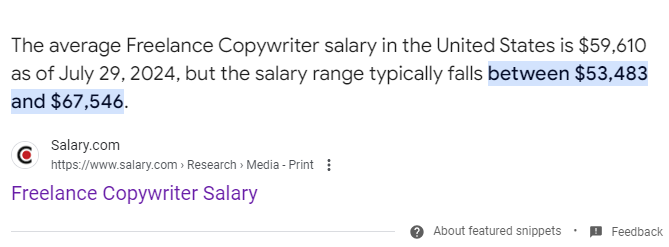
See the featured snippet below from Salary.com.

Featured snippet from Salary.com citing the average salary for a freelance copywriter in July 2024: $59,610.

Too often, I see people considering freelance copywriting because of the romantic vision or the promise of six figures rather than asking themselves, “Hey, do I actually like writing?” and “Am I any good at writing?”

If you want to make a successful go at running a freelance copywriting business, YOU MUST LOVE WRITING.

There’s no getting around this. You either love writing. Or you don’t.

If you were that kid in high school or college who loved getting assigned term papers, that’s a good sign. Because being a copywriter basically feels like you always have a term paper due. All the time. 52 weeks. Even during the summer.

So, be honest with yourself. If you don’t love writing but you’re intrigued by some of the things you’ve been hearing about copywriting and content writing, know this: There are still plenty of other jobs in the digital marketing realm that are creative and fun and allow you to work remotely.

WAIT! Are you sure you’re ready to be a freelance copywriter?

OK, so let’s say you love writing.

YAY!

But are you any good at it?

Again, be honest with yourself.

Do you know in your gut your writing is solid? Have people other than your mother, lover, or best friend told you you’re a good writer? Have you written in some professional capacity? Maybe as part of a past job (even if your job title wasn’t “writer”)?

Listen to your gut. You should know if you have writing chops or not.

OK, so what if you love to write, but your skills are a bit rusty?

Good news! Writing is a learnable skill. Some folks come to the table with natural talent. Others have to work hard at learning the mechanics of grammar and punctuation. (And yes, you need to know those things. You can’t break the rules until you understand what the rules are.)

Here’s the thing: If you love to write but your writing skills need work, stop, drop, and roll toward your nearest resource and shore up on the fundamentals before you worry about starting a copywriting business.

Here’s a good place to check out: The Purdue Online Writing Lab (OWL), particularly these sections:

The Purdue “OWL,” as it’s known, is world-famous, and it’s my favorite price: FREE.

In terms of physical resources (books!), here are my recommendations.

Note: I use affiliate links for some of them. If you use one of the links to buy something, it won’t cost you more, but I’ll earn a small commission. I only recommend stuff that I believe in.

A Writer’s Reference by Diana Hacker and Nancy Sommers. (Amazon affiliate link.) I have the fifth edition, which is excellent. I’m thinking about upgrading to the 10th. Hacker was incredible. She died in 2004, but her memory lives on.

Dreyer’s English: An Utterly Correct Guide to Clarity and Style by Benjamin Dreyer. (Amazon affiliate link.) Another gem. I gave this one to Mr. Word Nerd.

OK, so what if you’re a solid writer, but you know zero, zilch, nada about copywriting or content writing?

Good news there as well. Copywriting and content writing are learnable skills, too.

And even better? Everything you need to learn to be a good copywriter and content writer is available online for free. (Or for books you can borrow from your local library.) There are also some good paid courses out there.

Be wary of copywriting gurus who tout their courses that promise to teach how to learn copywriting in 30 days. I have no doubt these courses work for some people.

But most folks need a slower pace.

That’s why I created a 14-week “course” on teaching yourself the basics of copywriting, content writing, and digital marketing. Click on the YouTube description to access all the materials.

I also recommend two books for new copywriters.

Again, I’m using Amazon affiliate links. It won’t cost you more if you buy, but I earn a small commission if you do buy. I only link to stuff I believe in. I own both of these as well.

The Copywriter’s Handbook by Robert Bly (Amazon affiliate link)

Using Behavioral Science in Marketing: Drive Customer Action and Loyalty by Prompting Instinctive Responses by Nancy Harhut (Amazon affiliate link)

The first book is the one I turned to when I got started in 2002. Bob Bly is a legend. I moved a couple of years ago, and I lost my copy in the process. So, I bought a new copy this year—the improved and fully updated edition.

And Nancy’s book on behavioral science is a GEM because it’s so comprehensive.

What is involved in copywriting?

I use the phrases “copywriting” and “content writing” interchangeably simply because the lines between them have blurred over the last twenty years.

Simply put, copywriting is any writing that sells a product, service, or cause. That’s the ultimate goal. But the “selling” aspect can be extremely subtle, depending on what the writer is drafting. For example, an educational blog post for people doing research about a problem isn’t going to scream, “Buy now.”

But if the content is truly helpful and engaging, the hope is the person reading it will stick around and read another article. And another. And follow the brand on social media. Or download a piece of content or subscribe to receive updates. Over time, the person might convert into a sale. But it all began with that blog post that a writer wrote. Whether you call the writer a copywriter or content writer is irrelevant.

Cranky critics will tell you that content writing is all about engaging, and copywriting is all about selling. Here’s the thing: All writing must be “engaging.” (Otherwise, what’s the point?) The content writer engages the reader in the hope that someday they’ll become a customer, client, subscriber, voter, whatever.

Smart writers understand that different pieces of content have different goals. That blog post I mentioned earlier? The goal is to educate. That sales email trying to upsell an existing customer? The goal is to get the sale, so I’d use more persuasive tactics as a result. But both pieces must engage first. Good writers use multiple tools from a comprehensive toolbox to get the job done, not just one tool, like a hammer.

As a freelance copywriter (content writer), I create the following:

  • Blog posts
  • Social media posts
  • Content editorial calendars
  • Sales decks
  • Sales emails
  • Marketing emails
  • White papers
  • Guides
  • eBooks
  • Print collateral
  • Radio spots
  • Case studies/customer stories
  • Brand and messaging exercises

That’s not an exhaustive list, either.

Still with me? Feeling excited by all the different types of content you’d be working on?

Keep reading.

WAIT! Are you sure you’re ready to be a business owner?

Being a freelance copywriter involves more than just writing. You’re a business owner, which means you’re responsible for things like marketing, contributing to retirement, and paying taxes, just to name a few items.

You must also . . .

  • Be good at managing your time.
  • Be good at managing finances.
  • Be good at managing multiple projects at once.
  • Get comfortable with networking and marketing yourself.
  • Know how to hustle.
  • Be smart about protecting yourself and your business
  • Be flexible. Digital marketing has evolved considerably since I entered the game in 2002. And now, with artificial intelligence (AI) like ChatGPT, who knows how much will change in the next one, three, or five years?

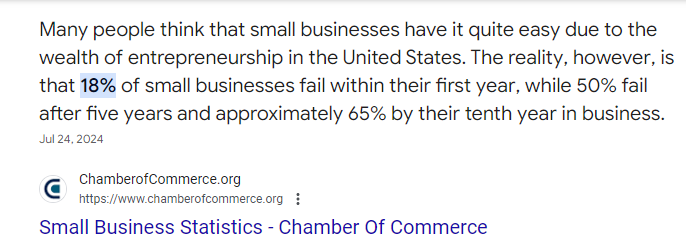
Running a small business and being your own boss isn’t for everyone. Consider this featured snippet from the U.S. Chamber of Commerce.

Featured snippet that says, "18% of small businesses fail within their first year, while 50% fail after five years and approximately 65% by their tenth year in business."


Keep in mind that you don’t need to freelance “to be” a copywriter, either. Some might argue it makes more sense to work as an employed, W-2 copywriter or related role first before striking out on your own. Why? You’ll develop connections, get experience, and get those all-important portfolio pieces, too.

Again, there’s no right or wrong answer here. You must decide what’s best for you.

How did I become a freelance copywriter?

I’ve always wanted to be a writer. Writing fiction was (and still is) my dream. I took a detour during my senior year of college and worked for a Boston radio station for several years. My final role was promotions director. During my radio tenure, I learned a lot about marketing and marketing writing.

When I left radio, I decided to focus on freelance copywriting, figuring that could pay the bills while I worked on The Great American Novel.

It wasn’t nearly as neat and tidy as that last sentence makes it sound. When I started my copywriting business in 2002, I cobbled together my existence by juggling a bunch of things: part-time radio work, teaching, copywriting, and even working as an activities assistant in a nursing home for a short stretch.

It took me five years before I made a full-time income doing only copywriting. I’d do a lot of things differently if I had to do it all over, of course.

How to start a copywriting business

OK, so you’ve figured out that copywriting is for you—and that you have the necessary skills to write effective marketing copy.

Now, you’re wondering about the next step: how to start a copywriting business.

Disclaimer: I’m not a lawyer or an accountant, so whenever I talk about money or taxes, think of it as general information rather than specific guidance. Also! I’m based outside of Boston, Mass. I can only offer my perspective based on my experience in the U.S. Your mileage will vary depending on where you are, but the ideas below should provide a good springboard.

Make sure you have enough financial padding while you get your business off the ground.

Nothing is more stressful than trying to build a business with one eye on a dwindling bank account. Starting a freelance copywriting business isn’t expensive, but making it financially viable takes time.

So, you’ll need something to fill the gap, like . . .

  • A supportive spouse/partner or family that covers living expenses while you build your business (that’s what I did—I moved back home with my folks and stayed there for seven years)
  • Savings to cover expenses for the next six to nine months (or, if you want to be more conservative, call it a year)
  • A part-time job or other side hustle. I also did this! I continued working in radio on the weekends and holidays, and I taught for a couple of years.


Determine how much you’re willing to invest in getting your copywriting business off the ground.

This is beyond the financial padding I mentioned above.

Listen. Starting a freelance copywriting business is one of the most economical businesses you can start. You don’t have employees and payroll. You don’t have a physical storefront (so no rent, utilities, etc.). You don’t need a lot of fancy equipment.

But you will need to budget for some things, like . . .

  • Computer (including a backup, ideally)
  • Email/Internet
  • Insurance (like professional liability, disability, and possibly health, depending on your situation)
  • Software like Microsoft Office, Dropbox, Grammarly, Zoom, and Canva (you might not need all of those items, and you can find and use free alternatives, like Google Docs)
  • Legal fees (at the outset for things like creating your contract—more on this below)
  • Bookkeeping/accounting services

My point: You need some sort of operating budget. You absolutely can start your copywriting business on a shoestring budget, but you will have some one-off expenses and ongoing monthly expenses.

Decide if you’ll operate as a sole proprietor or limited liability company (LLC).

Many freelancers start out as sole proprietors. That’s what I did, but I would definitely do things differently now.

If I were launching a freelance copywriting business today, I’d launch as an LLC, and here’s why: An LLC can better protect your personal assets. If you’re sued for, say, copyright infringement, your business assets would be in play, but not your personal assets, like your car or home.

(Note: I became an LLC in 2023.)

Other benefits of being an LLC:

  • Some potential clients might see you as more professional or legitimate.
  • Some businesses might only be able to work with LLCs, not sole proprietors (I’ve seen instances of this).

The good news is that becoming an LLC isn’t a heavy lift:

  • You register as an LLC through your state (there’s a filing fee).
  • Report beneficial ownership information to the U.S. Treasury. THIS IS A NEW REQUIREMENT. It’s a one-time thing (and it doesn’t cost anything), but if you create an LLC, you have a short window for reporting this info, and penalties are stiff if you don’t.
  • You file an “annual report ” each year, which sounds a lot more daunting than it is—it essentially just confirms that you’re still operating as an LLC.
  • Sole proprietors and single-member LLCs (which is what freelancers usually opt for) are treated the same way in the eyes of the IRS in terms of taxes.
  • If you’re a single-member LLC, the way you keep your books, pay yourself, and all that stuff stays the same.

The protection an LLC offers is worth it, IMO. We live in a litigious society, and in the age of (even more) claims of copyright infringement and plagiarism, you’ll have peace of mind knowing your personal assets aren’t up for grabs.

AGAIN: I’m not a lawyer or an accountant. The above is merely meant to be educational in nature, not financial or legal advice. Always consult a professional about your circumstances.

Here’s a good article from NerdWallet on how to choose between being a sole proprietor and an LLC.

Think through your sales process.

Your sales process will be fluid, especially in the beginning. But! You should think through the items below.

How are you going to charge clients? (This ties in closely with how much you want to make.)

I recommend using project quotes instead of hourly or per-word rates. A project quote communicates value rather than something that’s simply transactional.

What do I mean by value? The content you create for clients continues working for them long after you’ve cashed your check. There’s an inherent value in blog posts, white papers, website content, etc.

Plus, with project quotes, everyone knows where they stand, and you won’t get penalized for becoming faster and more efficient, which will happen organically over time or the longer you work with clients.

Need more guidance? Here’s my in-depth post on how to charge for copywriting services.

What about your copywriting contract?

Always have a contract. Here’s the thing: If you want a contract that’s going to hold up in court, you need a lawyer to ensure you’ve got all that magical legalese in there.

I know, I KNOW.

You’re a writer. Can’t you write a straightforward contract that will just “work” if both people sign it?

You’d be surprised at what you’ll miss.

And resist googling “what to include in a freelancer contract.” You will not know who wrote the contract or how well it will work for your situation.

It’s much better to use a lawyer, and this doesn’t need to be a big expense (but it will cost something).

How will you invoice?

Hint: It doesn’t need to be fancy. You can even download my freelancer invoice template if that helps.

Should you focus on a niche?

You’ll find no shortage of opinions, and the reality is, there’s no right or wrong answer—only what’s right for you. What to keep in mind as you noodle:

If you have natural expertise or knowledge of a certain industry, focusing on a niche might be one way to drum up business. For example, if you have a medical background—maybe you worked as a nurse or medical assistant—you could focus on medical writing (or make that one of your service offerings). If you have an engineering degree, you might have success doing technical writing or writing for engineering or manufacturing firms. You get the idea. Lean into your strengths.

The other benefit of focusing on a niche: You might be able to bring targeted traffic into your website. I wrote a blog post on copywriting niches (the post includes a video that demonstrates my thinking).

Choose a business name.

Sounds so simple, but you need a name, a brand identity, something to hang your hat on. We could go down a rabbit hole about strategies for naming a business.

For your purposes, I wouldn’t overthink it. For solo professionals like writers, using your name—or a version of it with the word “writer” or “copywriter”—is a good strategy.

EXAMPLE: Copywriting By Stewie

Register a corresponding domain name.

You’re going to need a website (more on this below). And you’ll need a custom domain for that website. The custom domain should correspond with your business name (as best it can).

EXAMPLE: www.CopywritingByStewie.com

Don’t stress too much if you can’t get a dot-com. People are used to seeing other extensions, like dot-biz or dot-us. So www.CopyWritingByStewie.biz would be perfectly OK.

Create a website.

I know, I know. This probably feels like the most daunting step of all! But you need a website. It serves as your storefront. Prospective clients can find you via search engines. Or they will go to your site to check out your credentials after you approach them (at a networking event, for example).

Your initial site can be simple. Basic. You don’t necessarily need to hire a web designer if your budget doesn’t allow for that. You can use a budget-friendly or free website builder to get the initial job done. Just make sure it allows you to have a CUSTOM domain. (Like CopywritingByStewie.com.) Most don’t.

But I found a great article that lists six options, including one that was new to me: Google Sites.

What pages should your copywriting website include?

  • Home
  • About
  • Portfolio
  • Contact
  • Blog*
  • Terms of service/privacy policy – I’m a big fan of plug-and-play products that stay updated when the laws change (which is often). I use Termageddon.

Regarding search engine optimization (SEO).

If you’re not familiar with SEO, that’s OK, but get cozy with it SOON. SEO is the heart and soul of effective online marketing. The best place I can send you is HubSpot: The Ultimate Guide to SEO. That link will explain EVERYTHING you need to know about SEO. Bookmark it, revisit it, and study it.

Bottom line: You need to optimize your website so that Google can easily find it, index it, and serve it up for relevant searches. If you have only a four-page site, you’ll need to find four kickass phrases to focus on (one for each page). (Here’s a link that highlights free keyword tools.)

To blog or not to blog? That is the question.

Blogging benefits include the following:

  • You can show off your writing chops.
  • You can show off your marketing expertise.
  • You can optimize a blog post for a keyword phrase, which gives your site more ranking opportunities.
  • Writing thoroughly about a topic can solidify your understanding of marketing topics.

The biggest blogging con is the time commitment: You need to commit to it. This doesn’t necessarily mean publishing a blog post every day or even every week. But once or twice a month is a must.

Your home page doesn’t need to be complicated.

Keep it personal, conversational, and error-free. Make it more about the prospective client reading the site than about you. Talk about how you can make their life easier by supplying clear, compelling copy for all their marketing needs.

Your About page should be about you. 

This is the place to talk about yourself. Highlight your background and skills. Let your personality shine through. Include a picture. I like keeping things fun and light. A headshot of your smiling face is a must. (Using your phone to take the pic is fine. Just make sure the lighting is good.) Add candid shots to further show who you are and your personality.

Here are tips for About page copywriting.

Your portfolio page proves your ability as a copywriter.

This is where you show off your mad copywriting skills. Link to stuff you’ve written. If a prospect lands on your site, they want to see evidence that you know what you’re doing.

If you’re a new copywriter, I realize this is a chicken and egg conundrum. If you’re just starting a business, you likely don’t have a lot of client work, but there are ways to get clips quickly.

  • Do you have great writing examples from a previous job? Did you write anything for your previous employer’s website, social media platforms, or email newsletter? Take screenshots and upload them. (I recommend only showcasing public-facing items unless you receive permission from your former employer to share something else, like an internal presentation you put together.)
  • Do you have a friend who owns a business? Offer to write a blog post and/or web page for free and add the links to your portfolio.
  • Do you have a local charity you’re involved with? Many local charities need marketing help. Offer to rewrite their home page or any printed collateral.

Worst-case scenario: Create your own examples. “Here’s an example of a series of emails promoting a webinar about X.” Once you start working for clients, you’ll swap in real clips and remove the examples.

I’ve done several YouTube videos about copywriting portfolios:

Your contact page should offer multiple ways to get in touch.

Offer an email address. Ideally, avoid using a Gmail or Hotmail address or anything like that. You want it to be related to your domain name. So Stewie@StewartCopywritingServices.com instead of @gmail.com

Why? Perception. You’ll come across as a legit business. Here are tips on how to write a good Contact page.

In terms of what social media channels to include on your Contact page/website footer, you don’t need to include those unless you have an active, relevant, and professional presence on places like Facebook, Instagram, TikTok, and so forth.

The one exception is LinkedIn. I recommend having a strong LinkedIn profile and including a link to it from your site. It’s another place for prospective clients to check you out. And LI has the benefit of showing common connections and endorsements.

Here’s a primer on how to create a compelling LinkedIn profile.

Do you need a logo?

No, you don’t need one. If you want one, that’s a different story. You might be able to get an acceptable logo done on a shoestring budget from a place like Fiverr. Or if you have a contact—maybe a friend/relative is a graphic designer or dabbles enough to be dangerous—you could go that route. Or if you yourself have any design chops, you could play around with making one.

Again, it’s easy to get lost in the weeds when starting a copywriting business. A logo is not going to make or break your business at this point—and it might be an unnecessary expense or distraction.

At some point, once your business starts gaining traction and you’re feeling confident that you’re in it for the long term, you can always revisit the logo question—and the custom web design question. I DO think there’s value in going with a professional web designer (here’s the web design firm I use) when the time is right and you have the money to invest.

One final thought on developing a copywriting website (for now)

This goes without saying, but grammar and punctuation matter BIG time on your website. Sure, typos happen and are a part of life. But it’s worth having another set of competent eyes proof the main pages of your site.

Open a business bank account.

Don’t wait until you’re making a lot of money to do this. If you’re serious about starting a copywriting business, open a business bank account ASAP.

Why? To keep business and personal expenses separate. This will make tax time much, much easier. You will likely have some clients who will want to pay you electronically as well, and it’s much more professional to be using a business bank account.

When shopping for a business bank account, be mindful of fees. Get a business debit card and pay all business-related expenses with it.

Why? It makes recordkeeping easier since you’ll get monthly itemized bank statements. Keep all receipts anyway (especially if you pay for anything with cash). But the monthly statement will save you a lot of grief.

My business and personal accounts are with the same bank, which makes things super easy. The bank has a user-friendly online portal. I easily transfer funds from my business account to my personal account every month. This is called an “owner’s draw.”

Note: If you’re an LLC, you’ll be required to get a business bank account.

Mind your business Ps and Qs.

File a business certificate (or its equivalent) with your town or city, if needed.

Not everyone does this. In fact, I’m the only person I know who does it.

But I suffer from Big Catholic guilt and always follow the rules. 🙂

Google “business certificate” and your city/town’s name to see what it requires.

Consider getting disability insurance and professional liability insurance.

You might not need disability insurance as you’re launching your copywriting business. But if you’re able to make a true go of this and you’re bringing in regular scratch, consider getting disability insurance. If something happens to you that affects your ability to work for a stretch (like a car accident), disability insurance can be a good financial bridge. Check out the Freelancers Union, which is free to join. It offers robust insurance options (disability is among them).

Professional liability (also known as errors and omissions) is one that a lot of writers carry. If someone mounts a copyright infringement claim (whether it’s bogus or not), you still need to defend yourself, and legal fees can add up quickly. I use BiBERK from Berkshire Hathaway.

How to start a copywriting business: More tips

Get thee a writing machine.

Obviously, you’re going to need a computer, laptop, and/or tablet. This is where the writing happens. If you can swing it, I highly recommend having two machines and making them mirror images of each other. Meaning if you’re working on a Word doc on one machine, it will automatically sync to the other. This way, if one machine goes down—which will happen at some point—you don’t miss a beat. You simply switch to the other machine. I also recommend building in redundancies. I save things to the cloud, but I also have two external hard drives, one for each machine.

Invest in reliable Internet.

Along the same lines, make sure you invest in reliable Internet. This is one area where I don’t recommend skimping because you will notice the difference—and it will likely frustrate you. You need speed and reliability. Again, pay with your business bank card.

Get comfortable with word processing software.

I’m a Microsoft Word girl. I use it 90% of the time. The other 10%, I work in Google Docs. But I always write in Word first before uploading to Google Docs. I use Outlook for email. I use Excel/Google Sheets probably 5% of the time. (Usually for editorial calendars or project plans.) I often need to read PowerPoint presentations, but I rarely create any these days. Your mileage will vary, of course.

That said, the majority of your clients will work in either Word or Google Docs. (You’ll want to make sure you can read and create PDFs, too.) So make sure you’re familiar with popular/common software and that whatever machine you choose can open/work in Word.

Keep good records.

This ties in with the business bank account. You want to make sure you keep records/receipts for all business-related expenses. You should also have a basic profit & loss statement. This includes revenue, cost of goods sold, general expenses, other expenses (think taxes), and net income. Remember my disclaimer at the beginning of the blog post? I’m not an accountant.

Here are some links:

Do you need an accountant/bookkeeper right away?

Like so many things in life, it depends. I’ve used one since the beginning. Once you’re making money, you’ll need to pay quarterly taxes, and an accountant can help forecast the estimates, answer questions, and the like.

One thing to keep in mind as you decide whether to use an accountant or to do everything on your own: Consider what your time is worth.

Let’s say you spend 10 hours doing your taxes. But let’s say your internal hourly rate with clients is $65/hour. (Note: The word “internal” is key here—I don’t recommend giving clients hourly rates, only project quotes. Still, you need to have an internal sense of what an hour of your time is worth to you.) So, let’s say your accountant charges you $500 to prepare your taxes. It takes you ten hours (essentially, $650 worth of your time). You can see it makes more economic sense to pay someone else to do your taxes while you use those ten hours working for a client.

Again, your mileage will vary. Figure out what works for you.

More quick Q&As about how to start a copywriting business

  • Do you need a printer? I have one and hardly use it.
  • Do you need a fax machine? It isn’t 1995. You don’t need a fax machine. When I started, I used eFax, but I canceled the account a few years ago.
  • Business cards. I do have ’em. I can’t remember the last time I handed one out. But as you start your copywriting business, you’ll likely be doing much more networking. So get some business cards. Don’t overthink it. VistaPrint and Moo offer budget-friendly options.
  • Office supplies. Basics only. One of the nice things about a copywriting business is the low overhead. If you’re going to spend money anywhere, put it towards a good chair. You’ll be spending a lot of time in it!

Note: I’m assuming you have a smartphone, but I know what they say about assumptions. You need a phone. I use my cell as my business phone. I also have a landline that I use when talking to clients or interviewing subject matter experts because I find the sound quality better, and a landline is more reliable. This is my own preference. You don’t necessarily need a landline.

Embrace the mess and the unknown.

Starting a new business is messy. Just when you think you have all your duckies lined up, you’ll be thrown a curve ball. It happens to all of us. KEEP GOING.

Is this an exhaustive list of how to start a copywriting business?

Nope! But sometimes the hardest part about getting started is simply getting started. My goal here was to provide actionable items that you can tackle. If you do all of the above, you’ll be in good shape—and then you can build/adjust from there.

Got questions? Drop me a line.