The Story Behind My Copywriting Business Name: What Copywriters Can Learn From It

My copywriting business name is E.T. Robbins Productions LLC.

Where the heck did that come from?

Well, I’m about to tell you.

Or if you prefer watching a video, here you go.

It all began circa 1982.

Yes, kids. We’re talking decades ago in simpler times before smartphones, social media, and streaming. I was a wee lass of nine. I’m the youngest in my family and closer in age to some of my nieces and nephews, like Jason and Tesha.

I was nine or so, and Jason was two and Tesha was right behind him.

They had a hard time wrapping their little tongues around “Aunty Robyn.”

They said “E.T. Robbins.”

In my tween wisdom, I declared that E. T. Robbins would be my pen name when I grew up.

Because by this time, I knew I wanted “to be” a writer.

I’m not sure why a nom de plume held such allure.

But it did.

And it lasted!

Then what?

Fast forward twenty years. I’d done some stringing for my hometown newspaper under E.T. Robbins. I wrote an article for the Globe once, and I tried using my pen name, but they rightly informed me that they didn’t allow that. Makes sense, of course. I think that experience helped me transition to using my real name for bylines moving forward (even if the publication allowed pen names).

I decided to use E.T. Robbins Productions for my copywriting business name.

Why did I add the word “Productions”? To sound cool? More professional? Bigger than I was? I was coming from a seven-year stint in radio, so I think I envisioned doing voice-over work in addition to writing. So the word “productions” felt all-encompassing.

But yeah . . . it was a little confusing, especially in the early days when I networked and handed out business cards. (I can’t remember the last time I handed out a business card, although I do have them.)

(Interestingly enough, my author website is robynbradley.com.)

The evolution of my copywriting business name over 20+ years.

When I revamped my copywriting website a few years ago, my web designer (hi Jeff!) and I discussed my business name and logo at length. Should I change it? We decided to keep the name and the domain, but we shifted the emphasis from E.T. Robbins Productions to Robyn Bradley in the logo and throughout the site. I think the logo, the contact page/footers, and now this blog post are the only places I say the name.

But! Plot twist! I formed an LLC earlier this year, so now my official business name is E.T. Robbins Productions LLC. And because I’ve made this shift, I need to keep it somewhat prominent.

I usually joke that how I named my business is a lesson in how NOT to come up with a copywriting business name.

A few years ago, I made this crack to a prospect after explaining the name’s origin. The prospect surprised me and said he disagreed because the story behind my business name was interesting and memorable.

I’d never thought of it that way, but since then, other folks have said similar things.

It helps that it’s not a long story to tell. It’s easy to explain and for people to understand. And it usually elicits a chuckle or smile.

But I still find the name kind of clunky, especially when I have to give someone my email address over the phone or in person: robyn at etrobbins dot com. I often default to my author email or my Gmail address for ease.

I do sometimes wonder if I’ve lost potential clicks when my site appears in SERPs (search engine results pages). The name is meaningless if you simply see etrobbins.com. Of course, I strive to have good page titles and meta descriptions, but still.

So what can new copywriters learn from my story as they come up with a copywriting business name?

  • If you’re just starting out and you’re simply a party of one, your copywriting business name won’t likely make or break you. Yes, branding matters. And sure, a business name is often a core part of a brand’s identity. Think Google, Microsft, Dropbox, and Nike. But you’re not Google, Microsoft, Dropbox, or Nike, right? My point: Don’t agonize over this decision. Yes, you need a name. But if you’re stuck, go with the obvious: your own name. That’s what many copywriters do, and it works just fine.
  • If you’ve secured your name (or some version of it) as a domain, you can use that for your website. And it can be the building block for a potential copywriting business name. For example, if you’re Jane Smith, and you’ve registered JaneSmith.com, you could use that for your business website. Your business name could be something simple like Jane Smith, Copywriter. Or Jane Smith.
  • If your name isn’t available as a clean [FIRST NAME][LASTNAME].com, try modifying it and seeing if that name is available. Like JaneSmithWriter.com. Or JaneSmithCopywriter.com or JaneSmithCopy.com Again, the domain doesn’t have to be your business name. You could still use Jane Smith as your business name.
  • Do consider registering relevant domain extensions. For example, if JaneSmith.net and JaneSmith.biz are available, you might want to snag them just to avoid someone else scooping them up and creating confusion.
  • Be careful when trying to develop a clever name. I tend to see two types of copywriting business names. The first involves the writer’s name. The second is usually something more creative, clever, or punny, like The Hired Pens. I think The Hired Pens is a great name. It’s clear what the company does. But coming up with clever ain’t always easy. And one person’s “clever” might read as corny or cliche to someone else. I’m not saying you should avoid coming up with something clever. Just think it through. AND MAKE SURE YOU GOOGLE THE HECK OUT OF IT BEFORE COMMITTING. You might think you’ve come up with the Best. Name. Ever. Chances are (very) good that some other writer is using it. Being clever and creative is what we writers do!
  • Remember, nothing is forever. You can always change your business name. I’m not saying it’s an easy decision . . . or that it would be easy to do, depending on how long you’ve been in business. But it’s doable.

Two resources to check out to guide you as you name your copywriting business.

  • I recently discovered this AI tool to help you name your copywriting business. I’m not suggesting you use whatever it spits out. But it might be fun to play around with. It could get your creative juices flowing.
  • Check out the Fritinancy blog, especially the sidebar items under Naming 101. LOTS of excellent advice. And the woman behind this blog, Nancy Friedman, has a website, too. She offers a low-cost way to get advice on naming a business. (I haven’t used the service, but I do know a company that used her for naming a product, based on my mentioning her to them . . . and they loved her process.)

Got a Question for the Copy Bitch?

That’s me! I’m the Copy Bitch. Contact me or visit my YouTube channel and leave a comment on one of my videos. I might make a blog post or video with the answer.


What Does a Website Copywriter Do?

I recently discussed what a copywriter does, but now let’s drill down into some categories: What does a website copywriter do?

If you’d prefer watching a video, here you go. Otherwise, scroll past it for All. The. Words.

First, what is website copywriting?

Website copywriting is exactly as it sounds: You’re writing the words that appear on websites. In this case, we’re talking about company websites. Go to any business website and look at all the pages. Someone had to write those words, right? And that someone is often a professional copywriter.

I say “often” because not every business website under the sun was written by a pro. The business owner might have penned their own site. This is especially true for small businesses that are a party of one. But when a company gets big enough, they’ll often outsource the copywriting to a writer or to a web design firm or marketing firm (and those firms will either have writers on staff, or they’ll outsource to someone like me).

Do all copywriters do website copywriting?

It’s hard to be a successful copywriter today if you don’t have any website copywriting skills. Just about all businesses have an online presence. The company website typically serves as the main hub.

That said, I’m sure there are copywriters out there who only do, say, email marketing or long-form direct response copywriting for printed sales letters. But I suspect those folks are exceptions and not the rule.

Isn’t website copywriting just . . . copywriting?

Not when you add the words “search engine optimization” or SEO to the mix. I’d argue that all website copywriting is (or should be) called SEO copywriting. Because you want to optimize a company’s website for search. You want to attract people who are already searching on phrases related to your client’s products or services.

Of course, as I write this blog post in May 2023, we’re possibly in the midst of a seismic shift in how search is going to work moving forward. Yes, I’m talking about ChatGPT, Bard, and Google unveiling Search Generative Experience (SGE).

So moving forward, good website copywriters will likely be thinking about SEO and SGE . . . and whatever else we have to think about to keep up with how people search . . . and how search engines deliver results to search queries.

OK, so let’s get back to the question: What does a website copywriter do?

A good website copywriter will write compelling, optimized copy that draws in targeted traffic and helps you turn that traffic into leads and eventually customers.

Website copywriters will draft optimized copy for things like . . .

  • Home pages
  • Landing pages
  • Calls-to-action (CTAs)
  • Robust “About Us” sections
  • Product/Service pages

You get the idea.

But before they get to the writing, a good website copywriter will . . .

  • Have an in-depth discovery call with the client
  • Study the client’s target personas
  • Review competitors’ sites
  • Review and analyze the current website (if there is one) and all related marketing materials
  • Collaborate with the designer, marketing manager, and other key decision-makers
  • Do keyword research/analysis

That’s not an exhaustive list, either.

A good website copywriter will also keep up with SEO trends and SGE (see above).

So there you have it. Hopefully, this gives you a good sense of what a website copywriter does.

Got a Question for the Copy Bitch?

That’s me! I’m the Copy Bitch. Contact me or visit my YouTube channel and leave a comment on one of my videos. I might make a blog post or video with the answer.

How to Brainstorm Content Ideas without Hurting Your Noggin

One of my specialties is coming up with ideas. I’m never at a loss, whether in my copywriting life or fiction-writing life. The problem is never a lack of ideas. It’s a lack of time to do something with all the ideas. (And, of course, not all ideas are good ideas. But that’s a subject for another time.) Not everyone is like me, though, and that’s OK. Some truly gifted writers struggle to come up with ideas, which is precisely why I’m writing this blog post on how to brainstorm content ideas without hurting your noggin.

Below, I provide ways to get those creative juices flowing so that you’ll be pumping out ideas in no time.

If you learn better by watching a video, here you go. Otherwise, keep scrolling.

1. How to brainstorm content ideas: Turn to Google.

Yes, I’m starting with the obvious. If you have a topic, go to Google, plug in a question about the topic, and see what comes up in the various hot spots, as I call ’em. (Or if you want to get all formal about it, the featured snippets.)

If you’ve ever plugged a question into Google, you no doubt encountered the “people also ask” box. That’s a rich source of content ideas (and keyword-rich ones, too, which are great for blog posts).

2. Use your keyword research tool.

Plugging in a main keyword phrase (what’s known as a seed keyword) will bring up plenty of other keyword phrases. And depending on the tool, you can continue drilling down from there. One of the things I love about Semrush, which is the keyword tool I use, is that it generates keyword-rich “optimization” ideas for me. It even regularly sends me emails with new ideas.

3. Visit Quora or Reddit

Both Quora and Reddit are underused by copywriters, and yet both have a treasure trove of info. Type in a topic, and bam! I guarantee you’ll find threads on the topic and a bunch of angles you never considered.

4. Get a little help from your friend ChatGPT or Bard.

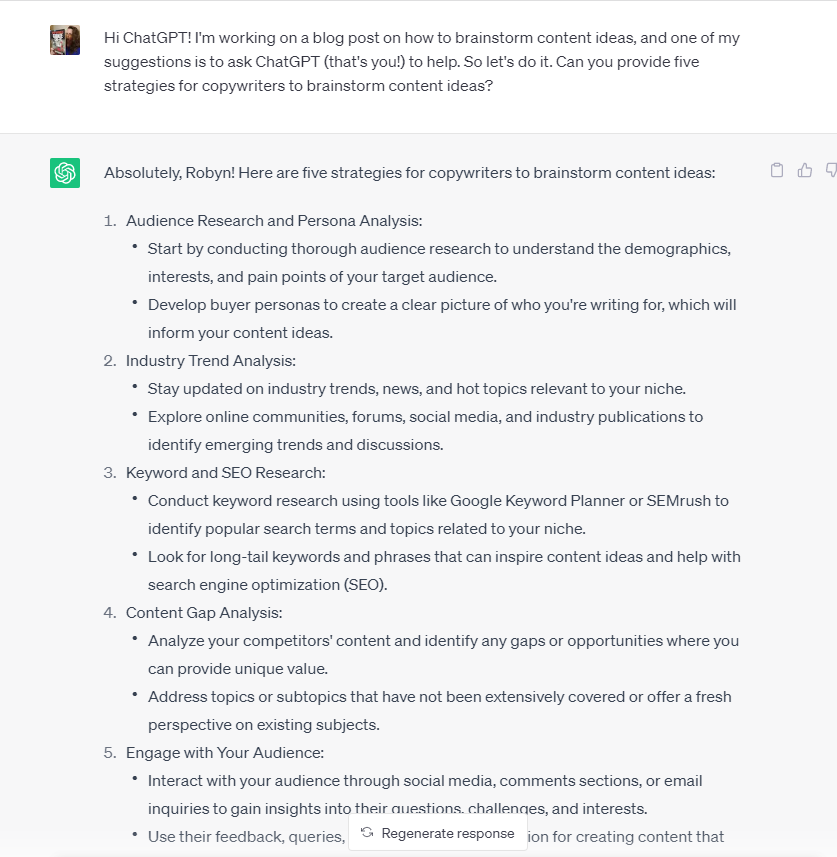
AI is GREAT at brainstorming. I told ChatGPT that I was working on this blog post. Check out my prompt and ChatGPT’s response. (I did this AFTER I’d come up with my ideas for this blog post already. Interestingly enough, we didn’t overlap much beyond the tip about engaging with your audience.)

screenshot of prompt to ChatGPT asking it to come up with 5 strategies for copywriters to brainstorm content ideas. It provides an outline.

5. Pick your client’s brain.

Seriously, they are the keepers of great content ideas. They just don’t always realize it because they’re too close to what they do. Always remind them that if they hear the same questions from prospects and customers, the questions would make a great springboard for a piece of content. This is especially important if your client has a sales team. Make sure you have access to the head salesperson so you can pick their brain, too.

6. Survey your client’s audience.

You want to write content that resonates with your client’s specific audience. So why not ask the audience what content they need? OK, so you might not be THAT direct. It’s not like you’re going to run a survey asking what four blog posts they want to read next. But conducting occasional surveys to see what’s on customers’ minds can be a treasure trove for content ideas (among other things).

7. Read reviews. (And not just for your client.)

Reading reviews will reveal what’s on people’s minds, why they chose to buy from your client, what the experience was like, what they love about the product or service . . . or not. This is great intel for the entire marketing team, but you’re likely to find content gems buried in the good, the bad, and the ugly. And ditto on competitors’ reviews.

8. Check out social media.

For platforms driven by hashtags, do searches on relevant hashtags and see what people are talking about, posting, and sharing. For example, let’s say I was writing a blog post about Women’s Health Month, which is May. I might do a search on that topic and relevant hashtags. From there, I could create a quick curated blog post on “Our Six Favorite TikToks Celebrating Women’s Health Month.” That could be a fun blog post for the urology practice I blog for.

9. How to brainstorm content ideas: Develop content around holidays and monthly designations.

That brings up another idea I use. Holidays and monthly designations. Going back to my urology client, we do lots of themed content, like Prostate Cancer Awareness Month and the other March Madness . . . no I don’t mean basketball. I mean vasectomy season. (If you know, you know.)

Got a Question for the Copy Bitch?

That’s me! I’m the Copy Bitch. Contact me or visit my YouTube channel and leave a comment on one of my videos. I might make a blog post or video with the answer.

How to Write Good Contact Us Pages

Before we talk about how to write good contact us pages, let’s consider my experience with one that stunk up the joint.

This was from a few years ago, but I remember it well. I was referred to a business, so I went to its website. The home page was professional-looking with clear navigation. It had three boxes for three separate audiences, along with hyperlinked bullet points in each box. So far, so good. I appreciate sites that effectively “talk” to multiple audiences and direct people to where you want them to go next.

But then I went to the Contact Us page.

There was a form. And this line was above the form:

“This contact form is not yet active. Please call 555-555-5555 to contact Great-Biz-With-Crappy-Website at this time.” (And no, there was no email address anywhere on the site.)

Listen, if your contact form doesn’t work, then do this: Take. It. Down. Consider how much business you’re losing. Think of the people who don’t even see your disclaimer line and they go ahead and fill out the form, hit submit, get an error message, and don’t come back. How many people are going to think, “If these guys can’t make their forms work, how the heck are they going to do the job I hire them to do?”

Remember, your website is your virtual storefront. If you went to a store and all its shelves were empty, no one was manning the register, and you kept hitting the little bell thingy to get someone’s attention, but it didn’t work, what would you do?

Right. You’d walk out.

How to write good Contact Us pages

A company’s Contact Us page should never be an afterthought or a place to simply dump phone numbers and a snail mail address. Below, I’ll discuss how to write good Contact Us pages for your clients that will wow them and actually work.

And by “work,” I mean the page copy will inspire people to fill out the form, email, or call.

How to write a Contact Us page: Don’t do it last.

When I tackle website writing projects for clients, I often start with the Contact Us page. Why? The page copy tends to be shorter and hyper-focused.

When you get ready to write this page, start by asking yourself some questions: Why would someone click on Contact Us and subsequently NOT take that action? What’s causing them to hesitate? And what can your words do to help them overcome that hesitation?

It’s a fun challenge. Put yourself in the prospect’s shoes.

  • Are they worried about the cost? You could allay those fears by saying there’s no obligation or that the initial consult is free, for example.
  • Are they worried they haven’t done enough due diligence? Contact pages are a great place to include one of the client’s most powerful testimonials. On other pages, like home pages, I usually encourage the client to have scrolling testimonials. The contact page is a different beast: Put your best one on there—the one that could help persuade that hesitant person to make the call.
  • Are they looking for an email address, but you only give them a phone number or a form? Give people multiple ways to get in touch. Put them in charge. (I discuss this more below.)

How to write good Contact Us pages: Optimize your page for a keyword phrase.

This is especially important if local SEO matters to your business. Like all pages on your website, you want to optimize it for a keyword phrase. Write a compelling headline around the phrase. Resist the temptation to simply have “Contact us.” That’s a wasted opportunity.

After the compelling headline, remind people, with a bit of inspiring copy, WHY someone should contact you.

This serves another purpose. You never know how people will enter your site. It’s possible they could enter your site via the contact page (especially if it’s optimized well). So by having a clear, compelling headline and good copy on “what’s in it for the prospect,” you’re helping to orient the new site visitor.

How to write a Contact Us page: Be mindful of form fields.

As the copywriter, you won’t be building the page or setting up the form, but you can share recommendations on what to include on the form. Different businesses will have different needs. While longer forms do create friction, you’ll likely want to go longer than simply name, email, and phone number. Other landing pages on the site could have super-short forms, but good Contact Us pages are places where you can ask for more details.

My next suggestion will require your client’s cooperation, but I always believe the prospect should be able to choose how they contact a business. If they prefer phone, great. But if they prefer sending an email or filling out a form, that should be allowed as well.

Here’s the challenge: many small businesses aren’t good about monitoring emails or contact forms. So offering choices will ONLY work if the client actually pays attention and monitors all the different modes of contact.

What to put on a Contact Us page: Make it easy for people to connect in other ways and give them compelling reasons to stick around.

For most business websites, the social media icons live in the footer or in the courtesy link area at the top of a website. But the Contact Us page is a great place to highlight them and encourage people to follow.

After someone submits a form, what happens? Ideally, they should receive confirmation that the form went through. From there, it’s a smart practice to include a link or two to helpful content—like an FAQs page—to encourage people to stick around the site.

Do I follow my own advice? YES.

I wouldn’t make recommendations that I don’t follow myself. In the video below, I walk you through my Contact page. You can see how it stacks up against these suggestions. Or you can simply navigate to the contact page itself.

Got a Question for the Copy Bitch?

That’s me! I’m the Copy Bitch. Contact me or visit my YouTube channel and leave a comment on one of my videos. I might make a blog post or video with the answer.

Copywriter Websites: 5 Great Examples to Learn From

One of the most common questions new copywriters have is how to put together a website, including the all-important copywriting portfolio. My advice? Look at other copywriter websites for inspiration, which is exactly what we’re going to do in this blog post.

Below, I’m including screenshots from five different copywriter websites. I’m not affiliated with them, and I don’t know them, either. I think these sites are well done, for various reasons, which I’ll get into. See what you think! I’m also embedding a video at the end from my YouTube channel where I walk through the sites in real time.

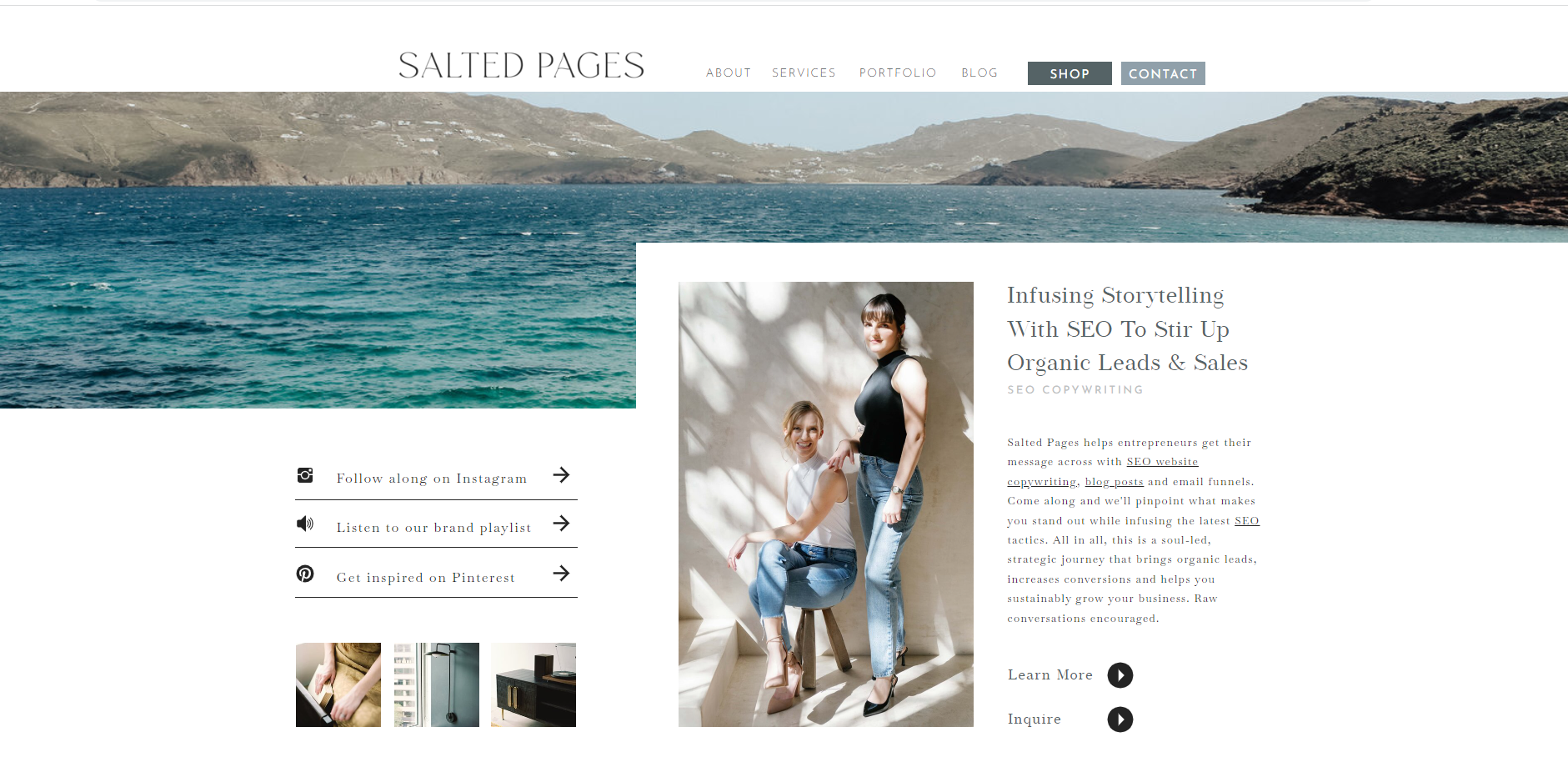
Copywriter Websites: Salted Pages 

website home page for a copywriting agency called Salted Pages. The home page shows an image of the sea in the background and two young-ish white women dressed casually in jeans, along with text about their agency.


I love the feel of the site, which reflects the fun name “Salted Pages.” The headline clearly explains what these women do: “Infusing Storytelling with SEO to Stir Up Organic Leads &Sales.” The whole site feels like a breath of fresh sea air. The copy reflects the sea theme, too. (Packages include Low Tide, Sea Level, and High Tide, for example.) They list prices for copywriting packages, which is interesting. I’d be curious to know how well that works for them.

There are pros and cons to including pricing. The pro: It helps someone self-identify whether they have the budget. The con: You could potentially lose someone who has the budget, but doesn’t understand the value of copywriting—yet. Sometimes you need to have a few discussions with prospects to get them to understand. Then, they might be more willing to accept a quote that they might have otherwise found “pricy.”

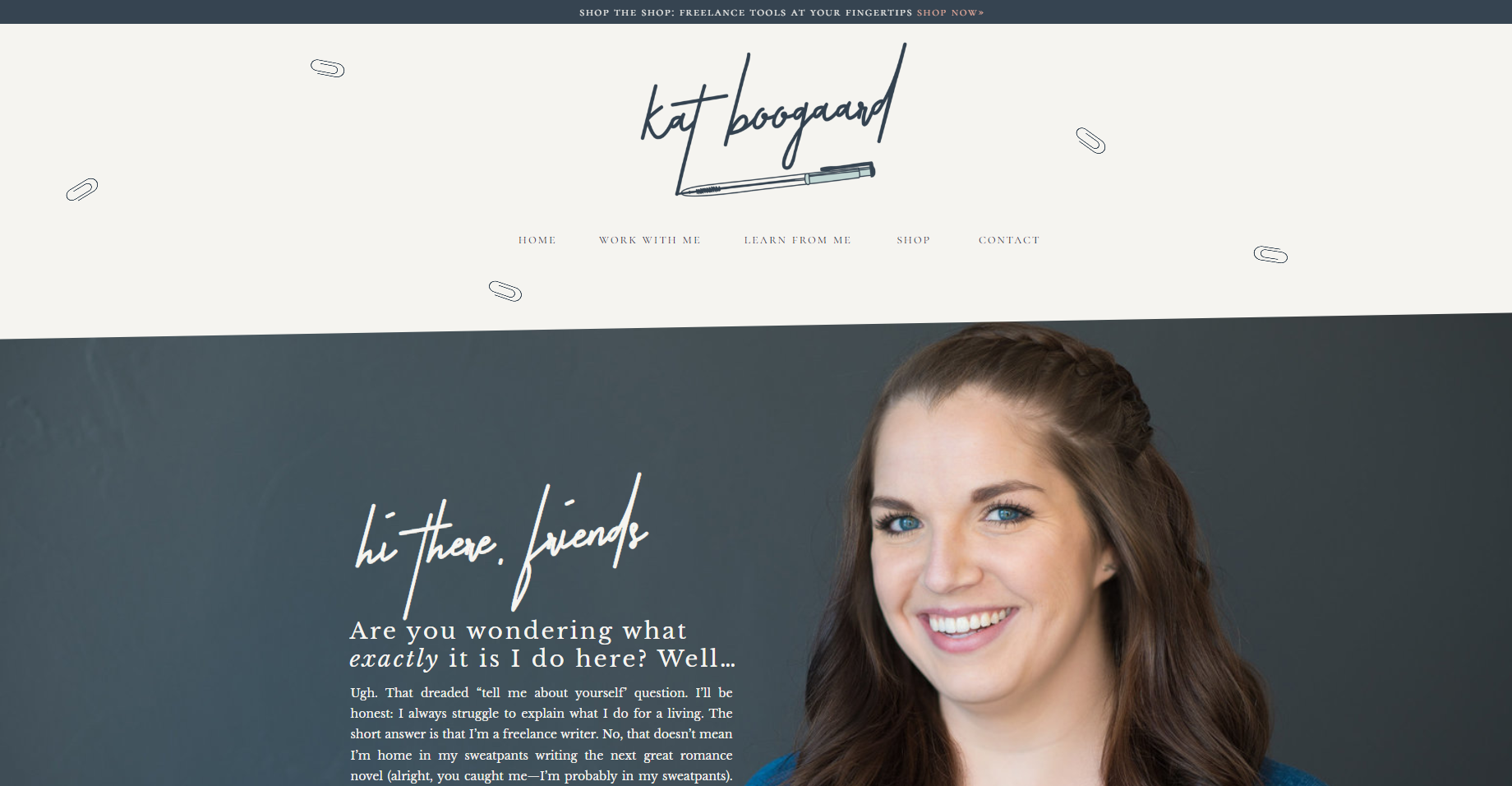
Copywriter Websites: Kat Boogaard

snapshot of home page for copywriter Kat Boogaard. The snapshot shows the headshot of a young-ish white woman with shoulder length brown hair. She is smiling. To the left is text about her and her business. Her logo above says "Kat Boogaard"

Kat is well-known in the copywriting space. She does a lot to help new copywriters thrive. Her website captures her professional work and the work she does on behalf of new writers. The navigation clearly indicates where people need to go if they want to work with her—or learn from her. The writing itself is excellent . . . conversational, friendly, and warm. You truly get a sense of what it would be like to work with her and the writing she’d produce for you.

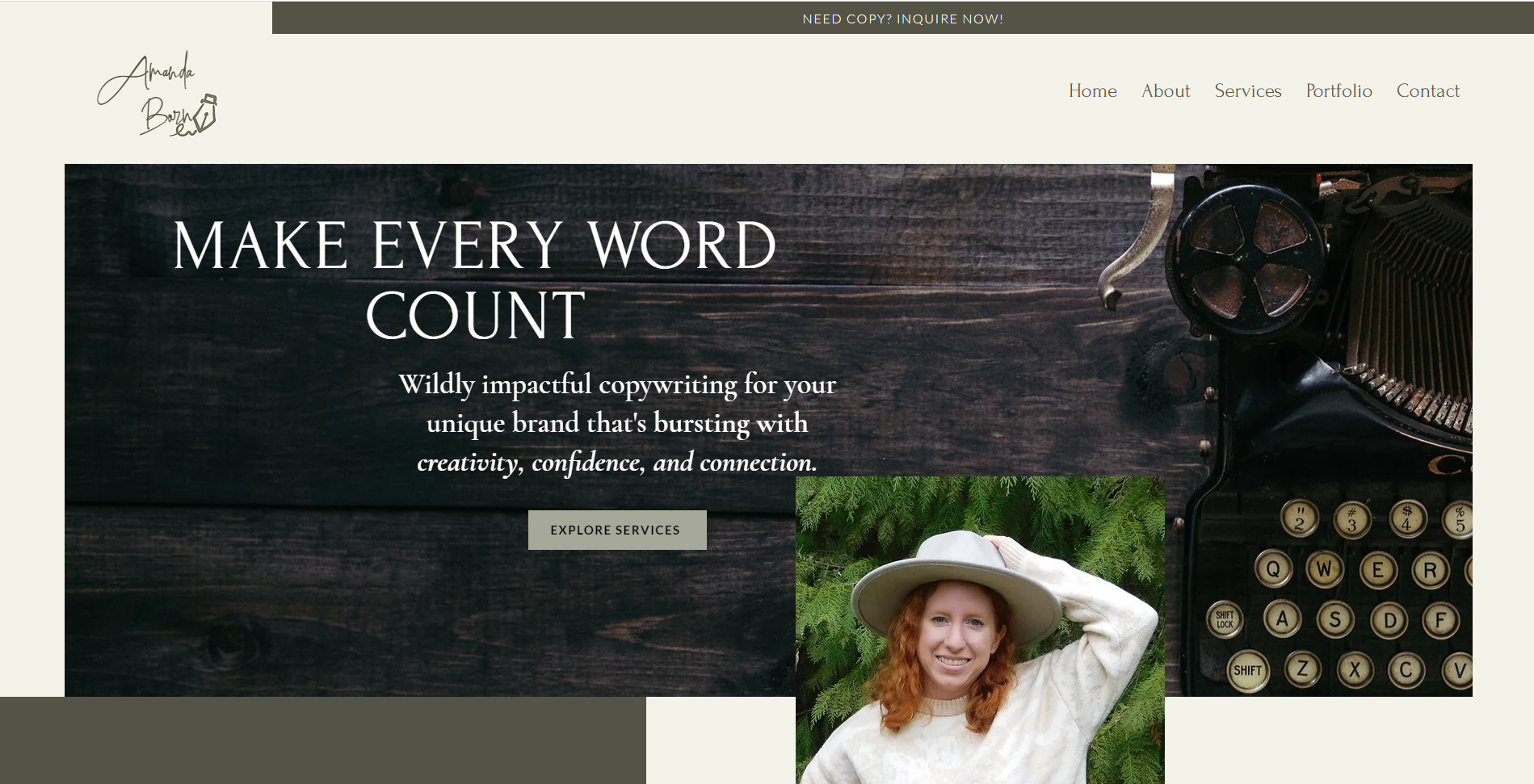
Copywriter Websites: Amanda Born

snapshot of home page for copywriter Amanda Born. The headline read "Make Every Word Count," and it features a shot of Amanda who is youngish white woman with shoulder length red hair. She's wearing a white hat and smiling.

I love the flow of this site—it’s smooth and aesthetically pleasing. It’s not overly complicated. Her contact form is good (so if you’ve been wondering how to address this on your own site, Amanda’s is a good one to study).

I *think* Amanda is a newer copywriter, which is one of the other reasons I’m including her site as an example because it shows how you can have a great site even when you’re just starting out. (I’m gleaning this from her Insta page for her copywriting biz, which looks like she started in January of 2022; also she uses a bunch of spec ad examples in her portfolio, which is absolutely OK. When you’re starting out, you can use copy that you write “on spec” for a brand or fictional company to demonstrate your copywriting chops.)

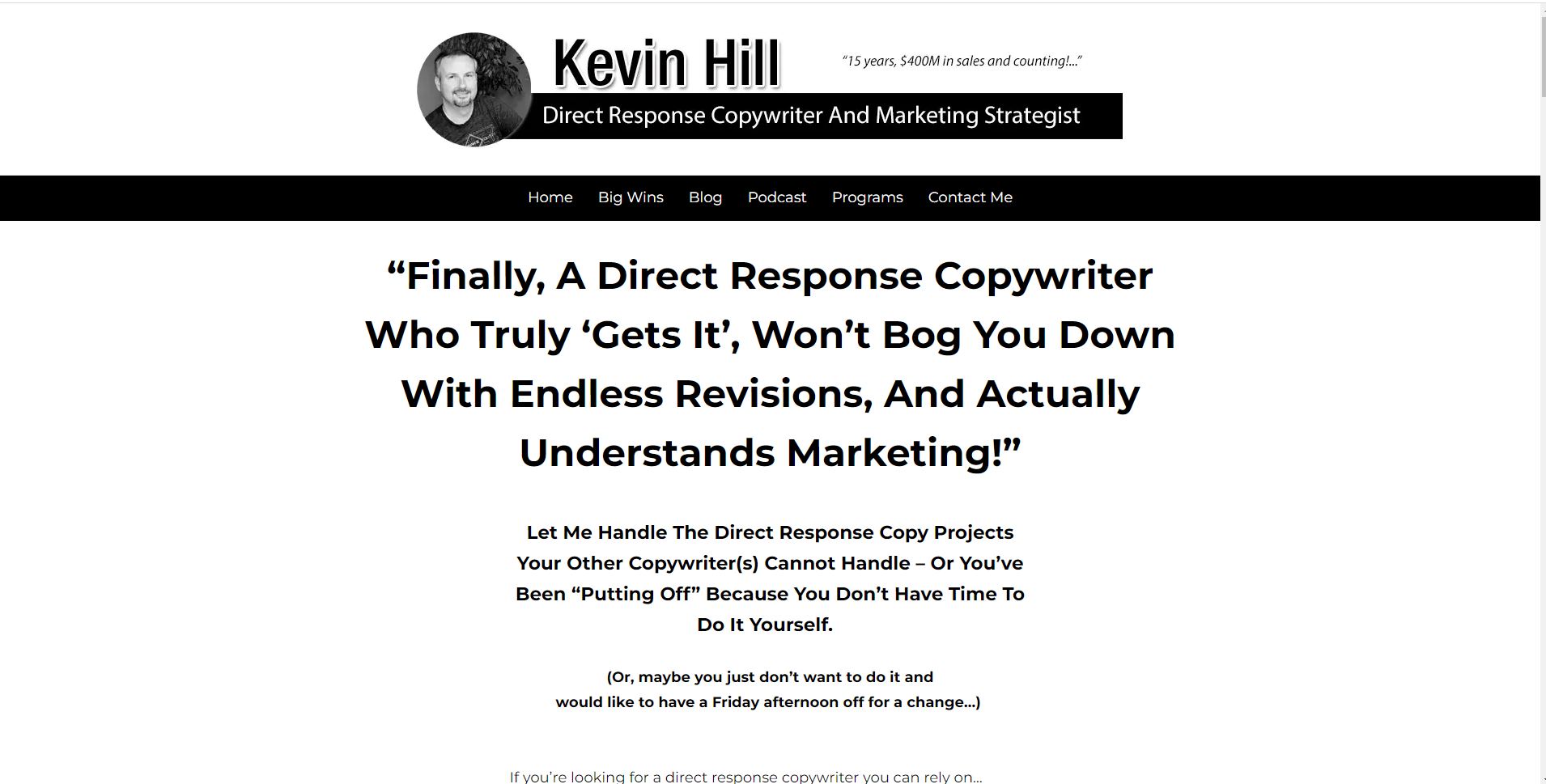
Copywriter Websites: Kevin Hill

snapshot of home page for direct response copywriter kevin hill. The site includes a headshot of a white male in the header area that's part of the logo. The rest is direct response copywriting.

Kevin is a direct response copywriter, and what I LOVE about his site’s home page is that it’s written in the format that copywriters use for direct response—so he demonstrates his ability for this copywriting service right on his own home page.

Direct response copywriting in a nutshell—it’s a type of longer-form copywriting that takes advantage of people’s willingness to scroll if the info is good, with the goal of getting them to ACT NOW. This type of writing is usually very persuasive, starting with the problem the prospect is having and then walking through a solution, social proof, the “deal” that people will get if they choose this solution, compelling calls-to-action peppered throughout, etc. And it’s not just for digital. You’ll find direct-response copywriting techniques used in sales letters. (Have you ever gotten a long sales letter in the mail? I’m talking multi-pages? That’s direct response copywriting at work. Oftentimes, copywriters will earn royalties.)

Anyhow, Kevin’s home page does a brilliant job of showing people he knows exactly how to write engaging long-form copy.

Copywriter Websites: Charlotte Wilkes

snapshot of home page for beauty copywriter Charlotte Wilkes. The page shows the logo in the top left-hand corner, which is her name is script. The headline reads "beauty writer to the aesthetics and skincare industry". To the right, is an image of a profile of a mannequin's face in grayscale

Charlotte is a specific type of copywriter—she writes for the skincare market—and her site makes this immediately clear while reinforcing her own brand. It’s a lovely site, and I imagine it would be extremely appealing and persuasive to a beauty brand looking for a beauty copywriter.

Here’s the video where I walk through the sites.

Definitely watch since I poke around the writers’ copywriting portfolios, too!

Got a Question for the Copy Bitch?

That’s me! I’m the Copy Bitch. Contact me or visit my YouTube channel and leave a comment on one of my videos. I might make a blog post or video with the answer.


What Does a Copywriter Do Exactly?

What does a copywriter do exactly?

Step right up. Below is my “tell it to me like I’m ten” explanation.

Or if you prefer a video, here you go.

What does a copywriter do exactly?

Simply put, we provide the words that sell a product, a service, or a cause.

Let’s illustrate this with an example.

Your clock radio goes off at 6:07 AM, because that’s how you roll, and you hear a commercial for Dunkin. Yes, America runs on Dunkin. You get up out of bed, stumble to the kitchen, and flip on the TV. Yet another commercial is playing, this one for a car. You get ready for work, page through the latest issue of The Week, and pause on a full-page ad for a river cruise that follows Lewis and Clarke’s expedition along the Columbia and Snake Rivers, and you think, “Damn. That would be cool.”

You get in the car, hop on the Mass Pike, and head to work. On the way in, you spot a billboard for the Museum of Science and think it would be good to bring your nieces and nephews there soon.

At work, you futz around online for a bit, checking Facebook, pausing on an ad for Olive & June nail polish. You resist the temptation, but you’re definitely intrigued, along with an ad you see for Lume Deodorant. (If you know, you know.) You check your personal email and see a Groupon with a great deal on a massage and you decide to get it as a gift for your bestie who’s turning 50 soon.

Come lunchtime, you and your coworkers decide you want Indian food, so you do some Googling and click on a new restaurant’s Google Business Profile. The pictures look delish, and the write-up sounds intriguing.

For work, one of your current tasks is researching background check companies so that you can make recommendations to your boss. You find three you really like, based on their websites, their blogs, and their reviews, so you hand that info over to your boss.

As you’re leaving work, you notice someone has tucked flyers under everyone’s windshield wipers in the parking lot. The flyer is advertising a nearby bar’s all-you-can-eat wings every Thursday night.

When you get home, you fetch the mail and notice a direct mailer for a new dentist’s office in town, which you file away as a possibility since your dentist is retiring at the end of the year. You also receive a packet from Mass Audubon and decide to make a donation because you’ve gotten REALLY into birding lately. (No judgment!)

Later that night, in bed, you’re scrolling through Insta and see another ad for Olive & June nail polish, and this time you click over, read the reviews, watch a video, and order. And then you do the same thing for Lume.

OK . . . all of that stuff . . . all of that is an example of copywriting at work.

The words in the radio and TV spots, the Groupon email, the highway billboard, the print ad in the magazine, the social media ads, even the flyer tucked under your windshield wiper . . .  Someone had to write those words.

Not all of the words were necessarily written by a professional writer. But all of the words still qualify as copywriting.

Because repeat after me, kids: Copywriting is writing that’s trying to sell a product, service, or a cause.

So what does a copywriter do exactly?

They wrote the words companies and organizations use to promote or sell their product, service, or cause.

Companies or organizations might hire them as employees. Or they might outsource to them.

Some copywriters, like me, are generalists. We work with a variety of companies, both b2b and b2c, and we write different types of content, like blog posts, websites, print and digital ads, social media posts, emails, a little bit of everything.

Other copywriters might specialize. For example, some might focus only on SEO copywriting. Others might be email copywriters or direct mail copywriters.

Again, what does a copywriter do exactly?

I’ve been working as a freelance copywriter for over twenty years and feel fairly confident I can represent . . .

We sit in our jammies or yoga pants (you know, the days we’re actually wearing pants), and we’ll write blog posts and white papers, landing pages and email campaigns, social media posts and more blogs.

We’ll think about strategy and develop editorial calendars.

We’ll participate in marketing meetings.

We’ll interview subject matter experts for the content we’re writing.

We’ll conduct research, including keyword research for website copy and blogs.

We’ll write.

And revise.

Write some more.

Proofread.

And did I mention writing, writing, and more writing?

We’ll drink coffee.

And Slack colleagues.

We’ll Zoom and Skype clients.

Occasionally we’ll send invoices and reconcile our checking accounts and pay taxes, because we’re running a business here.

And sometimes we’ll even take showers and do laundry.

And some of us have YouTube channels and put on makeup so we can do videos about what a copywriter does exactly.

Very meta.

Got a Question for the Copy Bitch?

That’s me! I’m the Copy Bitch. Contact me or visit my YouTube channel and leave a comment on one of my videos. I might make a blog post or video with the answer.


How to Write a Great Bio for a Website

I recently discussed “About” page copywriting. Website bios are a big part of robust About pages. Often, brands will include bios for key people on the management team, and someone needs to pen those narratives, right? That brings us to the subject of this blog post: How to write a great bio for a website.

You can apply the advice I share below to other “types” of bios for other applications, like LinkedIn or conference speaker bios.

And if you learn better by watching a video, here you go.

What is a bio anyway?

A bio, which is short for “biography,” is just that—it’s a short narrative about a person. “Short” is relative here. Some bios might only be a paragraph or two. Others might be as long as a full page. I rarely see bios that go longer than a page.

A good bio tells a good story. But it doesn’t include every last detail of a person’s life.

Your job is to capture relevant highlights about the person’s life while giving us a sense of who the person is. That last bit isn’t always easy to capture—a person’s essence. And the truth is, not all bios require that. Some bios are very much “just the facts, ma’am.”

It all depends on who the bio is for and how it’s being used.

Why do people need website bios?

Have you ever been on a website and it’s just . . . sparse? And you’re wondering if it’s legit? You go poking around to see if you can find any info on people in the company, and you come up empty. How’d that make you feel? Probably not all that inclined to buy from the business, right?

Website bios lend credibility. Look! There are real people behind this business! Plus, many consumers like to know who they’re doing business with. They’re interested in learning more about the people behind the brand. (This can be true for b2c or b2b companies.)

Website bios and pics can also make it easier for customers and prospects to connect with the person they’re doing business with, like a sales rep or an account manager.

And bios offer an opportunity to glean whether the person has the credentials you’re looking for.

How to write a great bio for a website: What should you include? 

What you include in a website bio is up to the business, the person being written about, and even the writer (if the writer is directing the bios for the entire team).

Usually, website bios include relevant education and credentials, relevant employment, details about the current position, and—ideally—some personal info. “Robyn lives in a suburb of Boston with her faithful plush sloth, Stewart.”

I always encourage clients to have fun with their bios.

Should website bios be written in first or third person?

Like so many things in life, it depends. I’ve written them both ways. It will depend on the business, the people, and the goals.

For the urology practice I write for, I draft the doctors’ website bios in the third person. For this morning radio show consultant, I wrote the bio in the first person. For this mortgage broker, I did a combination of first for the opening of the “About Me” page before transitioning into a bio written in the third person. (And I cheekily made reference to the switch from first person to third.) For my LinkedIn bio, I wrote it in first person—and as you might expect, it’s not the “typical” bio.

I would say this: I think consistency is key. So if you’re writing website bios for 10 people on the same team, it makes sense to choose either first or third person.

Another caveat: If the person has a lot of credentials, awards, etc., it will come across much less braggy if the bio is written in third person.

Is it OK to write your own bio?

People are often very protective of their personal bios, which makes sense. If someone wants to take a stab at writing their bio—or maybe they had a bio at another company and they update it for the new one—I’m OK with this. I’ll always review and fine-tune to make sure the bio is consistent with others in the company.

Some folks, however, hate writing about themselves. Or they’re modest and don’t know how to write about themselves.

And that’s where copywriters come in.

How to write a great bio for a website: Tips for getting the info you need

This is often where the heavy lifting comes into play.

You can . . .

  • Put together a bio “input” form. I do this for one of my clients that’s always adding new people to the team.
  • Conduct interviews via phone/Zoom. Make sure you record.
  • Use a person’s CV/resume. For basic “just the facts, ma’am” bios, this usually provides enough info.

Make sure you have a go-to set of questions that you use as your building block for all bio-input forms. You can customize them for the business and/or person in question.

How to write a great bio for a website: Use these professional bio interview questions to get started.

Here’s the bio-input form I use with one of my clients. (I’ve removed any identifying info.) Feel free to copy and paste and customize it for your bio-writing needs.

I email these instructions and questions to the person I’m writing about.

What I Need from You:
Please provide three short paragraphs about yourself and your work experience. Use the existing bios on our site as a guide. I’ll lightly edit what you send me, as needed, but you’ll get final approval.

If writing isn’t your thing, please thoroughly answer all questions below and I’ll draft a bio for you. (You will get final approval.)

BIO INPUT:

  • Please share your name and title as you’d like to see it appear on the site.
  • Where are you based?
  • Tell me about your role with AWESOME COMPANY—what will you be doing day-to-day, week-to-week?
  • What do you love most about your job with AWESOME COMPANY?
  • Please provide a brief paragraph on your experience: work experience and relevant education. Definitely highlight any relevant experience as it relates to AWESOME COMPANY.
  • You’re at a cocktail party and someone asks you what you do for a living. What do you say?
  • When you’re not working, what do you like to do?
  • What’s something you wish everyone understood about your job, and why AWESOME COMPANY is different/better than its competitors?
  • Please include a link to your LinkedIn profile (and make sure your profile is up to date and has a picture).
  • Anything else you want to make sure I include?

Lightning round
Fill out whatever you’re comfortable with and feel free to add something else:

  • Star Wars, Star Trek, neither:
  • Favorite (food, author, movie, sport – pick/share something):
  • A little-known fact about yourself:
  • How you unwind:
  • Words to live by:

PHOTOGRAPHS:

  • One headshot – you can take it with your phone. Just make sure the lighting is good, the background is plain/solid, and that you shoot from the shoulders (or so) on up. See the website for examples.
  • Three candid shots, at least one of which should be a “you” shot. The other two can also feature you (family photo, childhood photo, you jumping out of a plane), and/or pets, a prized possession (car, boat, piece of art), you get the idea. Something that captures the essence of who you are. Again, see the existing bios on the site for inspiration.

Got a Question for the Copy Bitch?

That’s me! I’m the Copy Bitch. Contact me or visit my YouTube channel and leave a comment on one of my videos. I might make a blog post or video with the answer.

Mother’s Day Email Subject Line Examples [Tips for Copywriters]

For the last few weeks, I’ve been corralling all the Mother’s Day email subject lines that have entered my inbox. Even though the holiday is over as I write this blog post in late May 2023, I’m publishing this blog for two reasons. First, you can apply the tips to other holiday-related email campaigns. Second, it’ll be next Mother’s Day before you know it, which means someone will be searching for ideas. Make sure you scroll down to the video below because I share my screen, show you my collection of Mother’s Day email subject line examples, and discuss what works.

1. You must tread carefully around Mother’s Day marketing.

Thirty years ago, you might have gotten occasional reminders via TV ads or radio spots. But now we’re bombarded with Mom’s Day messaging for weeks leading up to the event thanks to social media.

And here’s the thing: It’s a tough day for many people, for many different reasons.

It’s tough for folks who are . . .

  • Grieving over the recent (or even no-so-recent) death of their mom
  • Dealing with a sick mother
  • Dealing with estrangement
  • Coming to terms with childhood trauma
  • Dealing with a contentious mother-child relationship
  • Struggling with fertility issues
  • Mourning the loss of a child
  • Worrying over a sick child

And that’s an incomplete list.

Companies have taken note. It’s becoming more common for brands to allow people to opt out of Mother’s Day marketing emails. This means the person remains in the main email distribution list, but they won’t get any Mother’s Day-related marketing.

I think this is smart. It shows empathetic marketing.

If you’re doing a lot of email marketing for brands, especially b2c brands, you’ll want to make sure you bring up this point with clients.

2. Mother’s Day isn’t the only holiday that can strike a nerve.

People are sensitive around other holidays, like Valentine’s Day, Father’s Day, and even Christmas.

You obviously can’t please everyone. Nor should you have to pause your email marketing because it might upset some folks. But you need to be mindful (as always) about who you’re marketing to. If you’re a brand that sells primarily to women between 25 and 54, for example, you’ll want to carefully think through your Mother’s Day marketing.

3. Even with opt-out options, you might want to soften your messaging.

I’ve been seeing this more in general and from some clients specifically. They’ll cast a much wider net regarding who their message is aimed at.

You’ve likely encountered examples of this as well, where the messaging talks about “all those who’ve mothered—or who have loved like a mother.” That strikes a nice balance. You’re acknowledging moms, but also acknowledging those with mom-like qualities.

Bottom line: Always be mindful of your marketing messages.

4. Now, let’s look at some Mother’s Day email subject line examples.

In this video, I share my screen—and my inbox.

Also, check out my other blog post on time-sensitive email subject lines.

My two go-to tools:

Got a Question for the Copy Bitch?

That’s me! I’m the Copy Bitch. Contact me or visit my YouTube channel and leave a comment on one of my videos. I might make a blog post or video with the answer.

Copywriter vs Copy Editor: What’s the Difference?

If you’re new to Copywriting Land, you might be wondering what the difference is between a copywriter vs copy editor. I got you!

But first, a disclaimer. For this post, I’m talking about copy editors who work for brands/companies rather than publishing houses or the media. While there’s overlap, a copy editor working for a brand is biased by the fact they work for a company. So that’s a biggie and something you should remember as you read through what I have to say below.

(BTW: Do you learn better by watching a video? Jump to the end for my video on this topic.)

Copywriter vs Copy Editor: One writes the words. The other makes them shine.

As a copywriter, you’re tasked with getting the words down on paper and pixels.

You’ll be writing things like . . .

  • Blog posts
  • White papers
  • Social media posts
  • Website copy
  • Ebooks
  • Video scripts

When it comes to digital marketing, the list is seemingly endless.

A copy editor, on the other hand, will revise a writer’s words for the following:

  • Clarity, quality, and consistency
  • Grammar and punctuation
  • Overall alignment with the brand voice
  • Overall alignment with the brand messaging
  • Alignment with an in-house style guide and other relevant style guides (AP, Chicago, etc.)

Copy editors won’t typically rewrite a piece of content. They’ll lob it back to the writer with their requests for more significant edits.

How they communicate with writers will vary. Some might track their comments in Word. Others might email. Some will get on a call. I find that most copy editors prefer sticking to the source material and making edits and comments on the doc itself.

Copywriter vs Copy Editor: How are they the same? How are they different?

Here are some ways they’re the same:

  • They both care about the final piece.
  • They both care about writing, conveying a message, and communicating clearly.
  • While both tend to be detail-oriented, copy editors will almost always win that battle, hands down. I’m a fast writer. I get things down. Good editing is all about slowing down and taking a breath.

Here are some ways they’re different.

  • Copy editors are usually less concerned with results. The copywriter’s job is to create something that resonates with the target audience and gets them to act. The copy editor’s job is to ensure the message is clear, on brand, and punctuated correctly.
  • Copywriters are usually more familiar with the nuts and bolts of digital marketing. Good copy editors, especially today, must have a basic understanding, but good copywriters must be immersed.

Good editors have a damn fine nose for bullshit.

Copy editors don’t typically fact-check, but this can vary. They might ping the writer if there’s a glaring error—or something that doesn’t make sense. But they’re counting on you, the copywriter, to get the facts right, to use good sources, and to provide proper attribution.

I wouldn’t be surprised if more copy editors run copy through plagiarism checkers. And I won’t be surprised if they soon run copy through AI detectors.

They can’t always prove when a writer makes something up. But they can smell it. There’s a great scene from Season 5 of my all-time favorite show—The Wire—where Gus, the managing editor of a Baltimore newspaper, knows that one of the writers on staff is making stuff up, even though he can’t prove it. (NSFW. If you don’t like raw language, scroll past it.)

All copywriters need copy editors.

Including me! My copy for clients always has several eyes on it. It might not always be a professional editor, although sometimes it is. Even though I’ve been writing professionally for over twenty years, I still need that gut check, that person who’s a little more objective and can correct my messes and save me from myself.

A good editor-writer relationship can be magical.

An analogy I like to use? Think of a good football coach and quarterback. A coach’s job is to help the QB be the best he can be by leaning into strengths and correcting weaknesses. The editor’s job is to see a writer’s strengths and weaknesses and help the writer adjust for both so the writer can perform their best.

Of course, not all of us have editors, which is why it’s important to “get good” at self-editing.

Here are my go-to writing and editing resources. Note: I use affiliate links for some of them. If you buy, it won’t cost you more, but I’ll earn a small commission. I only share stuff I stand by and use.

Got a Question for the Copy Bitch?

That’s me! I’m the Copy Bitch. Contact me or visit my YouTube channel and leave a comment on one of my videos. I might make a blog post or video with the answer.
5 Examples of Time-Sensitive Email Subject Lines

We can’t discuss email marketing without discussing email subject lines. They are a critical component of a campaign’s success or failure. (And some would argue they’re the most critical component.) Below, I’ll be getting into examples of time-sensitive email subject lines.

But first, here’s some helpful info: One of the best people you can follow when it comes to email subject lines (and email marketing in general) is Jay Schwedelson. Here’s a link to his famous “Scoop” newsletter. (You can access back copies as well.) And you can try his free subject line rating tool.

I highly recommend the tool since it will give you a score, show you where you get dinged, and offer other variations to consider.

When it comes to email subject line best practices, the big ones you have to keep in mind are length and tone.

For length, the rule of thumb as I’m writing this now in 2023 is to aim for fewer than 60 characters and no more than eight or nine words.

For tone . . . I wish I could tell you there’s one winning formula. There isn’t. Action-oriented words and verbs tend to work. Clever copy can work, even with businesses you might not expect. But straightforward can work as well. Both b2b and b2c audiences have gotten used to emojis. (Remember, in both cases, a human is receiving your emails, so this isn’t a surprise.) But where you place the emoji can matter. Putting them at the beginning of your subject line rather than the end can have a positive impact.

For now, though, let’s discuss time-sensitive email subject lines.

If something is truly time-sensitive, you’ll want to make sure you’re being super clear. Experiment with words like . . .

  • Hurry
  • Time’s running out
  • Last chance
  • Don’t miss out
  • Final call

Emojis to experiment with include:

  • Hourglass emoji
  • Clock emoji
  • Wide eyes
  • Worried face/surprised face

You get the idea. And I’m riffing here. When you sit down to write email subject lines, you begin like you would any other piece of content. Who’s the audience? What do you want them to do (besides open the email)? Why should they open this email? What’s in it for them? Why should they care? Why does this matter? WHAT’S THE MEANING OF LIFE?

And then encapsulate all of that in fewer than 60 characters.

Fun challenge, right?

Let’s turn it over to me on Zoom below, where I’ll share my screen so I can .  . . 

  • Review five time-sensitive email subject lines plucked straight from my inbox
  • Show you how to use SubjectLine.com
  • Use SubjectLine.com to audit a couple of my subject email lines for a client

Make sure you check out my other blog post on five examples of “We miss you” email subject lines.

Got a question for the Copy Bitch?

That’s me—I’m the Copy Bitch. I have over 20 years of experience as a freelance copywriter and love sharing what I’ve learned. Reach out with a question or leave a question in the comments on one of my YouTube videos.