The most common question new copywriters ask me is how to get copywriting clients. This question is usually followed by whether they should consider focusing on copywriting niches.
I’ve always been wishy-washy about copywriting niches, and here’s why.
I’ve been working successfully as a generalist since 2002. I consider myself a b2b and b2c copywriter who can write about a variety of topics. Over the years, I’ve never gotten the sense that potential clients cared if I worked in a copywriting niche or not.
But the other day, while doing keyword research on copywriting topics, I came across some data that surprised me and forced me to reconsider my stance. I discovered tons of phrases that suggest people are searching for copywriters based on niches and specialties.
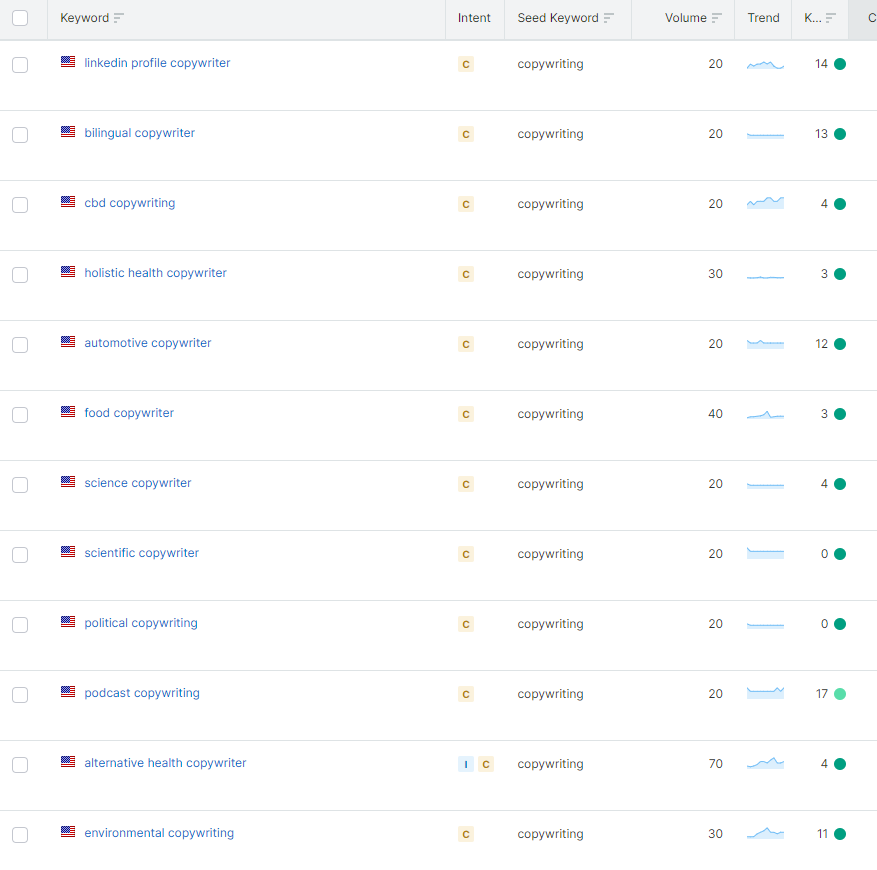
Check out this screenshot from Semrush, which is the keyword tool that I use.
Pay attention to the columns labeled keyword, volume (monthly search volume), and the one that starts with “K” (it got cut off: the full acronym is KD, which stands for keyword difficulty)
The screenshot suggests to me that people are essentially searching for copywriting niches (like food copywriting and science copywriting) in search engines like Google.
This is a very small sampling, too.
Food copywriter
Science copywriter
Holistic health copywriter
Environmental copywriter
The little “I” and “C” next to the search terms stand for “informational” and “commercial.” Semrush is a great tool because it tries to understand the searcher’s intent. Informational means the person doing the search wants information. For example, someone searching on “alternative health copywriter” might want to know what one is or how to become one.
The commercial intent category means people doing the search are investigating brands and services. So, someone searching on “LinkedIn profile copywriter” might be looking for a writer to help them develop their LI profile.
My takeaway: There’s a TON of opportunity here, which suggests focusing on a copywriting niche might make sense.
Newer copywriters could find copywriting niches they’re excited about (and have experience in) that people are searching for. For example, a copywriter could build a page on their site about being a LinkedIn profile copywriter and what their process is like. Sure, it’s a low-volume search term, but with a well-written page (and an overall good site), the page could land on the first page of Google (over time).
Again, the above is a small sampling. There are TONS of niches, like . . .
financial copywriter (110 MSV, 0 KD)
wedding industry copywriter (50 MSV, 2 KD)
insurance copywriter (50 MSV, 6 KD)
(Honestly, if you have any financial chops at all, you could make a go of it being a financial copywriter. I can’t tell you how many prospects I’ve turned away over the years simply because writing for the financial space isn’t something I’m interested in doing.)
How this could play out if you focus on a few copywriting niches:
You could have service pages on your website about the copywriting niches you specialize in. These pages would demonstrate your knowledge and passion for these niches. You could also have blog posts on various spin-off topics that would highlight your knowledge and writing ability.
You could focus your LinkedIn content around these copywriting niches and become a real thought leader in the space. You could also zero in on and engage with brands and businesses that use (or might use) a freelance copywriter in your niche.
If you do a great job optimizing your site around your copywriting niches, you will likely capture some of the related search traffic (over time). And if you do a good job with your site, people who land on it as a result of their search could end up becoming clients. BOOM! That’s more than half the battle right there. When a client comes to you about a project, you don’t need to sell them on who you are. They’re already interested, thanks to what they’ve read on your website.
I can’t emphasize that last point enough: When you cold call or cold email a company, you’re trying to sell them on why they need a copywriter and why they should use you specifically. But when someone comes to you through organic search, you don’t need to sell them. They’ve already bought into the idea of using a copywriter. If they check out your site and get in touch as a result, it’s simply a matter of discussing the project, seeing if you’re a good fit, and providing a quote.
How to discover copywriting niches that people are searching on in Google – a visual tutorial
Below is my video, in which I take a deeper dive and show you exactly what I discovered about copywriting niches.
The search I ran and that you should run to find the perfect copywriting niches to focus on
How to develop spin-off topics for blog posts
A couple of excellent sites that are doing exactly what I’m suggesting here
NOTE: I recommend watching this video on a desktop or laptop, not your phone.
A couple of assumptions:
1. I’m assuming you’ve done your homework and you know what search engine optimization (SEO) is. If you’re serious about making a living as a copywriter, you need to understand SEO. If you haven’t done that work yet, start with this: HubSpot Academy’s SEO Certification Course (it’s free).
Are you new to copywriting? Here are my go-to resources for learning the ins and outs.
I use Amazon Affiliate links. If you use one of the links to buy something, it won’t cost you more, but I’ll earn a small commission. I only recommend stuff that I believe in. I own both of these books.
Have other questions about copywriting niches? Ask the Copy Bitch!
That’s me. I’m the Copy Bitch! I have a YouTube channel for copywriters. You can browse the videos and leave comments. Or you can contact me directly with questions, and I will (hopefully) either update this post and/or record a video that answers your question.
https://etrobbins.com/website/wp-content/uploads/2017/04/robin-bradley-logo-300x105.png00Robyn Bradleyhttps://etrobbins.com/website/wp-content/uploads/2017/04/robin-bradley-logo-300x105.pngRobyn Bradley2023-03-19 13:27:012024-08-31 14:49:48Copywriting Niches: Yes or No? A Smart Way to Decide
Good primary and secondary sources can enrich your content marketing and transform an otherwise mediocre article or blog post into something that’s worth reading.
But what are primary and secondary sources? Is one better than the other?
Why do you need primary and secondary sources in content marketing anyway?
You might be thinking, “Heck, I’m writing a blog post about a long-tail keyword phrase for a client that’s ultimately trying to draw in a prospective customer to buy what the client is selling. Why on earth do I need to worry about sources? This isn’t an eleventh-grade English class; I’m not writing an academic paper.”
That’s all true.
But using reliable, accurate sources lends credibility to what you’re writing. Are you trying to create light fluff with generalizations and hazy stats that sound suspect? Or are you trying to create a compelling piece that educates and inspires action of some kind?
This is the biggest problem I have with AI right now—and why I’m not worried about AI coming for my job as a freelance copywriter. AI technology hasn’t evolved anywhere close to what a human can bring to the table. AI simply scans the vastness of content already in existence and, through complex algorithms, culls what it’s been programmed to deem as relevant and salient—and then it spits out a narrative.
But how reliable is AI? Not very, based on what we’re seeing. Yes, it gets a lot of stuff right. It also gets a lot of stuff wrong. And where the heck is it getting the right stuff and wrong stuff from—that’s the thing you need to ask yourself.
And it’s precisely WHY you always need to cite sources in your blog posts, white papers, and ebooks. As a writer, it’s your responsibility to evaluate said sources before you include them in the first place.
Is the source reputable?
Is the source reliable?
Does the source have an agenda?
If you’re dealing with statistics, are they recent?
Regarding that last bullet point, the definition of “recent” will vary, depending on the topic. For example, health data is a moving target and is often updated regularly. Always aim to find the most recent data and statistics available.
I’m linking to a media bias chart that I encourage you to check out. It provides an excellent starting point for determining what media publications and news outlets you should consider using—and avoiding—when doing research and citing sources.
Remember, using reliable, reputable, accurate sources shows the reader that you’ve done your due diligence.
For example, let’s say someone is searching for information on kidney stones. Maybe they recently had one, and they want to learn ways to prevent a future stone or what to do if they suspect they have another one.
First, they land on a blog post written in the first person where someone talks about their experience with one kidney stone and their “cure” for preventing any subsequent stones from forming. The cure involves a recipe with herbs that the writer says people should drink once a day if they’ve had a kidney stone. There are no stats or sources for this supposed cure.
But in another article, the writer provides official stats on the prevalence of kidney stones (from a reliable source like the National Institutes of Health), tips for foods to eat and avoid (from the National Kidney Foundation), and an interview with a urologist who regularly treats kidney stones and who offers six tips for preventing them.
See the difference?
How do you evaluate a source’s credibility, reliability, and accuracy?
This is not the place to attempt to break new ground. Go with the gold standards. (A caveat is that I’m US-based, so I’m writing this from a specific lens in terms of what are considered reliable, credible, and accurate sources.)
Sources I consider credible, reliable, and accurate:
Pubs and outlets in the middle column (labeled “neutral) in the media bias chart
Official US government statistics and data (e.g., census data, Department of Labor stats on various industries, National Institutes of Health, etc.)
Interviews with true subject matter experts (SMEs) in their field. A urologist is an expert in kidney stones but not brain cancer. And I’m not going to quote SMEs who are considered controversial. During the pandemic, a clutch of MDs had vastly different opinions from the majority of other MDs regarding vaccines. Your job as a copywriter isn’t to stir the pot (unless it is, but that will likely be rare). Again, you don’t want the source you use to get in the way of the information you’re trying to impart.
Other reliable primary sources (more on this in a moment)
Reliable secondary sources (more on this below)
OK, onto the next section!
What is a primary source?
Don’t let the word “primary” fool you. It doesn’t automatically mean “better” than secondary. Think “original” and “first-hand” account when you hear the word primary.
Are original documents primary sources? Yep, original documents are primary sources. Examples: the U.S. Constitution, the Declaration of Independence, the Gettysburg Address
Are letters and diaries primary sources? Yep, original letters and diaries are primary sources. Examples: Letters between John Adams and Thomas Jefferson, letters between John Adams and Abigail Adams, The Diary of Anne Frank, Martin Luther King Jr’s “Letter from a Birmingham Jail”
Are photographs and videos primary sources? Yep, original photos and videos are primary sources. OK, so we live in an age where deep fake videos are a thing, and, of course, it’s easy to manipulate photos. So keep that in mind when looking at contemporary videos and photos. But footage and photos from, say, Woodstock or one of the World Wars—those are all primary sources. The footage people capture of events today on their cell phones is a primary source (think of all the footage we’ve seen over the last several years involving police shootings). Police body cam video would also be a primary source.
Are interviews primary sources? Yes, interviews with people who can provide first-hand or contemporary accounts of an event or topic are considered primary sources. As a copywriter, you’ll likely be interviewing “subject matter experts” or SMEs, as we say in the biz. Your SMEs will often be from your client’s company . . . or a client’s customer (when writing a case study). For example, if you’re doing work for a manufacturing company, you might interview the head engineer about a new product they just released. Or if your client throws a 50th-anniversary party with clients and employees, and you’re writing a blog post about the event, you might interview people who attended the party. Again, they’re giving first-hand accounts of the event. While these sorts of interviews are considered primary sources, you always have to ask yourself if the person you’re interviewing is reliable and credible. Think about it this way: five people can witness the same car accident, and all will have a slightly different “take,” right? That’s why eyewitness accounts, while compelling, aren’t always reliable, even though they are considered primary sources. (And it’s a great example of why “primary” doesn’t automatically mean “better.”)
NERD ALERT: Are you a fan of The Newsroom on HBO? I’m a big Aaron Sorkin fan and love this show. Season 2 deals with this entire topic—primary sources, how you decide if someone is credible, and what happens when a source (or the format it’s presented in) gets manipulated. This is something that’s becoming more problematic in our world, given the rise of deep fake videos.
Is original research considered a primary source? Yep! Again, anyone can produce “research.” You want to look for reputable, reliable research. The gold standard in scientific and academic settings is research published in peer-reviewed journals. And yes, since all research is being conducted by fallible humans, even reputable research in reputable journals can miss at times. Which means mistakes happen. And sometimes research, even in respected places, is retracted. (Here’s a famous example.) So you have to keep that in mind. But my point is if you’re doing an article on vaccines, for example, you’re probably going to want to rely on research from places like JAMA rather than a fringe publication. Unless, again, you’re trying to stir the pot.
Are official statistics and data considered primary sources? Yes, but the keyword is “official.” Anyone can spout a statistic. We see that all the time on social media. “The majority of folks believe X.” OK, well, how is “majority” defined, in this case, and where did the statistic originate from? What was the study? Has it been replicated? Peer-reviewed? And yes—it’s really hard for lay people (including me) without any training in statistics or statistical analysis to look at data and draw accurate conclusions. People spend years in school learning how to do this well.
I rely on places like government sources for data and stats on things related to health, economics, industry stats (for example, the number of truck drivers in the US), and things like that. Another go-to would be The American Cancer Society for all things related to cancer since its stats are always current and reliable.
Another good source for stats on a wide variety of topics is Statista. It describes itself as “the statistics portal for market data” and offers “insights and facts across 170 industries and 150+ countries.” You can access free statistics, but it also has paid options for unlocking even more. I don’t currently pay. I usually find what I need in the free database.
What is a secondary source?
A secondary source is only one step removed from a primary source. It usually relies on and/or refers to the primary source, but it brings in additional insight, interpretation, analysis, research, and commentary.
Primary Source: The Diary of a Young Girl by Anne Frank
Secondary Source: All About Anne by The Anne Frank House
Again, you have to always consider the reliability and credibility of the secondary source. Because anyone can “write” a secondary source. I could write blog posts about Anne Frank. But the secondary source listed above that’s written by the Anne Frank House Museum is a much better source, given the access it has to original materials and the vast knowledge base its curators and people have.
See the difference?
Your writing will likely have a good mix of primary sources and secondary sources.
For most stuff you write, you’ll likely be interviewing subject matter experts (a primary source), referring to official data and stats (primary sources), and rounding out our research with credible secondary sources (like articles about a specific topic).
How to find primary and secondary sources quickly: Here’s my go-to place.
English teachers will cringe at what I’m about to say, but Wikipedia is often my go-to place for doing initial research. I don’t recommend linking to Wikipedia as your source, but Wikipedia is a great place to do research because its articles do a lot of heavy lifting for you, thanks to all the citations within.
If you’ve ever read a piece on Wikipedia, you’ve likely seen the superscript numbers referring to footnotes. Those numbers are hyperlinked. You click on one, and it brings you to the footnote at the bottom of the page, which is where you’ll find the source information—and those are usually hyperlinked as well. So you can often find reliable primary and secondary sources in those footnotes.
Sure, sometimes links are broken. And yes, some articles have better sources than others. But it gives you a great place to start.
Again, you won’t use Wikipedia as your source, with very few exceptions. I know I’ve linked to Wikipedia in my personal blogs. I also remember a client’s blog where I linked to Wikipedia for a non-serious topic. I can’t recall what the topic was, but I do remember highlighting the fact I was deliberately linking to Wikipedia by saying, “According to our good friend Wikipedia . . . ” (or something to that effect).
But 99% of the time, you’re going to want to link to a solid primary or secondary source.
An example of how to use primary and secondary sources
One of my clients does compliance in the transportation space, mainly for trucking companies. For Women’s History Month, the client tasked me with writing a blog post about women truck drivers throughout history.
I started by googling “women truck drivers in history” and “first woman truck driver” and things like that. This brought up some names, including Luella Bates.
Luckily, Luella Bates has a Wikipedia page. Score! From that page, I learned about her, and I got links to truly great primary sources, including clips of articles from 1920 where she was interviewed and quoted. Talk about great color for my piece!
(Again, a newspaper clip where a person is quoted would be considered a primary source.)
For another woman, Lillie Drennan, I couldn’t find a Wikipedia page, but the Texas State Historical Association had a whole page dedicated to her. Drennan was the first woman to hold a commercial driver’s license in Texas. That’s a great example of a reliable secondary source.
When it comes to doing research for content marketing, use your best judgment.
The more blog posts, white papers, ebooks, and other marketing content you write, the faster and more adept you’ll become at conducting research. You’ll get a sense of where to go for certain stats and which publications provide the most reliable and accurate info.
When you’re not sure about something, use your best judgment and always err on the side of caution. If a statistic sounds too good to be true—or you can’t easily find its origins—it probably is too good to be true. Don’t be lazy with your stats. (Says someone who is certain she HAS been lazy at some point in the last 20+ years.) Go find one from a reputable source.
Here are my go-to writing and editing resources.
Note: I use affiliate links for some of them. If you use one of the links to buy something, it won’t cost you more, but I’ll earn a small commission. I only recommend stuff that I believe in.
Grammarly. The free version is great at catching critical errors. I used it for about a year before upgrading to the premium tier, and I’m glad I did.
A Writer’s Reference by Diana Hacker and Nancy Sommers. (Amazon affiliate link.) I have the fifth edition, which is excellent. I’m thinking about upgrading to the 10th. Hacker was incredible. She died in 2004, but her memory lives on. And yes, that’s a Wikipedia link. 🙂
That’s me—I’m the Copy Bitch. 🙂 You can browse through more blog posts, visit my YouTube channel (the video about this particular topic is below), or ask me a question. Contact me or leave a comment on my YouTube channel.
Happy writing!
https://etrobbins.com/website/wp-content/uploads/2017/04/robin-bradley-logo-300x105.png00Robyn Bradleyhttps://etrobbins.com/website/wp-content/uploads/2017/04/robin-bradley-logo-300x105.pngRobyn Bradley2023-03-14 11:14:092024-10-18 07:37:51What Are Primary and Secondary Sources? Content Marketing Tips
Today, we’re going to talk about copywriting exercises for beginners. Many new copywriters will say to me, “I want to do this copywriting thing, but I’ve never written one single bit of copy. How can I practice? What are some good copywriting exercises I can do to develop my skills so that I can feel confident? Are there any good courses or tutorials that I should take?”
These are all great questions, and I do have some ideas. But before we get to them, I’m going to assume that you know how to write well, meaning you’re a competent writer who understands the rules of grammar and punctuation. If you don’t, you can learn those skills, and you should focus on doing that first before you dive into these copywriting exercises and tutorials.
OK, so copywriting exercises for beginners . . .
Below, I’ll share some places where you can learn more about copywriting (and other relevant things, like inbound marketing) as well as some exercises you can do at home. I’m including free certifications as well as paid courses. Note: I’ve only done HubSpot Academy (which is free). But I’ve heard good things about the others. These aren’t endorsements. ALWAYS do your own due diligence.
HubSpot Academy
If you’re a regular reader of my blog, you’ve likely heard me talk about HubSpot. HubSpot is a SaaS company that makes all-in-one marketing software, CRMs, and sales tools. HubSpot made the term “inbound marketing” famous, and it’s the go-to choice for companies large and small.
If you’re not familiar with HubSpot, fix this ASAP. Check out its resources. It offers definitive guides on things like SEO, content marketing, and the like.
Both courses clock in under four hours each, so you could conceivably finish them in a weekend. You’ll get badges that you can display on your website, email signature, and LinkedIn page.
Copyblogger & AWAI
Copyblogger is another excellent resource. They have paid courses, which I suspect means you might have the benefit of a set of eyes on the work (great for getting feedback). Same thing with AWAI (American Writers and Artists Institute).
Note: My understanding is that AWAI is a bit more expensive than some others. You can also search on YouTube for folks who train new copywriters. I know there are lots of copywriter channels that tout being able to get writers up and running quickly. Again, I can’t speak from experience. Always read reviews etc. And I wouldn’t recommend spending money you don’t have on courses you can’t afford. But that’s just me! If you’re truly strapped for cash and just starting out, HubSpot Academy is a great place to start.
But also keep in mind that one of the best ways to practice copywriting is simply JUST PRACTICE COPYWRITING. 🙂
Learning copywriting is like learning to draw. Grab a pencil and start sketching. So challenge yourself to write a home page for—I don’t know—a personal trainer. Or a dog-walking company. Make up a name and a location, and practice what that copy would look like based on everything you learned in the courses you’ve taken.
What other marketing assets could you create for that dog-walking company?
Do some keyword research and write two or three 600-word blog posts with keyword-rich titles, compelling sub-headlines, engaging content, and strong calls to action.
Write a series of social media posts for this fictional dog-walking company (or whatever company you’ve come up with).
Create a downloadable offer—maybe something like “10 Things to Look for When Choosing a Dog Walker.” Create the landing page copy as well—and then create a series of lead nurturing emails that someone would receive after they download the checklist.
Look at all the content you just created—and all the practice you’ve done.
KEEP DOING THAT.
Keep doing it until you get into a rhythm and until things begin to feel like second nature.
If it feels weird to do these things for a fictitious business, ask yourself if you know a small business owner. If you do, consider doing all of the above for them pro bono (this is the ONLY time I’ll recommend writing for free). Tell them you’d like to create three blog posts, a downloadable offer for their website, a series of social media posts, and a series of lead nurturing emails free and clear.
You can simply explain you’re starting a copywriting business and looking to get practice. They can have the content free and clear, with no strings attached. You’re doing it so you get practice and portfolio pieces for your website.
And, of course, if they like the content, you can always talk to them about doing some paid work. But don’t expect it (or make them feel guilty if they don’t inquire about it after you hand over the pro bono work).
Other copywriting exercises for beginners:
Evaluate pieces you encounter, like print ads and direct mailers. If you don’t think the piece is any good, rewrite it and make it better. Again, for practice.
Practice brainstorming subject lines for emails and headlines for ads.
Offer to do pro bono work for a nonprofit you’re involved with/believe in. Is there a local food pantry in your area? They often need marketing help. Again, I don’t recommend writing for free too often, but when you’re learning, you need to think of these early stages as an internship. And at least with nonprofits or organizations you already volunteer with, you’re giving something valuable back to the organization. Plus, the items you create can also make great portfolio pieces.
If you’re more of a visual learner, watch my video where I discuss all of the above:
https://etrobbins.com/website/wp-content/uploads/2017/04/robin-bradley-logo-300x105.png00Robyn Bradleyhttps://etrobbins.com/website/wp-content/uploads/2017/04/robin-bradley-logo-300x105.pngRobyn Bradley2023-03-02 08:18:292023-03-02 08:18:29Copywriting Exercises for Beginners
One of my clients approached me about starting a quarterly email newsletter. I thought this was a great idea since the client wanted to use the newsletter to stay in front of clients and colleagues, share recent work, and discuss relevant industry trends.
The client is a small research company. I worked on the client’s website relaunch last fall. They’ve been in business since 2015 and haven’t done much marketing. So, a quarterly newsletter felt like a good next step for them and their budget.
However, my client had also been reading extensively about different marketing tactics, including blogging. That’s when she asked me about the benefits of having a blog vs newsletter.
Blog vs newsletter: Which is better?
Like so many things in life, it’s not an either-or situation.
Think of a newsletter as something a business shares with clients, colleagues, and prospects who are already aware of the business.
Maybe they stumbled on the website through a search and decided to sign up for the newsletter. Or maybe someone from the business asked permission to add the person to the newsletter list. (For example, if you have a booth at a tradeshow, you might ask the people you meet if it’s OK to include them in your newsletter distribution.)
Think of a blog as a way to attract people who aren’t already familiar with the business.
And yes, once someone lands on the blog, they might become an email subscriber if they like the content. But at its purest, a blog works hard to attract new people to the company’s site.
That’s the short explanation. I provide a deeper explanation below. If you’re more of a visual learner, you can watch this video I made on the topic.
What’s the purpose of a newsletter?
With newsletters, people opt-in (if you’re doing it right), which suggests that they are already familiar with the business/brand, at least somewhat.
A newsletter helps to keep the business at the top of people’s minds. The folks receiving the newsletter might not be in the market for the company’s services at that moment. But the hope is that they will think of the business when they are on the market for its services—and that the newsletter will have helped with these “instant recall” efforts.
People at the top of the sales funnel are in the awareness stage. They’re just becoming aware that they have a problem (“How do I improve my credit score?”). Sometimes, they simply have a basic question (“How is a credit score calculated?”). They might not realize they need a solution or that solutions even exist (and some people don’t need a solution at all; they simply want free info).
When they plug a search query into Google, they might land on a blog post that satisfies their query. For some folks, that will be all they need, and they’ll go on their merry way. For others, they might poke around the site, read other articles, or even download a piece of content. They might subscribe to the blog, newsletter (or both), or follow the brand on social media. Some of those folks might buy from the brand at some point. (The latter is the ultimate goal.)
Business blogging is part of a larger content marketing strategy. Writing blog posts around long-tail keyword phrases can be an excellent way to bring in extremely targeted traffic. (Long-tail keyword phrases don’t have a ton of monthly search volume, and they don’t have much competition either, which means it can be easier for the blog post to rank high in search results.)
For example, “What is a double-blind randomized controlled trial” has a monthly search volume of 20 and very little competition. So, if my client (a research company) were to write a blog post answering that question (a popular tactic for blog posts), over time, the blog post could rank well in search engine results when someone searches on that phrase.
Blogging works through a cumulative effect.
Writing one optimized blog post won’t likely be enough to have any measurable impact. But if over six months, you write, say, 10 well-optimized blog posts, you’ll bring in targeted traffic and build authority, which will help the overall health of the client’s domain—this is the sort of stuff Google loves and rewards by serving up your client’s website for various search queries.
Of course, someone searching for “what is a double-blind randomized controlled trial” might not be the right target for my client’s business. Maybe they just have a question about how randomized controlled trials work. That’s OK. But it’s also quite possible someone searching on that phrase might be someone who’s been told they need to conduct an RCT for their research, and they’re trying to educate themselves and figure out the next steps. In this case, my client might be a great fit for them.
But even if the blog post doesn’t generate any actual “leads,” it’s still a great piece that can demonstrate my client’s expertise and develop their reputation as a thought leader. They can share the blog posts on social media and via their newsletter.
The key to using blogging as a lead generation tool is to find long-tail keyword phrases that suggest someone might be looking for the sort of services your client offers and then write compelling blog posts about those topics.
Can businesses have a blog and a newsletter?
Sure. It doesn’t need to be about a blog vs newsletter.
Many businesses have a newsletter AND a blog. (Good news for copywriters and content writers!) It all depends on budget and time. An effective blog requires consistent work—doing regular keyword research, developing an editorial calendar, conducting research/interviews, drafting the blog posts, revising the blog posts, promoting the blog posts, monitoring analytics, and revisiting older blog posts for accuracy.
A newsletter—especially if it’s quarterly (which feels like the right cadence for this particular client)—requires much less heavy lifting. But some brands put out email newsletters at a faster clip, like monthly. B2C brands (especially retailers) will send emails weekly and even daily.
Again, it all depends on your goals and budget.
New to copywriting or content writing? Here are my go-to resources:
I use Amazon Affiliate links for some of the items below. If you use one of the links to buy something, it won’t cost you more, but I’ll earn a small commission. I only recommend stuff that I believe in. I own both of these books.
https://etrobbins.com/website/wp-content/uploads/2017/04/robin-bradley-logo-300x105.png00Robyn Bradleyhttps://etrobbins.com/website/wp-content/uploads/2017/04/robin-bradley-logo-300x105.pngRobyn Bradley2023-03-01 08:47:352024-09-02 15:30:28Blog vs Newsletter: Which One Is Better? Hint: It Depends